Ahrefs traces one in five of its signups to ChatGPT or Claude
Summary
Self-reported attribution caught an AI effect at Ahrefs that its own analytics could not see, because several AI platforms strip referrer data and many buyers search the brand name instead of clicking.
Add named assistants to the how-did-you-hear-about-us field now, and record direct and no-referrer traffic before the next AI content push. Neither number can be backfilled.
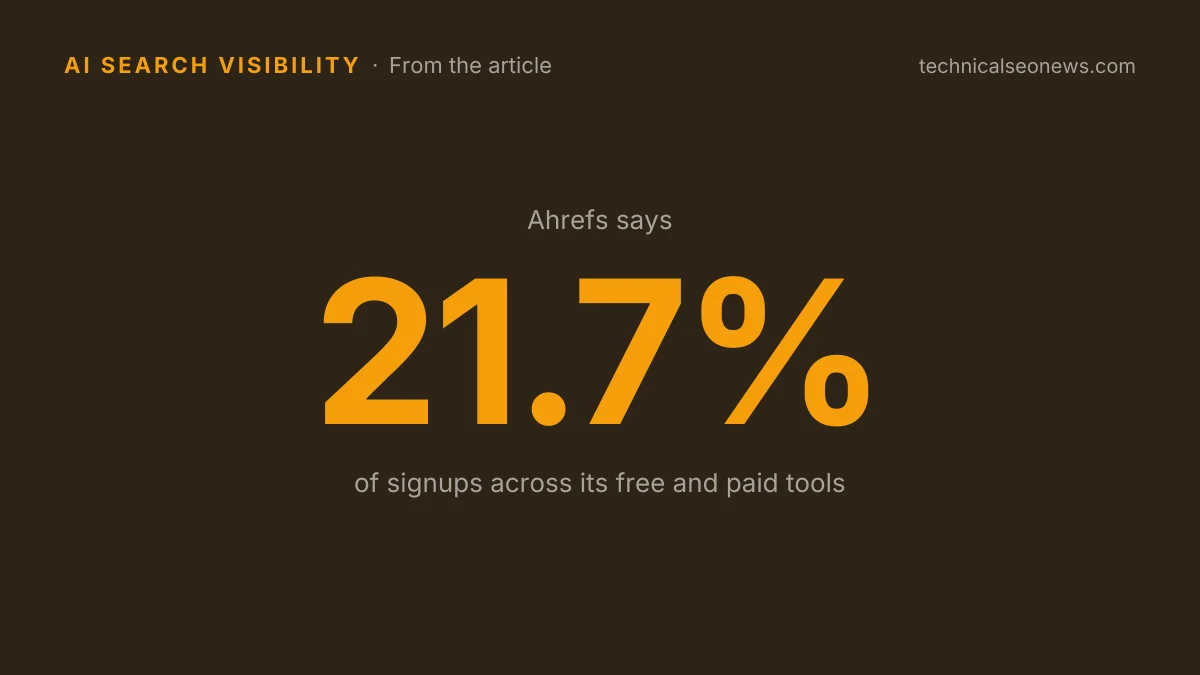
Ahrefs says 21.7% of signups across its free and paid tools come from people who report finding the company through ChatGPT or Claude, which puts AI ahead of YouTube and second only to Google. The figure is in Ahrefs’ guide to measuring AI search visibility, published October 6 by Louise Linehan, a content marketer at the company. It did not come out of an analytics report.
The 21.7% comes from customers’ own answers in the “how did you hear about us” field during onboarding. Ahrefs is direct about what the alternative would have shown: relying on referral traffic alone, the post says, would have “badly undersold” AI.
Why referral data misses it
Two things keep AI influence out of referral reports. Several AI platforms strip the referrer, so the session arrives with no origin attached. And a buyer who reads about a product in Gemini on Monday often types the brand into Google the following week, which lands in analytics as organic search.
The platform mix in referral data is also narrower than the mix customers name. On wordcount.com, a site Ahrefs owns, ChatGPT accounts for 92.4% of AI search visitors, with Perplexity, Gemini and Copilot splitting what is left. Claude does not appear in that breakdown, yet it is named alongside ChatGPT in the signup figure. The two numbers come from different properties, so they do not line up exactly. The likelier explanation is that assistants which strip referrers are invisible in referral data and present in the survey.
The traceable slice is small but it converts well. Ahrefs reports that 6% of its AI search visitors sign up for a free account, four times the rate from organic search. The post attaches its own caveat, which matters for anyone about to put that in a deck: a free signup is worth nothing by itself, so the dollar figure has to be modelled through the share of free signups that become paying customers.
Direct traffic is the other place Ahrefs looks, and the method it recommends there is weaker than its signup data. Record direct and no-referrer sessions before any AI work, watch them after each content push, and if they rise with no campaign, PR or seasonal explanation, treat the increase as AI. That inference will not survive much scrutiny in a quarterly review. The baseline is still worth taking, because it costs nothing now and cannot be reconstructed later. It will also drift: Google has begun tagging Gemini links with UTM parameters, which moves some of those visits out of direct and into referrals with no change on your side.
What to do
- Add named assistants to the “how did you hear about us” field rather than a single AI option: ChatGPT, Claude, Gemini, Perplexity, Copilot. One merged option tells you AI matters and nothing about where to spend.
- Ask for the prompt. Ahrefs’ post suggests collecting the wording customers used to find the brand, which points at the products and categories worth covering next.
- Write down today’s direct and no-referrer numbers, with a dated note of everything else that was running.
- Ask on sales calls. Ahrefs’ post points to Gong, a tool that records and analyzes sales conversations, as a way to do this at volume.
- Report the AI referral number as a floor, labelled as such, next to the self-reported share.
Watch out for
Self-reported attribution is, in the post’s own words, “by no means perfect”. Treat 21.7% as a direction rather than a count: it tells leadership that AI belongs in the plan, not how many customers each assistant produced. Keep referral and conversion data as the number you can defend line by line, and use the survey share to argue about scale.