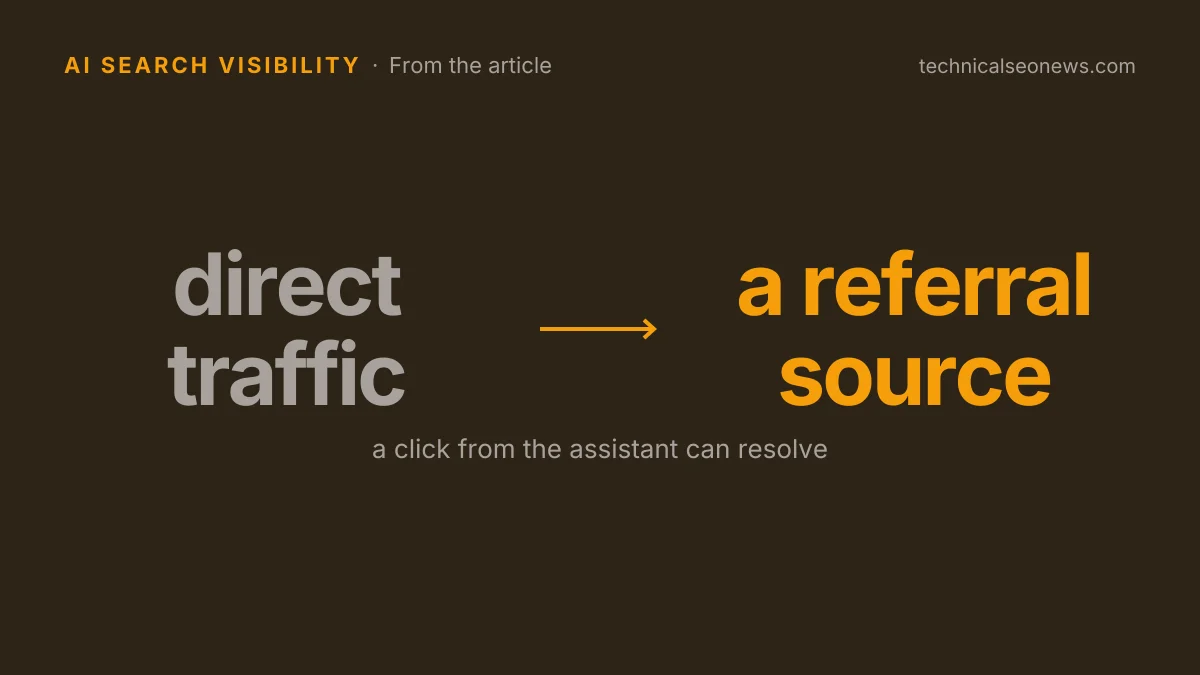
Google now tags Gemini links so referrals leave direct traffic
Summary
Gemini clicks that used to land in direct traffic now arrive tagged, so GA4 and raw server logs can separate them. The tagging is undocumented, which means the conditions that trigger it are not settled yet.
The job is a re-baseline. Record the date the tags appear in your own logs, treat the step up as a measurement change rather than demand, and expect direct traffic to give back roughly what the new referral line gains.
Google has started adding UTM parameters to the outbound links in Gemini’s answers, so a click from the assistant can resolve as a referral source instead of falling into direct traffic. Search Engine Journal’s report puts the change at about a day old when it was written, traces it to a Reddit thread where a Reddit user noticed the tags, and quotes Google Search Advocate John Mueller saying he sees it too. Google has not documented or announced it.
Mueller’s first question in that thread was why the tagging mattered, given that Gemini already passes a referrer. A commenter quoted in the same piece answered with where the referrer goes missing:
| Where the click starts | What the referrer does |
|---|---|
| Desktop web | Mostly survives |
| Gemini mobile app | Reported to pass through about 9 percent of the time |
| Android assistant | Stripped entirely |
Those figures are one Reddit commenter’s account rather than a published measurement, and the mechanism is the part worth crediting. A referrer that survives the desktop browser and little else leaves most assistant clicks looking identical to someone typing the URL. A query string rides through the in-app webview instead, and it lands in raw server logs, where nothing has to execute for the visit to be counted.
Gemini referral numbers will rise as a result, and the likelier explanation is the tagging, not new demand. A site that sees its Gemini line appear this week was already getting those visits, filed under direct. Expect direct to dip by something close to what the new referral line gains; if the two move together, that is the same traffic relabelled.
The new number is a floor, not a total. ChatGPT tags only the links in answers grounded in web sources, leaving answers drawn from training data untagged, and Google has said nothing about what triggers the parameter in Gemini. Until that is documented, a Gemini referral count is the share of assistant clicks that happened to get tagged. The absolute figure will probably stay small next to search: Microsoft’s own data put Bing Chat click rates far below search.
What the tagging does buy is the ability to segment AI-referred visitors and compare them against search on conversion rather than on impressions, which until now has been guesswork built on an undercounted denominator. Six studies that measured AI traffic conversions disagreed with each other, and an honest volume number for at least one assistant narrows the argument a little.
The referrer gap may still get fixed. Per the Search Engine Journal piece, Mueller asked for reproducible evidence of what happens to the referrer so he could forward it to the team, and said he would like the referrer retained in addition to the UTM tagging. A site that can reproduce referrer stripping on Android assistant invocations has something specific to hand over.
One limit is worth keeping in view: the tagging only describes humans clicking through from the assistant. It says nothing about how often Gemini cites a page without sending anyone, and nothing about Google’s crawlers, so citation visibility still needs its own measurement.
What to do
- Read the actual parameter values out of your own server logs before building any report on them. Nothing is documented, and an undocumented value can change without notice.
- Mark the date the tags first appear in your logs and treat it as a break in the series. Any month-over-month Gemini comparison that crosses that date compares two different measurements.
- Reconcile the direct-traffic line against the new referral line for the same window, so a drop in direct is not written up as lost demand.
- Keep referrer-based channel grouping in place rather than switching to UTMs alone. The tagging is new and undocumented, and the referrer is what Mueller is trying to get retained.
- Say plainly in any report that crosses the start date that the increase is attribution, not growth. Nobody downstream will infer it.