Google may reorder results using hovers and scrolls on the SERP
Summary
SALT.agency, an SEO agency, says Google's Glue records how searchers treat map packs, videos and other features on the results page, and feeds that into a popularity score that can reorder rankings. How much any of it weighs is unknown, and none of the inputs are visible to site owners.
The part you can act on is clicks. Start with queries that earn many impressions and few clicks, and with pages people leave straight back to search.
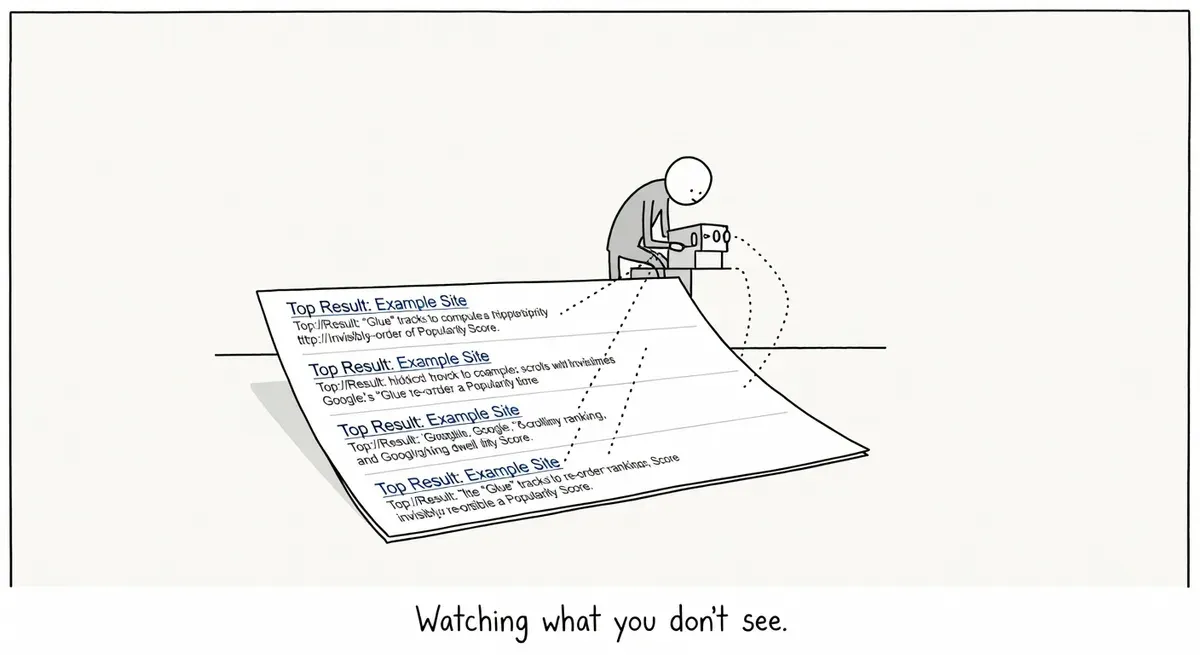
Google runs a system called Glue that records how searchers interact with everything on a results page other than the ten blue links, according to SALT.agency’s post on Google Glue. SALT.agency, a technical SEO agency, says Glue logs hovers, scrolls, swipes and the time someone spends looking at a map pack, video carousel, featured snippet or image box, even when they never click. The post names the US Department of Justice’s case against Google and leaked internal documents as its evidence, but it does not link to or quote either.
Glue works alongside NavBoost, the system that tracks clicks on the regular web results. SALT describes the two as branches of one system. Together they build a popularity score for each query from thirteen months of interaction data. Google’s usual signals, such as keywords and links, produce the first list of results, and the popularity score then reorders that list. In SALT’s example, a page at position five with a much higher popularity score than the page at position one would swap places with it.
SALT lists four kinds of interaction, two counted in a page’s favour and two against it:
- Good clicks: the searcher clicks and stays on the site.
- Longest clicks: the site is the last one the searcher visits before ending the search.
- Bad clicks: the searcher clicks and immediately goes back to the results.
- Impressions without clicks: the searcher sees the result and ignores it.
Glue also decides which formats appear and where, in SALT’s account. The post’s example is hypothetical: if mobile searchers for “coffee near me” keep scrolling past the text results to reach the map, Glue will eventually move the Map Pack to the top.
What the post leaves open
SALT’s own caveat is the most useful line in the post: the weightings of positive and negative interactions are not known. Nobody outside Google can see hover or scroll data for a results page, and the post gives no measured effect and no document excerpt for the hover and viewing-time claims. A safer conclusion is that Google collects interaction data on SERP features and uses popularity to reorder results, while the effect of any single micro-interaction on a ranking is unknown.
SALT’s conclusion is that brand recognition is a site’s strongest asset. Searchers who recognise a name on a busy page are more likely to click or hover on it, and those actions feed Glue and NavBoost. The post goes further and says lesser-known competitors cannot outrank an established brand however much they spend on SEO. The better bet is to treat that as a tendency, not a rule, since the post offers no data showing a recognised brand holding a position against a stronger page.
What to do
Glue cannot be optimised directly, because its inputs never reach a site owner’s analytics. The click side of the same system does show up in your own data, and that is where to work.
- In Search Console’s Performance report, sort your queries by impressions and look for high impressions with a low click-through rate. Under SALT’s description, those ignored impressions count against the page, not just as lost traffic. Where the title and description misrepresent the page, rewrite them.
- Search your main queries and note which features sit above your blue link. If a map pack or video carousel keeps winning the top of the page, Glue’s logic suggests searchers want that format, and a result in that feature is a better target than a higher blue link.
- Find organic landing pages with very short visits. SALT’s post does not say this, but those are the likeliest source of bad clicks, and the usual cause is a page that does not answer the query its title promised.