Google plans to run AI Mode hotel bookings on an open standard
Summary
Hotels and booking sites that want a direct booking option in Google's AI Mode will need to run a live booking service Google can query, not add markup. Integrating does not change ranking, and the hotel stays the seller of record.
There is nothing to deploy yet. Join Google's waitlist, confirm the payment provider can process Google's payment tokens, and plan to report AI Mode bookings as their own channel.
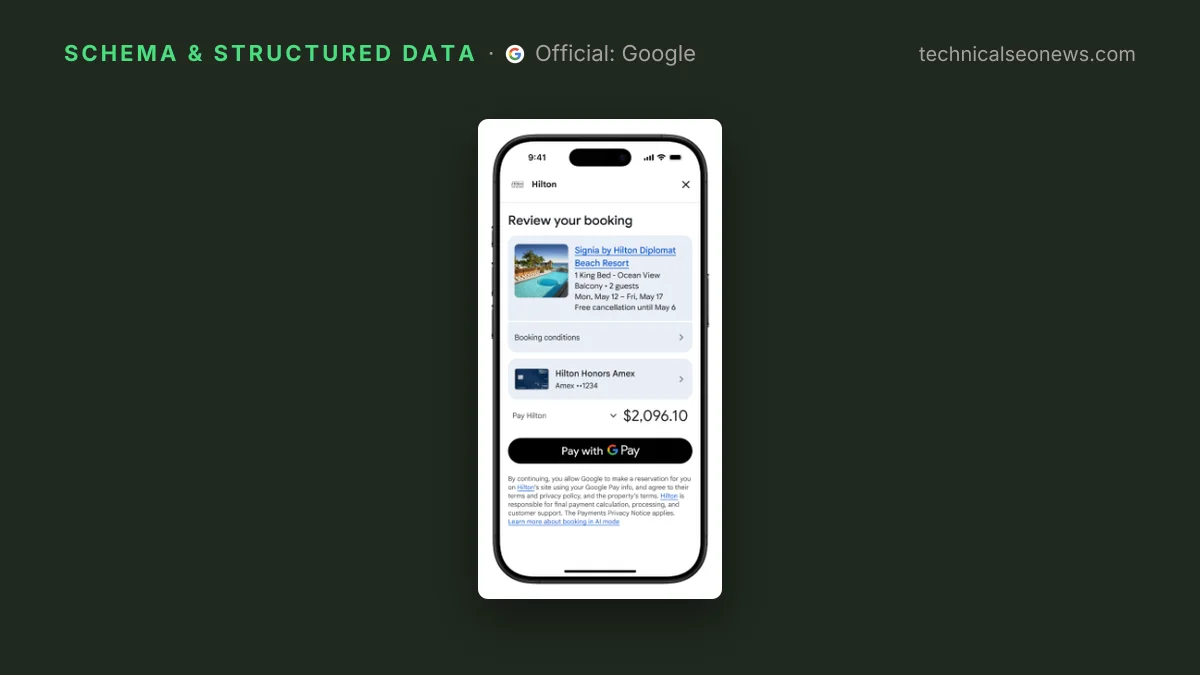
Google will move hotel booking in AI Mode onto an open booking standard “over the coming months.” The Universal Commerce Protocol (UCP) project published a draft lodging spec on Sept. 25. Google’s developer FAQ, updated Sept. 24, says Google will adopt the standard to power the feature, Search Engine Journal’s piece reports. AI Mode hotel booking has been rolling out to U.S. English users since August 27, with 10 hotel chains and online travel platforms.
Google’s lodging page describes UCP as an open standard for agentic commerce, meaning purchases that AI agents handle for a person. The lodging draft sits in the UCP GitHub repository. It sets how a platform such as Google opens a booking session with a hotel or booking site, updates it, and completes or cancels it. Those calls run over REST or MCP (Model Context Protocol, a common way for AI tools to call outside services). Each session carries live pricing and availability, guest details, occupancy, stay dates and special requests. Payment extensions cover deposits, deferred balances and split payments, and a new extension covers cancellation policies. The council that shaped the draft includes Booking.com, Expedia, Hilton, Marriott and Google.
Integration decides the Book button, not the ranking
Google’s FAQ, as quoted by Search Engine Journal, says choosing the booking integration “does not influence how we rank your properties or rates in listings.” Listings with UCP integration do get the direct booking option. That makes UCP a conversion question more than a visibility one: a property ranks the same either way, but only an integrated one gets the direct booking option.
Before the final “Book” button appears, Google checks real-time price and availability against the partner’s API. So UCP is a live service the hotel runs and answers, not markup published on a page. Google’s lodging page pitches it as running on a hotel’s existing central reservation system (CRS) or property feeds. The work will likely fall to the team that runs reservations, not the SEO team.
The draft also requires a person to finalize each booking through a trusted interface, unless the platform uses UCP’s AP2 Mandates extension for agent-led payments. Google’s FAQ describes AP2 as a possible payment layer for future agent-led transactions but does not call it required. The first milestone covers one room per booking, with multiple rooms “potentially as a future extension.”
The hotel keeps the guest
Google’s UCP for Lodging page says the business remains the merchant of record, meaning the party that legally sells the room. It keeps guest data, loyalty program rewards and the post-booking relationship. Per the FAQ, the business’s own terms govern the reservation. Lifecycle events sent through the API show which traffic and payments came from Google’s AI surfaces rather than the business’s own site or app.
Those events are how a hotel tells AI Mode bookings apart from its own. The likely consequence is that web analytics will not see these bookings, since the reservation completes in Google’s interface rather than on the hotel’s site.
What to do
Nothing can be deployed yet. Google’s lodging page offers only a waitlist, with onboarding and specs “coming soon.” Neither the FAQ nor the lodging page gives a date for the AI Mode switch or says which current booking partners will move to the standard.
- Join the waitlist on Google’s UCP for Lodging page if you run a hotel brand or a booking site.
- Ask your payment provider whether it can process Google’s payment tokens. Google requires that support but does not require the Google Pay API on your site. The draft also says PCI DSS compliance (the card industry’s security standard) is not needed for card payments.
- Plan reporting that separates bookings arriving through UCP lifecycle events from bookings on your own site, so AI Mode revenue does not show up as lost web conversions.
- Have your developers read the draft and send feedback on GitHub. Keep it out of production for now: the draft banner warns that data models and bindings may change, with breaking changes possible.