For the same need, people type 9 words to AI and 5 to Google
Summary
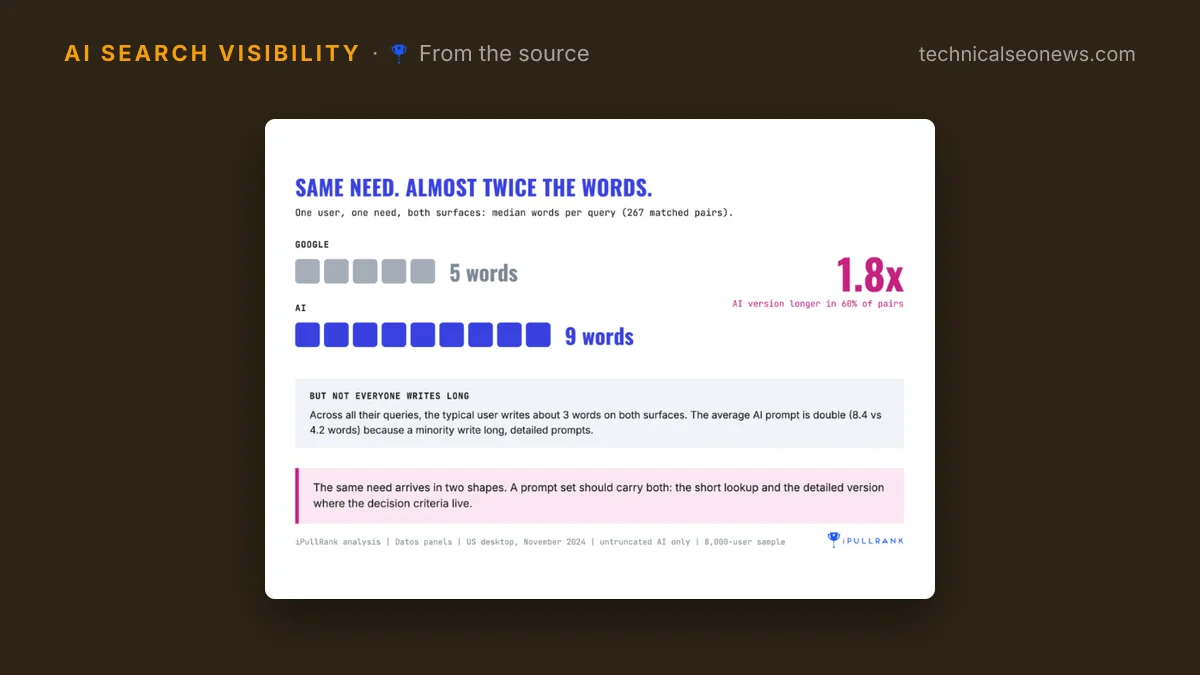
For the same need, the same people typed prompts to AI tools almost twice as long as their Google searches, a median of nine words against five.
Rebuild tracking prompt sets so the mix of lookups, questions and hand-off tasks matches what those users did.
iPullRank’s study of AI search behavior, published Thursday by the SEO agency, matched 16,310 people across two panels: one recording their Google searches, one recording what they typed into Perplexity, Copilot and you.com. The same users’ Google habits explained about 4% of how they prompted the AI tools.
Cate Dombrowski, who researches AI search at iPullRank, compared the two logs person by person rather than setting one population of AI users against a separate population of Google users. Where one person’s search and prompt covered the same need, the prompt ran a median of nine words against five for the search. Across all their queries, though, the typical user wrote about three words on both surfaces, and a minority who write long, detailed prompts drives the gap. Questions were 26.8% of prompts and 8.1% of searches.
Most of the extra length is context the user leaves out of a search box. Dombrowski’s examples from the prompts include a constraint such as a 3.5mm plug and not a 2.5mm one. Dombrowski’s illustration of the whole shift is a shopper who types “best laptop” into Google but tells the AI tool they are a freelance video editor on a $1,500 budget who cuts 4K in Premiere and needs something to carry to client shoots.
Prompts are also not a step on the way to a Google query. For 96% of AI prompts, the same user did not search the topic on Google within 30 minutes, so Search Console and keyword tools cannot show what those prompts were. AI was 2.7% of these users’ search activity that month, and that small slice is not overflow from the big one.
The mix of query types matters more than the length
Dombrowski classified every search and prompt by type. Three types carry most of the shift.
| Query type | AI | |
|---|---|---|
| Keyword or entity lookup | 84.8% | 46.3% |
| Informational question | 8.1% | 26.8% |
| Hand-off request (write, create, summarize) | under 0.5% | 6.9% |
The rest of the AI side spreads across more than a dozen smaller types, including prompts that open with the user’s own situation. Dombrowski’s summary of the AI mix is that roughly half of prompts are lookups and four in ten are asks.
That table is what most AI visibility tracking gets wrong. A prompt set produced by rewriting a client’s keyword list as questions is a set of lookups with question marks on them, and it measures the Google habit at a higher word count. Dombrowski’s framing is that search data tells you what an audience cares about but not how they will ask it. For a tracking setup, the keyword list stays the right source for topics and the wrong source for phrasing.
Keeping both versions of a need in the set is worth the extra runs. A brand can rank for the five-word lookup and go unmentioned for the nine-word prompt that carries a budget and a constraint, because the longer prompt gives the model more to filter on. The study measured what people typed and not what came back, so only tracking both versions shows whether that happens.
Context is thinner on the ground than persona-prompt templates assume. About 1 in 12 real prompts said who was asking or why, so a set where every line opens with a job title overstates how often users identify themselves.
The percentages are a direction and not a current benchmark. Both panels cover US desktop users in November 2024, and ChatGPT is 0.1% of the AI side, so the mix describes Perplexity, Copilot and you.com users from two years ago. The length finding drops every Perplexity row, because Perplexity truncates prompts to 30 characters in this dataset. That leaves 5,138 of the 16,310 users. The nine-versus-five medians come from 267 matched pairs among them.
What to do
- Rebuild the set from the query mix rather than the keyword list: roughly half lookups, four in ten questions, and a small block of hand-off tasks. Topics can still come from search data.
- Keep the short and the long version of each need as separate lines, and report them separately.
- Write real situations into persona prompts (budget, team size, current tool, deadline) instead of demographic labels, and leave most lines without a persona at all.
- Hold the set stable once it is representative, which also means settling the run count per prompt before you start. One industry standard has already set 30 runs per prompt as a reporting floor.
- Check what the tracker queries. A set built from real prompts still reports the wrong thing if the tool reads a model API rather than the consumer app.