Being on the pages ChatGPT cites is not enough to get named
Summary
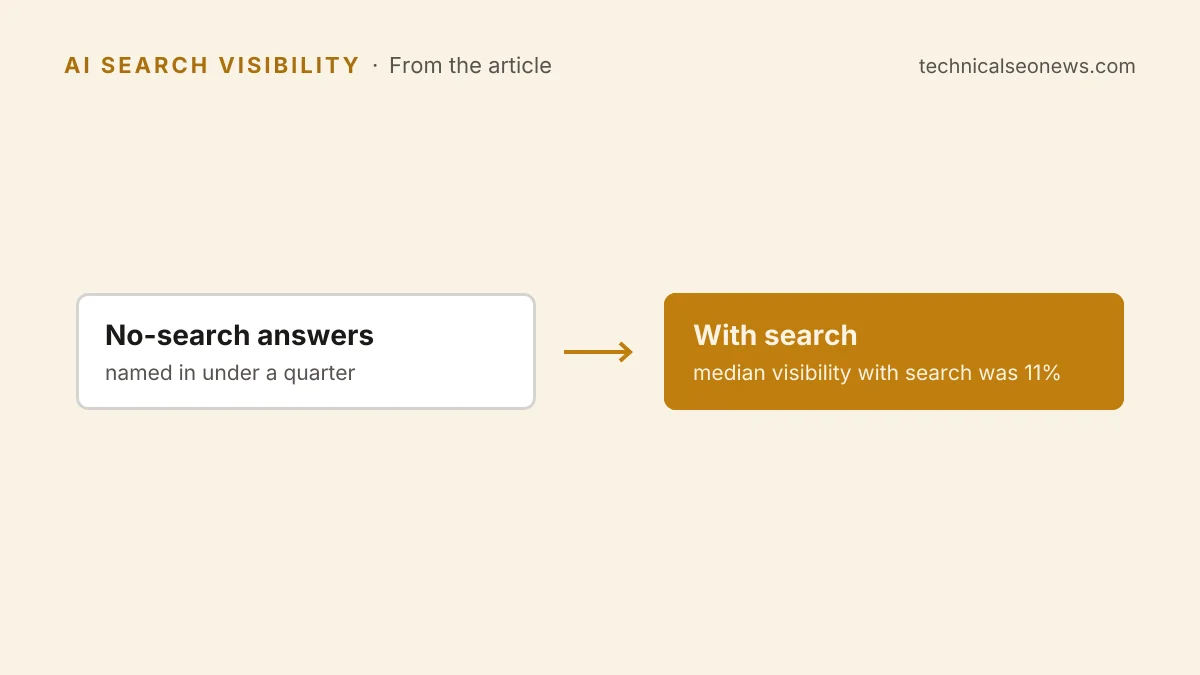
Brands ChatGPT rarely names without search held a median 11% visibility with search on, even when they appeared on many of the pages it cited.
Measure the brand through the API with search switched off before paying for more placements on cited pages.
Brands that ChatGPT rarely names when it answers without searching stay rarely named when it does search, even when they appear on 15% or more of the pages it cites. That is the main result of an Oct. 16 analysis from Graphite, a growth agency that sells work on getting brands named in AI answers, written up by Search Engine Journal.
Graphite’s dataset covers 3,115 entity-question pairs across 57 comparison questions, collected in August from logged-out ChatGPT, with visibility counted as the share of answers that mention a brand. For answers that used search, it grouped brands by the share of cited pages that substantially mentioned them. In the group mentioned on at least 15% of cited pages, for brands ChatGPT named in under a quarter of its no-search answers, median visibility with search was 11%.
Much of the work sold as answer engine optimization, or AEO, aims at getting a brand onto the pages AI engines cite, on the assumption that what the model retrieves decides what it says. Graphite’s figures say that assumption fails for the brands that need it most. Earlier data already showed ChatGPT linking brands without naming them in the answer, and the likelier explanation now is that the model’s existing familiarity with a brand sets the floor on whether it says the name, whichever pages come back.
ChatGPT’s background searches are themselves tilted toward brands it already knows. Graphite labelled brand names in about 957,000 fan-out queries, the searches ChatGPT runs before it answers. None of the 22,953 comparison prompts behind those queries named a brand, and 59.6% of the queries did anyway. Nearly a quarter used a site: operator, which matches the pattern of ChatGPT searching brand domains directly. Graphite says a brand in a fan-out query raises the odds that pages about that brand get retrieved, so training knowledge appears to steer retrieval before any page gets ranked.
None of this proves cause. Visibility with search and without it rose together in all three groups, and Graphite ran no control for how well known each brand was. Only one replication, a 100-prompt API run, explicitly disabled search. The sensible course is to keep the citation work and stop treating cited-page share as a proxy for being named, because citation metrics leave out how often the model names a brand when it does not search at all.
What to do
Track prompts through the API with search disabled, at least 50 responses per prompt, and rerun the set each time a new model ships. That API run was the only part of Graphite’s work where search was explicitly switched off. Graphite has also noted that ChatGPT could add inline links with no search behind them, so the presence of a citation does not prove a search happened.
Then check that training crawlers reach the site at all. GPTBot and ClaudeBot collect training data, and a CDN or firewall rule can block them even where robots.txt allows them, which is a separate decision from the retrieval bots (OAI-SearchBot, Claude-SearchBot) that feed live AI answers. Google’s crawler documentation says Google-Extended controls whether crawled content is used to train future Gemini models and for grounding in Gemini Apps and Vertex AI, and that it has no effect on inclusion or ranking in Google Search.
Give any of this months rather than weeks. For models released since July, the gap between the stated knowledge cutoff and the release date ran two to five months. Graphite calls that the minimum time-to-impact for newly published content, though the figure does not measure when a page actually enters a training set.