Half of AI citations drop by day two and about 75% come back
Summary
At least half of AI citations disappear by the next day and about three quarters of those come back, so one visibility check cannot tell a real loss from ordinary churn.
For each tracked question, count how many days in the past week you were cited instead of checking once.
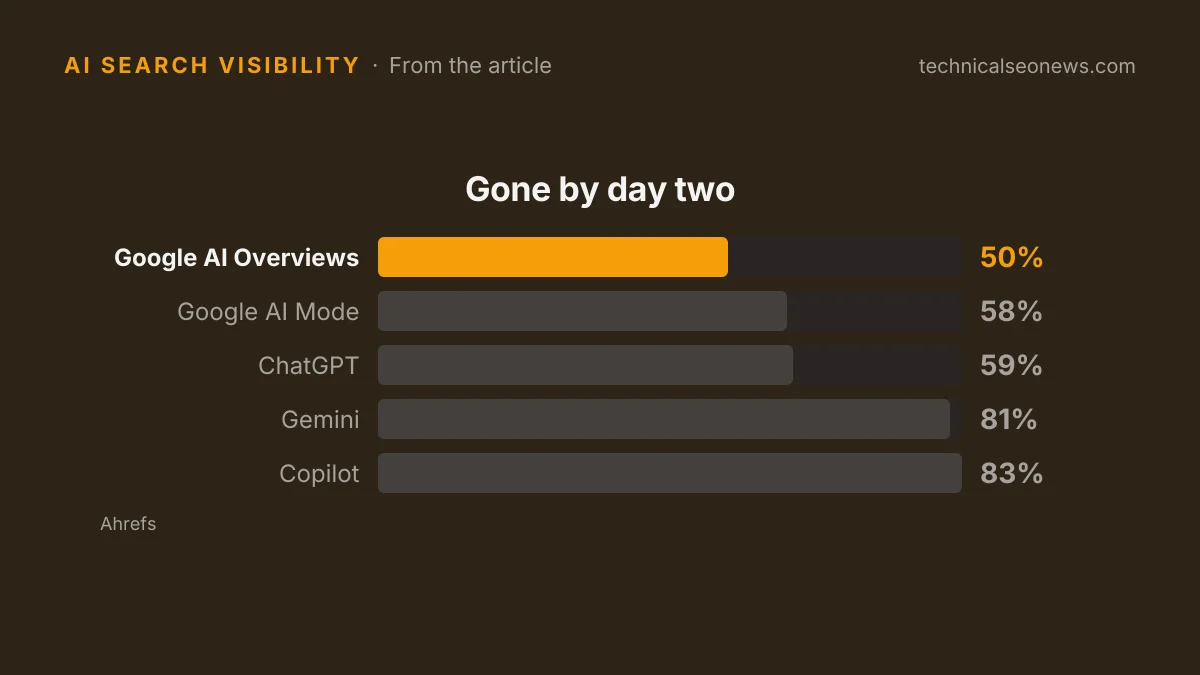
At least half of all AI citations disappear within a day, according to a study Ahrefs published Thursday. Xibeijia Guan of Ahrefs, who ran the tests, asked five AI tools the same questions every day for 20 days and followed each of the roughly 37,500 websites they cited on day one.
The loss rate split the tools into two groups, and the worse group’s numbers were partly a counting problem.
| AI tool | Gone by day two | Lasted all 20 days |
|---|---|---|
| Google AI Overviews | 50% | 6.6% |
| Google AI Mode | 58% | 6.8% |
| ChatGPT | 59% | 4.0% |
| Gemini | 81% | 0.2% |
| Copilot | 83% | 0.5% |
Gemini and Copilot gave answers with no citations at all 64% and 53% of the time, so a page scored as lost whenever the next answer cited nobody. Counting only answers that cited something, all five tools came in between 50% and 60%.
Most of those losses reversed. About three quarters of the citations that went missing at least once were back before the study ended, and half of those returned within three days. Only 20 to 27% of the websites cited on day one dropped out and never came back.
What a drop meant depended on how long the citation had already held. Citations that lasted a single day never returned 34 to 41% of the time. Citations that had held for eight to fourteen days failed to return at most 4% of the time. A page that has been cited for a week or more and then drops out is very likely coming back on its own.
Editing the page is the wrong first move, because much of the churn happens after the tool has already retrieved the page. Before answering, these tools run several searches of their own, known as fan-out. ChatGPT repeated exactly the previous day’s searches only 26% of the time, and even when the searches were identical its cited pages changed 81% of the time. Ahrefs’ reading is that much of the turnover happens where the model chooses which retrieved pages to cite, a step no publisher controls.
One page attribute did separate durable citations from one-day ones: ranking in Google. On Google’s tools and ChatGPT, pages that ranked anywhere in Google for the same question were about seven times more likely to keep a citation for at least a week. On AI Mode, around 40% of pages in Google’s top three stayed cited for a week or more. Pages ranking sixth or lower managed 20%. Domain Rating, Ahrefs’ link authority score, made little difference: the short-lived and the long-lived citations came from similarly strong sites, typically DR 64 to 78.
The type of question also moved stability. When the question named a brand, that brand’s own site held its citation for all 20 days in roughly 30% of cases on Google’s tools and ChatGPT. That is four to seven times the overall average. On “best X” questions, about 75% of cited pages changed daily. A single AI visibility score per brand therefore averages those two groups and describes neither.
Brand mentions outlasted citations. On Google’s tools and ChatGPT, 12 to 16% of pages that lost their citation kept the brand mention in the answer, and Ahrefs argues mentions are the better KPI for that reason. The two measures already diverge in the other direction too, since ChatGPT often links a brand without naming it.
What to do
- Count days rather than appearances. For each tracked question, record how many of the last seven days you were cited. One snapshot cannot tell a dead page from ordinary churn, the same reasoning behind the 30 runs per prompt that China’s ad industry now wants before an AI visibility figure is reportable.
- Wait out a drop on an established citation. If it had held a week or more, leave the page alone, and look at it only after two or three weeks of absence.
- Stop crediting edits for single comebacks. A rising days-cited count over several weeks is evidence. The next appearance is not.
- Report factual brand questions, comparisons and reviews, and open discovery questions as separate groups.
- When a drop does persist, check the page’s ranking and search traffic for that question, and whether its title answers the question, before spending anything on links or authority work.