AI answers cite retailers' size guides, support and policy pages
Summary
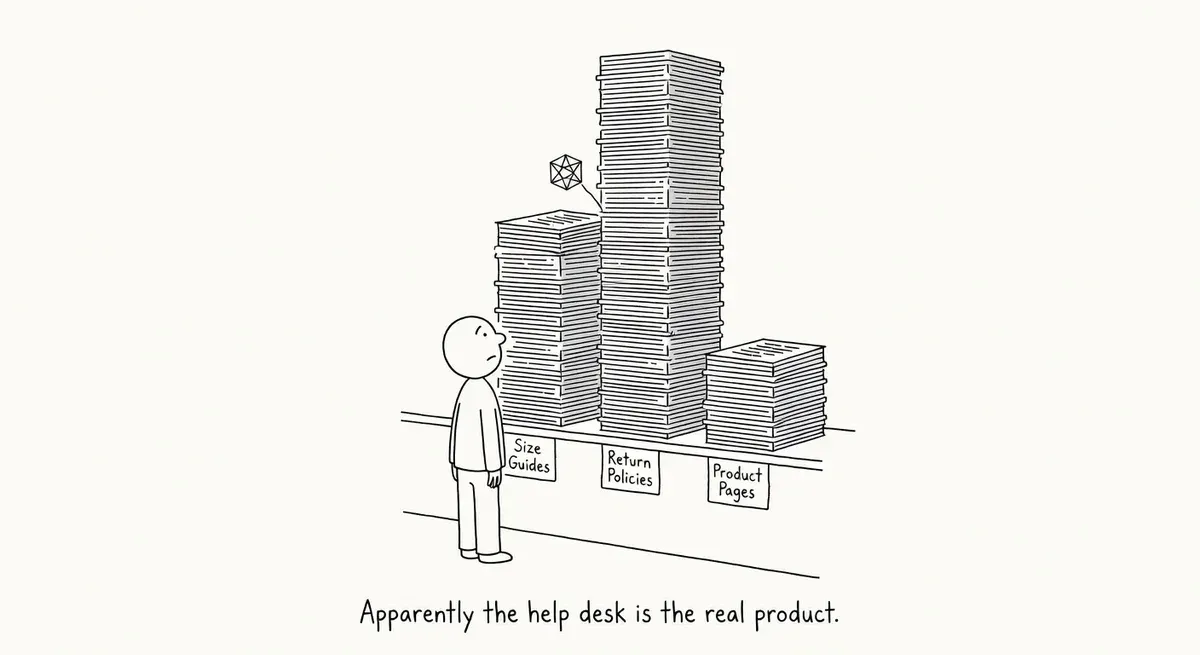
Retailers who judge AI search by their product pages alone miss much of what gets them cited. SEO consultant Aleyda Solis found answers drawing on size guides, help articles and return policies, while transactional answers push the clicks that follow toward product, listing and store pages.
Audit those support pages as seriously as product pages, make sure AI search bots can reach them, and report citations and AI referral visits as separate numbers.
Many of the pages AI platforms cite for big US retailers are not product or category pages. They are size and fit guides, support articles, return and shipping policies, store locators, buying guides, and repair or recycling pages. SEO consultant Aleyda Solis reached that finding in her ecommerce AI search analysis, which reviewed cited sources and cited pages for 25 leading ecommerce sites using Semrush Enterprise AIO data. She then added 90 days of Similarweb AI traffic data for the same sites to see which pages people actually visit from AI platforms.
The 25 sites span five subverticals: general marketplaces, beauty and skincare, fashion and apparel, consumer electronics, and sports and outdoors. Product, category and listing pages still make up a large share of citations, especially in beauty, fashion and marketplaces. They are just not the whole set. Solis concludes that commercially valuable citations can come from “pages that reduce purchase risk, not only from pages that capture the transaction.”
Cited pages answer the buyer’s doubt
Solis’s own examples show why a non-product page wins the citation:
- “What size Nike shoes should I buy?” The useful page is a fit guide.
- “Is this marketplace legit?” The answer draws on policies, third-party reviews, community discussions and entity information.
- “Best hiking boots for beginners” The better source may be a buying or activity guide, not only a product page.
The likelier explanation is that an AI answer needs a page that settles the question the user asked, and a product page rarely explains how a brand’s sizing runs or what its return window is. Solis’s post opens by questioning the usual playbook of making product pages, feeds and structured data more machine-readable. She still counts those as important, and they are not enough on their own. An Ahrefs test found adding schema did not raise AI citations on 1,885 pages, which points the same way.
The visited pages are a different list
Solis treats citations and visits as two separate measurements. Citation data shows which pages AI systems use as evidence. The Similarweb data shows which owned pages attract visits after someone uses an AI platform. A policy page can be cited often and get few clicks. Another page can draw steady AI referral traffic because it is the obvious next step, even if it rarely appears as a citation.
Answer format explains part of the gap, according to Solis. Informational answers lean on supporting sources and often satisfy the user without a click. Transactional and navigational answers can include product cards, merchant links, comparison tables and store modules, which make a click more likely and push users toward product pages, listing pages, homepages and store pages.
The practical risk follows from that split. A retailer that judges AI search only by referral traffic is likely to see product pages doing all the work and conclude the help center does nothing, when the help center may be what got the brand into the answer in the first place.
Amazon, YouTube and Reddit appear in every category
Owned pages are only part of the cited set. Amazon, YouTube and Reddit appear as cited sources in all five subverticals, and their role changes by category. YouTube supplies setup tutorials in electronics, reviews and routines in beauty, styling demos in fashion, and gear-in-use footage in sports and outdoors. Reddit threads validate product experience, expose complaints, compare alternatives or troubleshoot problems.
Solis calls the data directional. Her page groupings are rule-based, and the post does not claim market-wide citation share or causation.
What to do
- List the page types Solis names (size and fit guides, help articles, return and shipping policies, store locators, buying guides) and treat them as first-class pages in your AI search audit, with the same indexing and internal linking checks as product pages.
- Check that AI search and retrieval bots such as OAI-SearchBot and PerplexityBot can reach those pages. Solis’s post does not cover crawling, but help centers often sit on a separate subdomain or support platform with its own robots.txt, and a block there removes exactly the pages this study found being cited. Blocking training crawlers like GPTBot is a separate decision.
- Report AI citations and AI referral visits as two separate numbers. Merging them hides the support content’s contribution.
- Run your category’s decision prompts (sizing, legitimacy, “best X for beginners”) and note which YouTube videos and Reddit threads get cited next to you. Solis’s advice is to check whether those sources confirm or contradict your own site, and to bring PR, community and brand teams in where they contradict it.