AI Overviews skip thin, stale pages at the same organic rank
Summary
Ranking on page 1 buys an AI Overview citation about a third of the time, and climbing positions moves those odds only a little. A sample that held rank constant found the gap sat in the page itself: thin, stale and unstructured pages were the ones passed over.
The audit worth running covers pages that rank and are not cited, checked against word count, author, on-page structure and schema. One run per query is not enough to call a page uncited.
A sample of 600 commercial searches, posted to r/TechSEO by u/houdinidesigns, puts 45.7% of the sites Google’s AI Overviews cite outside the organic top 10 for the same search. On its own that number adds little, because Ahrefs already put most AI Overview citations outside the top 10 earlier this year. The new material is what the same run says about pages that do rank on page 1 and get passed over anyway.
Two thirds of the page-1 results checked were never cited. Position improves the odds without deciding them. Citation rates fell from 48.8% at the top organic result to 21.5% at the tenth, and Google left its own number one out of its own AI answer in slightly over half of these searches.
The useful part of the method is a control for rank. For 3,972 measured page-1 pages, u/houdinidesigns compared ignored pages only against cited pages sitting at the same organic position, so position is not what separates the two groups. Five attributes still did.
| Attribute of the page-1 page | Ignored | Cited |
|---|---|---|
| Under 500 words | 25.4% | 16.5% |
| No named author | 48.5% | 42.4% |
| No list or table anywhere | 45.3% | 38.4% |
| No schema markup | 35.1% | 28.5% |
| Older than three years | 16.8% | 10.8% |
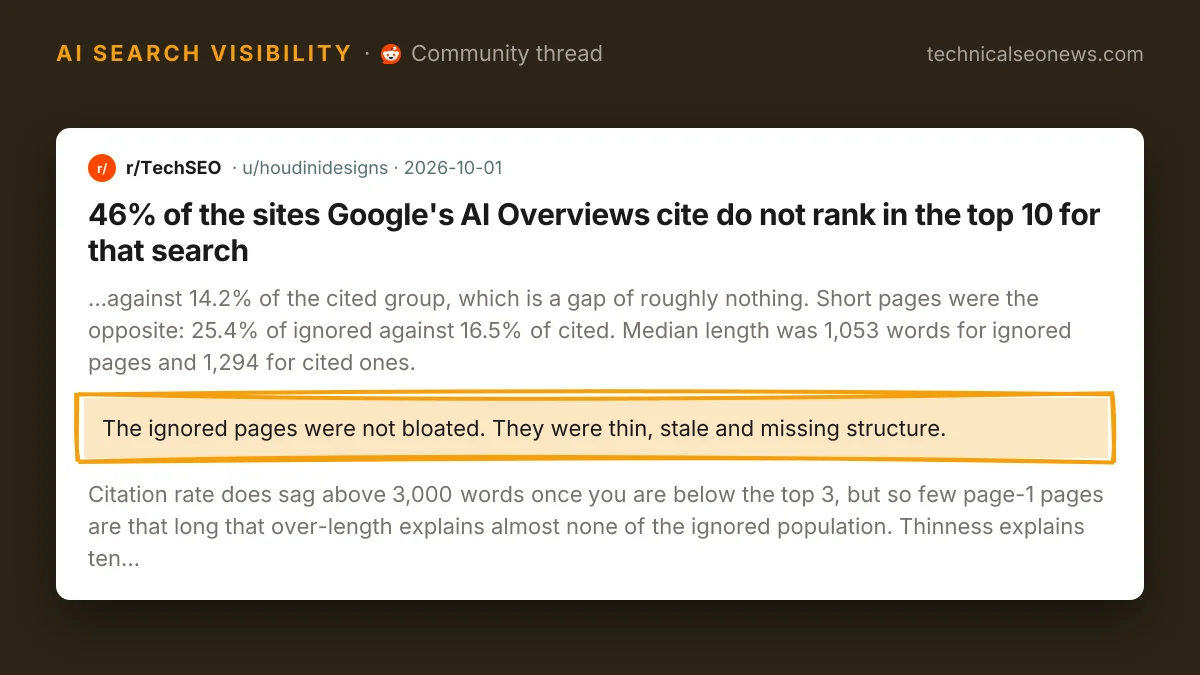
Thinness divided the two groups more sharply than anything else on that list. Median length was 1,053 words for ignored pages against 1,294 for cited ones. Over-length did close to nothing, since pages above 3,000 words made up about the same share of both groups, so the familiar advice to cut long pages for AI answers does not follow from this data.
The likelier explanation is that rank only gets a page into the running, and what the page itself offers decides whether the answer uses it. That ordering is what makes the rank-matched comparison worth more than the headline percentage.
One limit should stop anyone acting on the percentages as measured. The run took a single AI Overview per query, and the cited set for the same prompt moves between runs, to the point that measurement at ten runs a prompt can still swing 20 points on noise. The poster says the underlying data is not published yet and promises a release after a two-week analysis. The direction is the finding. The decimals are provisional.
What to do
- List the queries where a page ranks on page 1 and the AI Overview does not cite it, then check those pages against the five attributes above. Under 500 words, no byline, no list or table, and no schema is the combination that showed up disproportionately in the ignored group.
- Leave long pages alone. Length above 3,000 words did not distinguish ignored pages from cited ones at the same position.
- Refresh page-1 pages older than three years before rewriting anything newer. Stale pages were about half again as common in the ignored group.
- Capture a query several times before concluding a page is uncited, and again after changing the page. A single capture is not a measurement.