Only a quarter of ChatGPT's cited sites were on Bing page one
Summary
A 38-keyword test found Bing's first page held a quarter of the sites ChatGPT cited, almost the same share as Google's, so Bing rank tracking is no stand-in for ChatGPT citations.
Run your target prompts in ChatGPT, record the search string it rewrites them into, and check your rankings for that string.
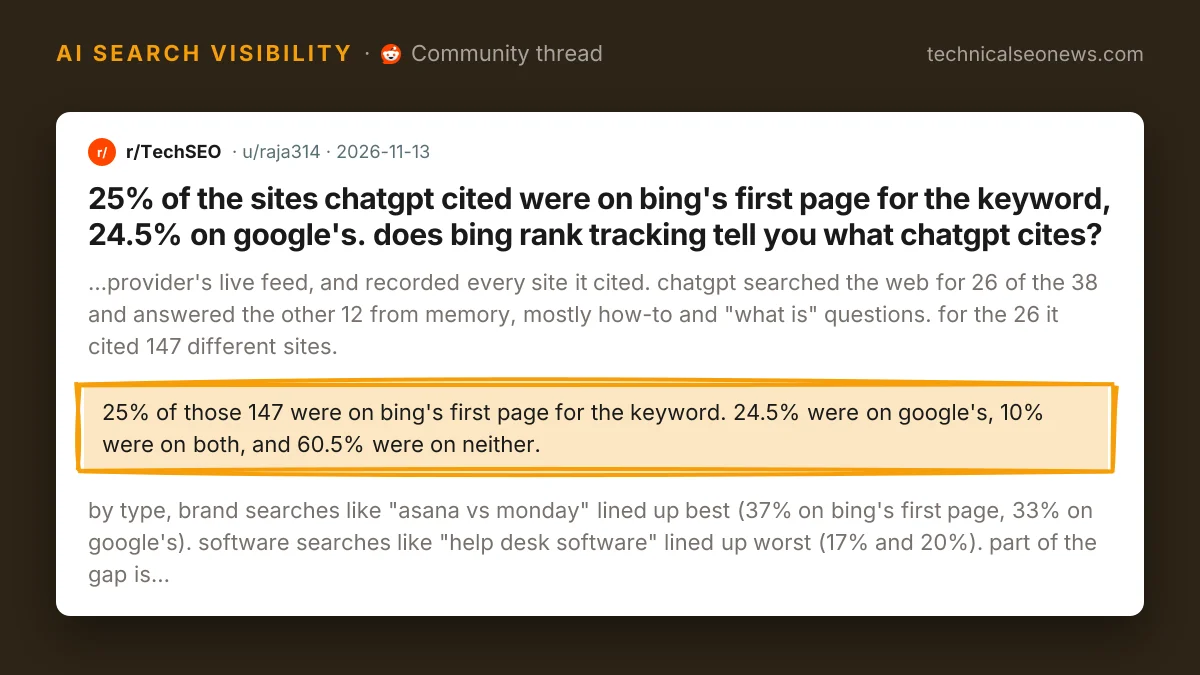
Only a quarter of the sites ChatGPT cited in a 38-keyword test were on Bing’s first page for the keyword behind the answer. The test, posted to r/TechSEO on 13 November by u/raja314, who ran the checks on 19 October, put Google’s first page at almost exactly the same share.
ChatGPT ran a web search for 26 of the 38 keywords and answered the rest from memory. Those searches produced 147 cited sites. Of those, 60.5% were on neither engine’s first page and 10% were on both. The keywords answered without a search were mostly how-to and “what is” questions.
The test was aimed at a claim that resurfaces whenever someone asks which index ChatGPT uses: if it is Bing’s, a Bing rank tracker doubles as an AI visibility tracker. A near-tie between the two engines undercuts that shortcut. Part of the gap is that ChatGPT does not search the keyword being tracked; it rewrites it first. For “best crm for small business” the thread recorded ChatGPT searching “best CRM software for small businesses 2026 pricing features comparisons”, and one of the nine sites cited in that answer was on Bing’s first page.
The overlap also varied by keyword type, and the likelier explanation is how much room the keyword leaves a rewrite. A two-brand comparison can be expanded in few ways, a broad category term in many.
| Keyword type | On Bing page one | On Google page one |
|---|---|---|
| Brand (“asana vs monday”) | 37% | 33% |
| Software (“help desk software”) | 17% | 20% |
| All 38 keywords | 25% | 24.5% |
Bing did show up one step earlier in the process, in the pool of results ChatGPT retrieved before choosing what to cite. Across the 26 searches that pool held 220 sites. Bing’s first page accounted for 18.6% of it, Google’s for 10%. One commenter read that gap as Bing feeding retrieval while the model then picks citations from a much wider set, which is the best available explanation for why the pool leans Bing and the citations do not.
A second commenter, u/Ishan_GS, reported a separate November run of 400 B2B buyer questions in which 21% of ChatGPT’s links sat on Google’s first page, a few points below raja314’s figure. Ishan_GS also described asking 200 topics twice, once as a short keyword and once as the long question a person would actually type, and finding only 24% of first-page results common to both versions. Ishan_GS works on Salient, an AI visibility tracker sold by Growthspree, so the advice to track citations directly comes with a commercial interest attached. The method is checkable either way.
One more figure from that run is worth keeping: 98% of ChatGPT’s links went to company sites, half of them homepages. A homepage does not rank for “help desk software” in any way a rank tracker would register, so even a perfect Bing index match would still miss most of what gets cited.
The limits are stated in the thread. Each keyword was run once, on a single day, from a browser outside the US, and the comparison was site against site rather than URL against URL. Page-level overlap can only come out lower than 25%.
What to do
Treat Bing and Google rankings as supporting context for AI visibility and measure the citations themselves.
- Record the rewritten query. Run your target prompts in ChatGPT, note the search string it actually issues, and check that string’s rankings instead of your seed keyword’s. This is the cheapest change and it is the one the test’s own CRM example argues for.
- Log the cited URLs, not the cited domains, and compare them to your Bing and Google positions separately. The gap between the two lists is the number to watch over time.
- Repeat the same prompt set on several days. A single run per keyword swings enough that one day’s overlap figure is not a baseline.
- Separate prompts that trigger a web search from those answered from memory. Nearly a third of the keywords here never reached retrieval, and no amount of ranking work touches those answers; they depend on what the model absorbed during training.
- Fix the prompt list before you fix anything else, because the list decides what the measurement says. An earlier test of AI travel answers moved brand share substantially just by changing which prompts were asked.
First-party numbers may eventually make some of this redundant. OpenAI is already building impression and click charts into ChatGPT for businesses, which would report citations without anyone inferring them from a search engine’s results page.