Most AI Overview citations come from pages outside the top 10
Summary
Ranking in the top 10 for a query no longer tells you much about whether you get cited in its AI Overview. Ahrefs links the gap to the related sub-searches Google runs behind each query.
The practical response is to track and cover the questions around a head term, not the head term alone. Treat the size of the drop with some caution, because Ahrefs also changed how it counts citations.
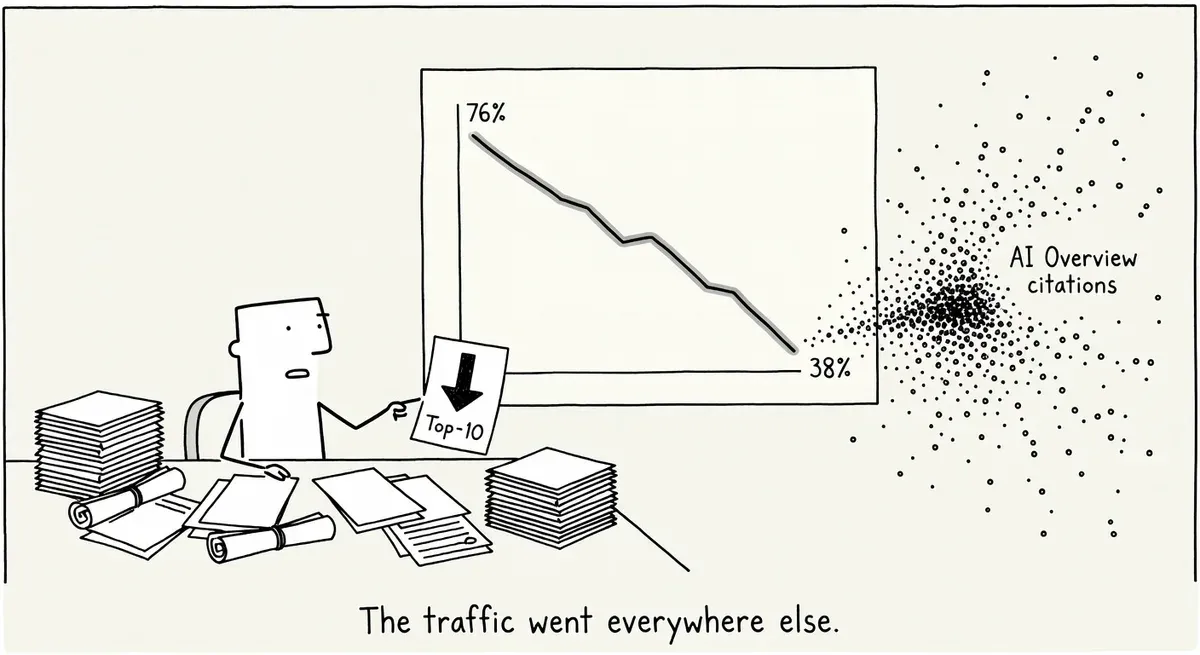
Only 38% of pages cited in Google’s AI Overviews also rank in the top 10 for the same query, down from 76% in July 2025. The figure comes from an updated Ahrefs analysis of 863,000 keywords and 4 million AI Overview URLs, which Search Engine Journal’s weekly SEO Pulse roundup led with.
The remaining citations split almost evenly between pages ranking deeper and pages that do not reach the top 100 at all. Ahrefs ran the numbers two ways, once counting every block on the results page and once counting only organic blue links:
| Where the cited page ranks | All result blocks | Organic blue links only |
|---|---|---|
| Top 10 | 37.9% | 37.1% |
| Positions 11 to 100 | 31.2% | 26.2% |
| Beyond 100 | 31.0% | 36.7% |
Counting only blue links, more than a third of cited pages do not rank in the top 100 for the query the user typed.
Query fan-out is the likely cause
Ahrefs’ explanation for the gap is query fan-out. Google splits one search into several related sub-queries and cites the pages that appear most often across their results. Google’s documentation on AI features says both AI Overviews and AI Mode may use the technique, running multiple related searches across subtopics and data sources to build a response. A page can therefore earn a citation by ranking for one of those sub-queries while sitting on page five for the original search.
An invented example shows how this plays out. A search for “how to move a site to a new domain” might fan out into sub-queries about 301 redirects, the Change of Address tool, and how long rankings take to recover. A guide that ranks first for the redirect sub-query could be cited in the AI Overview while ranking 40th for the typed query. Rank tracking on the head term would report that page as invisible.
Part of the drop is a counting change
Not all of the fall from 76% reflects a change at Google. Ahrefs improved how it parses AI Overviews, so the new study finds more citations than the old one did, and Search Engine Journal notes that the two datasets are not directly comparable. Google also moved AI Overviews to Gemini 3 globally in January, which Ahrefs mentions as timing context.
A separate analysis from BrightEdge, which sells enterprise SEO software, put the top-10 overlap at about 17% in February, using a different method and dataset. The exact figure depends on who counts and how, the same problem behind why AI visibility tools disagree with each other. Every study points the same way, though: a top-10 ranking for the typed query is a weak predictor of being cited.
What to do
Google’s own position has not changed. Its documentation says AI Overviews need no special optimization, and a page can appear as a supporting link only if it is indexed and eligible to show with a snippet in Search. The practical conclusion is that a citation is still an organic ranking outcome, just one earned across more queries than the one you track.
In order of priority:
- Confirm eligibility. A page with
noindexornosnippetcannot be a supporting link. Google’s documentation recommends the URL Inspection tool to check that Googlebot sees the directives you intended. - Track the questions around each head term. Ahrefs recommends studying fan-out patterns for your topics and grouping keywords by parent topic, so that coverage and tracking both reach the sub-questions Google is likely to run.
- Benchmark against the cited pages. Ahrefs suggests comparing your content with the pages that regularly win AI Overview citations for your target queries. Given the numbers above, those are often not the pages ranking above you.
- Review your own citations. Ahrefs recommends checking which of your topics already earn AI Overview citations and where competitors fill the gaps. Those topics are the ones worth expanding.
Search Console will not separate these citations out. Google’s documentation says AI Overview and AI Mode appearances are counted inside the Performance report’s “Web” search type, so a third-party citation tracker or manual checks are the only way to see them per query.