Google-only SEO misses Bing in Japan and Naver in South Korea
Summary
Across Asia-Pacific, a plan built only around Google leaves out a large share of search in Japan and South Korea. Telecom deals are also putting AI assistants in front of people who never went looking for them.
For Japan, treat Bing as a primary engine and give it the signals it reads. For South Korea, plan for Naver's own result formats. Everywhere, make sure Perplexity's crawlers get past the firewall.
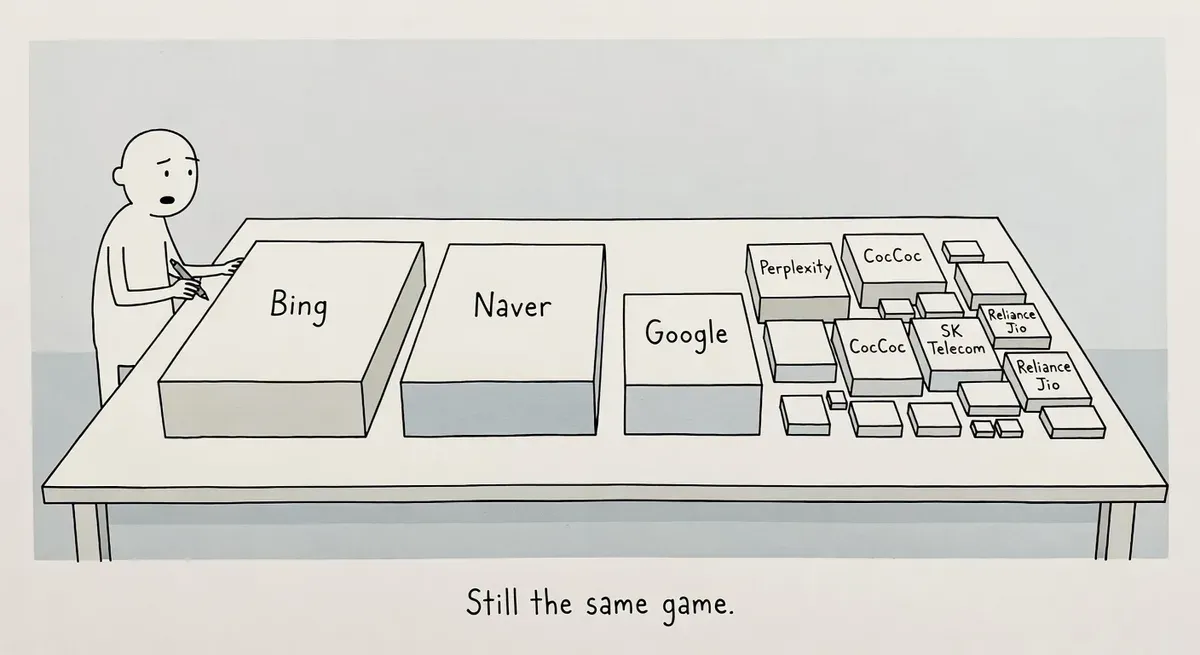
Bing handles 31.63% of searches in Japan, according to StatCounter figures cited in Search Engine Journal’s piece on Asia-Pacific search by Motoko Hunt, president of international search marketing at AJPR. Hunt argues that global teams treat the region as an extension of their Google plan, and the share data shows how much that plan leaves out.
The gap differs by market:
| Market | Main local rival | |
|---|---|---|
| Japan | 59.58% | Bing, 31.63% |
| South Korea | 46.81% | Naver, 43.96% |
| Vietnam | not given | CocCoc, 5.34% |
Japan is the market most teams get wrong. Hunt attributes Bing’s share partly to default browser settings and enterprise environments, and says it is large enough to move both organic and paid results. A Japanese site that only watches Google Search Console has no view of roughly a third of the searches in its market.
South Korea is a different problem. Naver, the Korean search portal, sits close to parity with Google, and Hunt says it does not behave like a typical search engine: the result formats, the way results surface and what users expect all differ. Naver works more like a portal, with commerce modules, local listings, media and knowledge panels built in, and Hunt says it is adding AI-generated summaries that answer questions without sending users elsewhere. Ranking a page is only part of the job there.
Vietnam’s local search engine, CocCoc, has a small share. Hunt’s point is that a small share is enough to win visibility when competitors ignore it.
Telcos are handing out AI assistants
Hunt calls telecom bundling one of the least discussed changes in the region. In India, the carrier Bharti Airtel gives Perplexity’s Pro tier to roughly 360 million users, and the rival carrier Reliance Jio distributes Google’s Gemini through bundled plans to more than 500 million. In South Korea, SK Telecom partnered with Perplexity to put AI search alongside the traditional engines. Because the tools arrive pre-installed and are framed as assistants, usage can grow almost overnight without people consciously changing how they search.
Hunt’s piece does not go into crawlers, but that is where the telco deals touch a site’s setup. Perplexity’s crawler documentation describes two agents. PerplexityBot finds and links sites for Perplexity’s search results and is not used to train models. Perplexity-User fetches a page when someone asks a question, and because a person requested the fetch, it generally ignores robots.txt. The likely result of a firewall blocking either one is a site that never appears in answers served to those bundled users.
What to do
Hunt’s own advice is to report performance by engine and by discovery type rather than as one organic number, because AI-driven referrals often go untracked. The setup work, in order of payoff:
- Set up Bing Webmaster Tools for Japanese sites. Bing added country targeting in 2013 at domain, subdomain, folder or page level, so a
/jp/folder on a .com can be pointed at Japan. - Add a content-language tag alongside hreflang. The hreflang guide from Mangools, which sells SEO tools, reports Fabrice Canal of Microsoft’s Bing team calling hreflang a far weaker signal at Bing than content-language. Keep hreflang for Google and add:
<meta http-equiv="content-language" content="ja-jp">- Check firewall and bot-management logs for PerplexityBot and Perplexity-User. Perplexity recommends allow rules that match both the user agent and its published IP ranges, pulled from its JSON endpoints and refreshed on a schedule because the ranges change.
- Look at your own pages in Naver before assuming Google work carries over. Hunt’s piece gives no Naver setup steps, so the first job is seeing which of its result formats your content appears in at all.