Hreflang won't carry EU rankings to a new US store domain
Summary
For a brand that already ranks in Europe, the most detailed reply in an r/TechSEO thread favors a subfolder of the existing .com. Hreflang points searchers to the right country version, but it does not hand EU rankings to a separate US domain.
Whatever structure wins, each country store needs its own crawlable URL and no automatic redirect by location or browser language. Googlebot mostly crawls from the US and states no language preference.
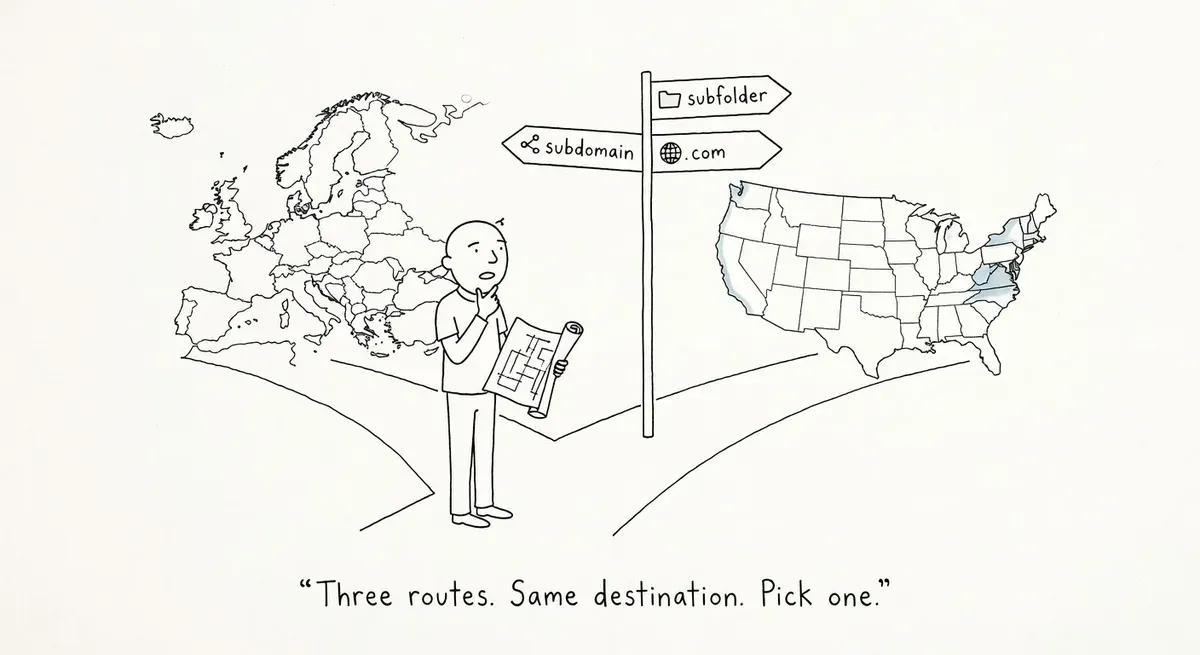
An established EU fashion retailer about to launch a US storefront asked r/TechSEO where to put it: a subfolder of its existing .com, a subdomain, a separate .com, or a .us domain. The poster said the brand already ranks in DACH (Germany, Austria and Switzerland), the UK, France and Benelux. It runs a Next.js front end with Strapi for content, and splitting storefronts per region is cheap. Marketing wanted a separate .com for a US brand voice. Engineering wanted a subfolder.
The replies leaned to the subfolder, for authority reasons. A commenter, u/mjmilian, wrote that a new domain starts from scratch on PageRank, while a subfolder inherits much of what the main domain has built. The same commenter called the front-end question (one Next.js app with locale routing or separate builds per region) an engineering choice, since PageRank moves through links, canonicals and redirects whatever the backend does. Another commenter, u/MikeGriss, said it should be a business decision first. A third, u/MerchySulica, said the structure should follow how different each market really is in pricing, delivery, returns and sizing.
Hreflang does not move rankings
The poster called hreflang “the textbook answer”. In a follow-up, mjmilian argued that it will not pass the EU site’s rankings to a US site. It only swaps in the correct version when the wrong one is ranking in a country’s results. Google’s guide to multi-regional and multilingual sites describes it in the same terms: hreflang helps search results link to the correct language version of a page. A standalone US .com would still have to earn its own links, and the retailer would be funding SEO on two domains instead of one.
Nobody in the thread offered data on the poster’s other question, whether AI Overview impressions differ between subfolders and subdomains for US fashion.
Each store needs a URL Googlebot can reach
A single Next.js app with locale routing works only if every locale lives at its own URL. Google’s guide says Googlebot usually crawls from the USA and sends requests without an Accept-Language header (the header a browser uses to state its preferred language). A site that picks the store from a visitor’s IP address or browser settings and serves it at one shared URL risks Google seeing only one version. Google also warns against redirecting users automatically to the version it guesses they want, because those redirects can stop both users and search engines from reaching the others.
For this retailer, the likelier risk is the reverse of what a new market launch suggests. If a location redirect goes in with the US launch, a crawler arriving from the US would be sent to the new US store. The established EU pages are the ones that could drop out of Google’s view.
The W3C’s guidance on language negotiation recommends it “almost always, but not alone”, with clearly visible language controls on every page so visitors can switch. For search, the safer version of that advice is plain links between the locale URLs, with hreflang doing the matching.
US and UK pages will both be in English, so they need more than a URL to tell them apart. Google’s guide lists local currency, local addresses and phone numbers among the signals it uses to judge a page’s audience. A US page with dollar prices, US returns terms and US contact details is easier to place than a copy of the UK page.
What to do
- Default to a subfolder such as
/us/on the existing .com unless the US business is a genuinely separate brand. The thread accepts that business reasons can outweigh the SEO case, but a brand voice can usually live on the same domain. - Serve every locale at its own URL and never redirect by IP or browser language. Put a country switcher on each page.
- Add hreflang across every locale pair, including the new one, in the HTML, HTTP headers or sitemaps. An example with placeholder URLs:
<link rel="alternate" hreflang="en-us" href="https://www.example.com/us/dresses/" />
<link rel="alternate" hreflang="en-gb" href="https://www.example.com/uk/dresses/" />
<link rel="alternate" hreflang="de-de" href="https://www.example.com/de/kleider/" />- Localize the US pages beyond the words: currency, shipping, returns, sizing and contact details.
- Settle the structure before development locks it in. The poster estimated a year of sunk cost to undo it, and a later domain move brings its own problems, such as catch-all redirects that turn old 301s into two-hop chains.