Chrome's new CrUX fields make single-page apps look much faster
Summary
The experimental fields count each in-app page change as its own view instead of charging everything to the landing URL. On sites built mostly of soft navigations, that accounting change alone lifts pass rates sharply, with no code shipped.
Pull the stable and experimental numbers side by side now, record the gap, and keep treating the old figures as the ones Search Console reports until Chrome ends the experiment.
Chrome’s October 13 CrUX release added experimental versions of all three Core Web Vitals that count soft navigations, the in-app page changes a single-page application makes without a full browser reload. Search Engine Journal’s writeup names the three new fields: experimental_largest_contentful_paint_with_softnavs and one each for INP and CLS. They are available in BigQuery, the CrUX API and the CrUX History API, and CrUX Vis has a new “Include soft navigations” toggle.
The fields track the same measurements as the stable ones. What changed is where each measurement lands. CrUX used to capture only an SPA’s first load, and every interaction and layout shift after it was attributed back to the landing URL. Now any user action that changes both the content and the URL and produces a visible paint is recorded on its own, under the destination URL. The data comes from the Soft Navigations API, on by default since Chrome 151 shipped on July 28.
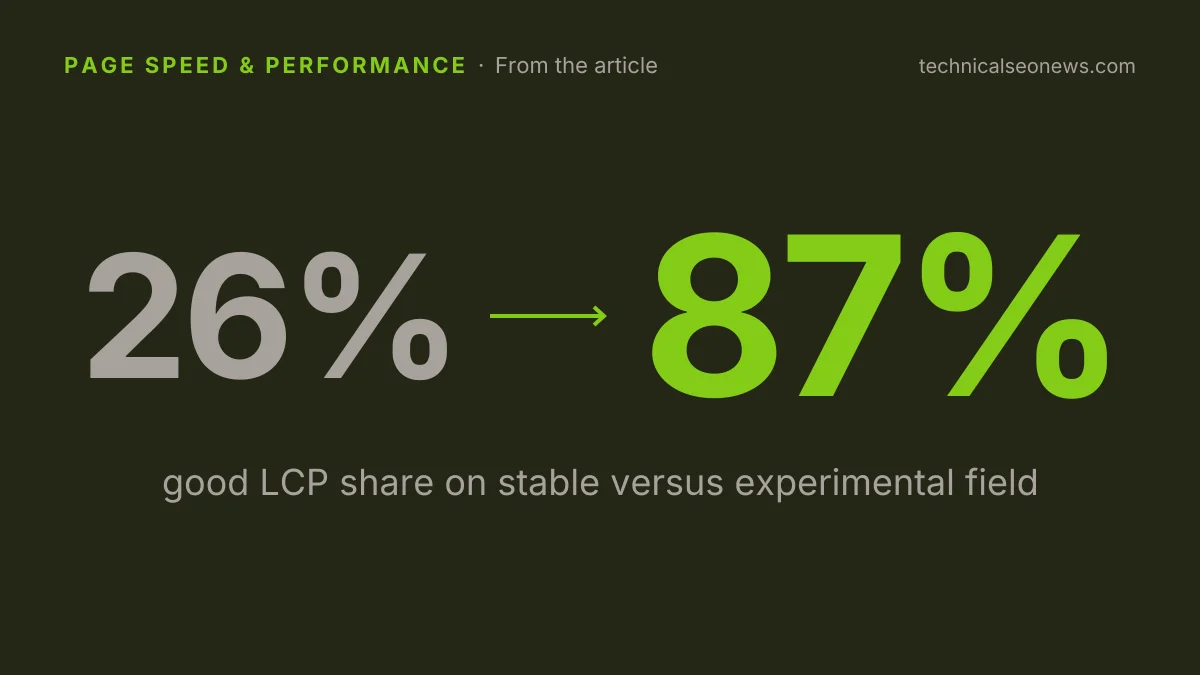
For sites built mostly out of soft navigations, the two sets of numbers are not close. Take Android origins where three quarters or more of page views are soft navigations. The share with good LCP is 26% on the stable field and 87% on the experimental one. Annie Sullivan, the Chrome engineer who wrote Google’s announcement, says that is not because SPAs are faster than multi-page sites. Follow-up clicks are faster on any site, and counting them separately brings SPAs with many follow-up views in line with multi-page sites that also get many. So the gap mostly measures how much of a site’s traffic used to be charged to its landing page, not how much faster the site became.
INP and CLS move for the same kind of reason. INP is now scored per page view instead of taking the slowest interaction across a whole session, which roughly doubles Android pass rates for sites that run mainly on soft navigations. CLS groups shift events by view rather than session, which puts SPA-heavy desktop sites level with multi-page sites, while Android stays slightly behind.
Most sites will see none of this. About 70% of origins in CrUX have little or no soft navigation traffic. Across every origin in the September dataset, the pass rate moved from 55.9% without soft navigations to 59.5% with them. The exposure sits at the top of the market. Among the top 1,000 sites, 35% on Android get more than half their page views from soft navigations. On desktop the figure is 42%.
INP is the one number still worth working. SPA-heavy sites continue to lag multi-page sites there even on the experimental field, so JavaScript cost during a route change shows up in both sets. A reported number depends on the measurement definition as much as on the site, as a monitoring bug that kept fast interactions out of INP for years showed.
Chrome is targeting May 2027 to end the experimental status, subject to the feedback it gets, and says Search Console will switch to the new data once that happens. The November CrUX release is the next checkpoint, with soft-navigation versions of FCP and navigation types expected.
What to do
On an SPA, query the stable and experimental fields together and keep a dated snapshot of the difference per URL. When Search Console switches, the likely result is a single step change in its Core Web Vitals report, and a recorded baseline is the only way to show later that it came from a change in accounting rather than from a performance project. The CrUX Vis toggle is the quick version of the same check.
Do not set targets on the experimental fields yet. Chrome expects shifts from month to month while the measurement improves, so the stable fields stay the ones to report against until the experiment closes. If client-side routing swaps content without updating the URL, none of this applies: Chrome registers a soft navigation only when the URL changes and something paints, so an app whose router leaves the URL alone will keep charging everything to the landing page.