DeepSeek's new Search API rates your pages 0 to 4 for authority
Summary
DeepSeek's new Search API returns an authority tier for every page in its results, and it takes site: queries, so for under a cent you can read how the engine rates your own URLs.
Run one site: query against your domain and keep the tiers as a baseline, because nothing in DeepSeek's docs explains how a page earns one.
DeepSeek opened its in-house search engine to developers on Oct. 17, and every result its new Search API returns carries an authority tier for the page, per Search Engine Journal’s report. The API also accepts site: queries, which makes the tier DeepSeek has assigned to your own URLs readable today.
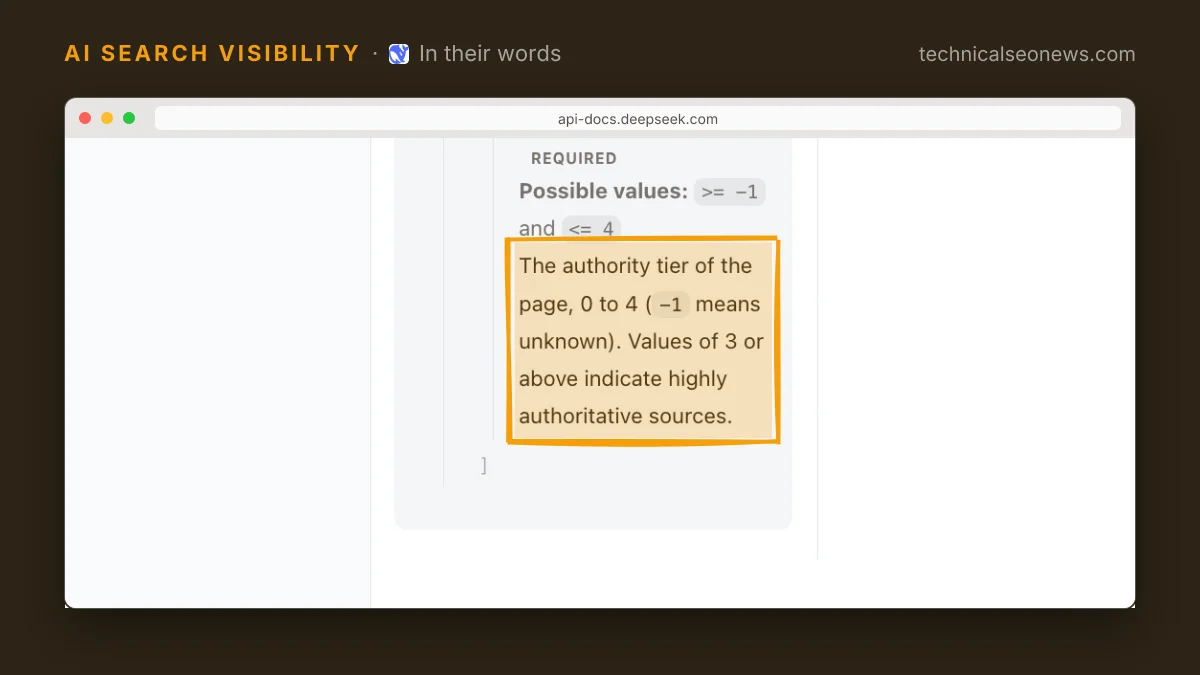
DeepSeek’s API reference defines two scoring fields on every result:
| Field | Range | DeepSeek’s threshold |
|---|---|---|
| authority | 0 to 4 (-1 means unknown) | 3 or above is “highly authoritative” |
| rerank score | 0 to 3 | 1.5 or above is “high-quality” |
Only the authority tier belongs to the page. The rerank score combines relevance, authority and freshness, so it shifts with the query; the authority tier sits on the URL, which is why it is the field worth recording. Until now, judging how an AI search engine treated your pages meant testing which sources AI tools cite for your own product and inferring backwards. A tier is a direct reading.
Getting it costs almost nothing. Search runs $0.75 per 1,000 successful requests, and searches that return no results are not billed. One site: query can come back with 50 of your pages carrying a tier each, for well under a cent.
Take a made-up case: a SaaS vendor queries its own domain and gets its documentation pages back at tier 3, its blog at 1, and nothing for its product pages. The tiers it did get are informative, since they say which templates DeepSeek already treats as authoritative. The absences are not, because neither the Search API guide nor the reference offers any way to tell an unindexed page from a filtered one.
The filters make that gap matter. DeepSeek’s changelog says the engine screens out SEO spam, “GEO manipulation” and low-quality AI-generated content, and credits strict detection for it. GEO, generative engine optimization, means shaping content so AI answer engines cite it. DeepSeek does not define which practices count as manipulating that, or describe how the detection works, so a page missing from a site: query tells you nothing about why it is missing.
No named crawler, and no clear way out
None of DeepSeek’s launch pages names the crawler that builds the search index, and none names the user agent its Fetch API uses. The EU summary of DeepSeek-V4’s training data says the crawler is “designed to respect robots.txt instructions and other standard web protocols, where applicable”, without saying which crawler that is. The Known Agents bot directory lists DeepSeekBot as an AI data scraper, a bot that downloads website content for datasets used to train AI models.
A Disallow aimed at DeepSeekBot is therefore a rule about model training. Whether it changes what the search index holds, or what Fetch retrieves when a user asks, is undocumented. Fetch returns a single page as Markdown and, per the guide, “is subject to the target site’s availability and access policies”, a line that names neither a policy nor an agent. That leaves site owners with a retrieval path they cannot identify in their own logs.
What to do
- Run one
site:query against your domain and save the authority tier for each URL it returns. That baseline is the whole value of this launch: the tiers are checkable even though the mechanism behind them is not. - Group the tiers by template rather than reading single URLs. One page at tier 1 is noise. A whole section at tier 1 is worth a look.
- Do not rewrite pages to chase a tier. Nothing DeepSeek has published says what moves one.
- Date the queries and keep them identical, so the next run is a comparison rather than a fresh snapshot.
Watch out for
- Your queries may reach a third party. DeepSeek’s privacy policy, last revised Feb. 10, says the company integrates “third-party APIs to provide search services” and shares users’ input keywords with those companies. Dan Petrovic’s post on the launch, from the SEO agency Dejan he runs, pairs that with a GitHub README in which Bocha, a Chinese search API company, calls itself DeepSeek’s official web search supplier. DeepSeek’s launch pages do not mention Bocha. Get client sign-off before running their domains through it.
- Server-side calls stop being free. If you point Claude Code, Codex or DeepSeek Harness at the DeepSeek API, their searches and page fetches run through Search and Fetch at no cost until Oct. 31 at 16:00 UTC, then start billing.