Semrush's new AI traffic metric is an estimate, not a count
Summary
Semrush's new AI-influenced traffic metric estimates the visits a brand earns after appearing in an AI answer, using a model trained on behavior within a 24-hour window.
Use it to compare topics and competitors, and keep the absolute figure out of client traffic reports.
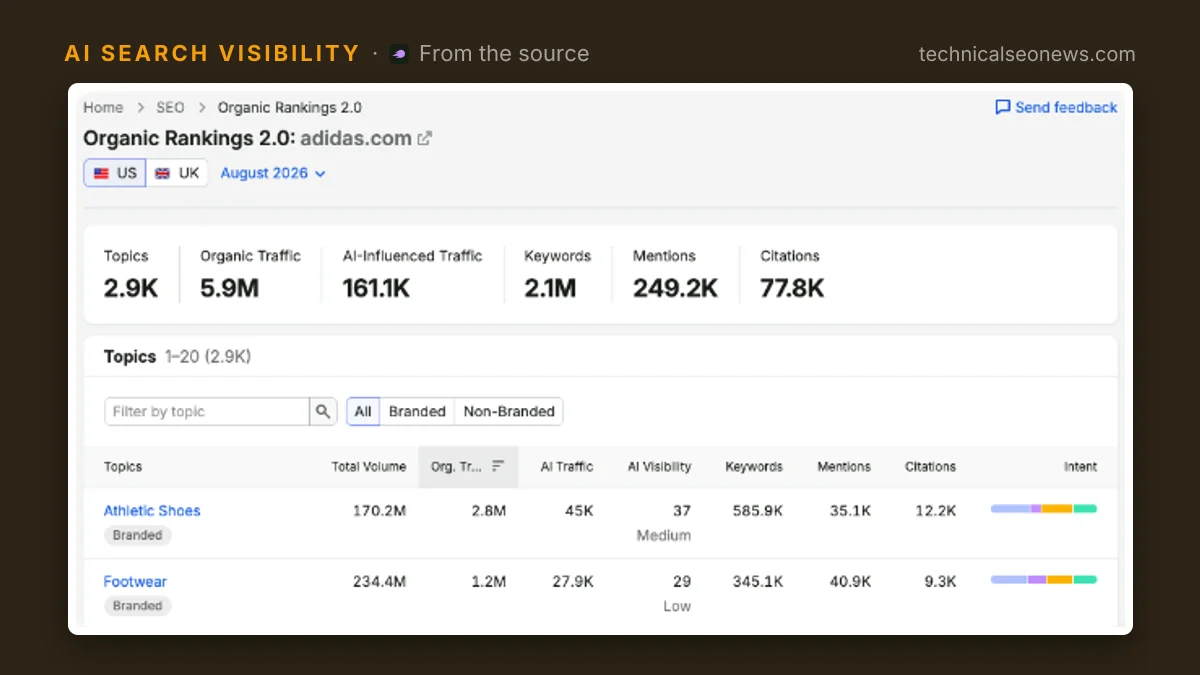
Semrush launched AI-influenced traffic on November 18, a metric that estimates the website visits a brand earns from being mentioned or cited in AI answers. Semrush’s announcement puts it inside Organic Rankings 2.0, next to organic traffic, mentions and citations for every topic a brand competes on, rolling out with US and UK data first. The figure comes out of a predictive model rather than out of anyone’s analytics.
Three kinds of visit feed the estimate: a direct visit from someone who got a recommendation from ChatGPT and typed the brand’s URL in, a branded search on Google from someone who read an AI answer, and a click on a citation link inside the answer itself. Only the last of those leaves a trace the site can see. The other two land under “direct” or “organic search” in ordinary analytics, where, as the Semrush post puts it, AI’s role never shows up. Google’s own reporting has the same blind spot: it counts AI Overview clicks inside the total for Search instead of splitting them out.
The model is trained on what Semrush’s methodology documentation calls “a reference dataset of aggregated web activity”, which links brand mentions in AI answers to visits through any channel within 24 hours. It then scores how often and how consistently a brand appears in AI answers across its topics, and weights each topic by how many people ask about it. Coverage is ChatGPT, Gemini, Google AI Mode and AI Overviews, and every keyword and prompt refreshes at least once a month, so the output is a monthly number.
Semrush’s own documentation is direct about the limits. It says the metric is “an estimate from a predictive model, not a direct traffic count”, that it “reflects statistical relationships, not proof that AI caused any individual visit”, and that it works as “a strong directional signal rather than an exact count”. On Semrush’s description, the 24-hour window is a correlation rule and nothing more. A visit three days after an AI mention falls outside it, and a same-day visit from someone who never saw the answer falls inside it.
The comparison between two domains is where the number holds up. Semrush runs the same model for every domain and topic every month, so, in the post’s words, “each figure is an estimate, but the comparison is apples to apples”. A competitor whose AI-influenced traffic on a topic runs at double yours is telling you where to spend. The absolute count is the part that will cause trouble. Set beside GA4 sessions in a client report, it invites a reconciliation that cannot be done, and the caveat in Semrush’s documentation will not make it onto the slide.
The model’s input, how often a brand appears in AI answers, is observed rather than estimated, and Semrush samples each prompt more than once because answers change from run to run. Semrush says the metric sits on more than 2.18 billion observed AI responses, with topics built from real search demand in its keyword database instead of a list of guessed prompts. Repeat sampling matters more here than the headline volume, because brand presence in AI answers is genuinely unstable: brand position in AI answers changes on two days in three. A traffic estimate sitting on one response per prompt would be noise.
Natalka Antoniuk, digital marketing lead at the agency Appius and an early-access tester quoted in the announcement, uses the metric as triage. Building AI visibility “takes time, money and resources” that smaller clients often lack, and the figure helps “identify the targets worth spending that time on”. Choosing between topics is the job this number can actually do.
What to do
- Use it to rank topics and to benchmark two or three named competitors. Keep the absolute figure out of client-facing traffic reports, or label it as modeled every time it appears.
- Compare AI-influenced traffic against organic traffic topic by topic. The gap is the argument for where AI visibility is worth paying for.
- Review it monthly, since the underlying keywords and prompts refresh on that cycle. A week-on-week chart would be reading model noise.
- Do not try to reconcile it with GA4 or Search Console. Neither one knows which visits followed an AI answer, which is the reason the metric exists.
- If the client’s market is outside the US and UK, there is nothing to look at yet. A low or absent figure in those markets says nothing about the brand’s AI visibility.