Google makes all three AI Overview citations fully visible
Summary
AI Overviews now show three citation cards with no fade on the lower ones, so a second or third citation gets read without anyone clicking into the block.
Record which slot a citation lands in from now on, because the display has changed twice in about a month and could change back.
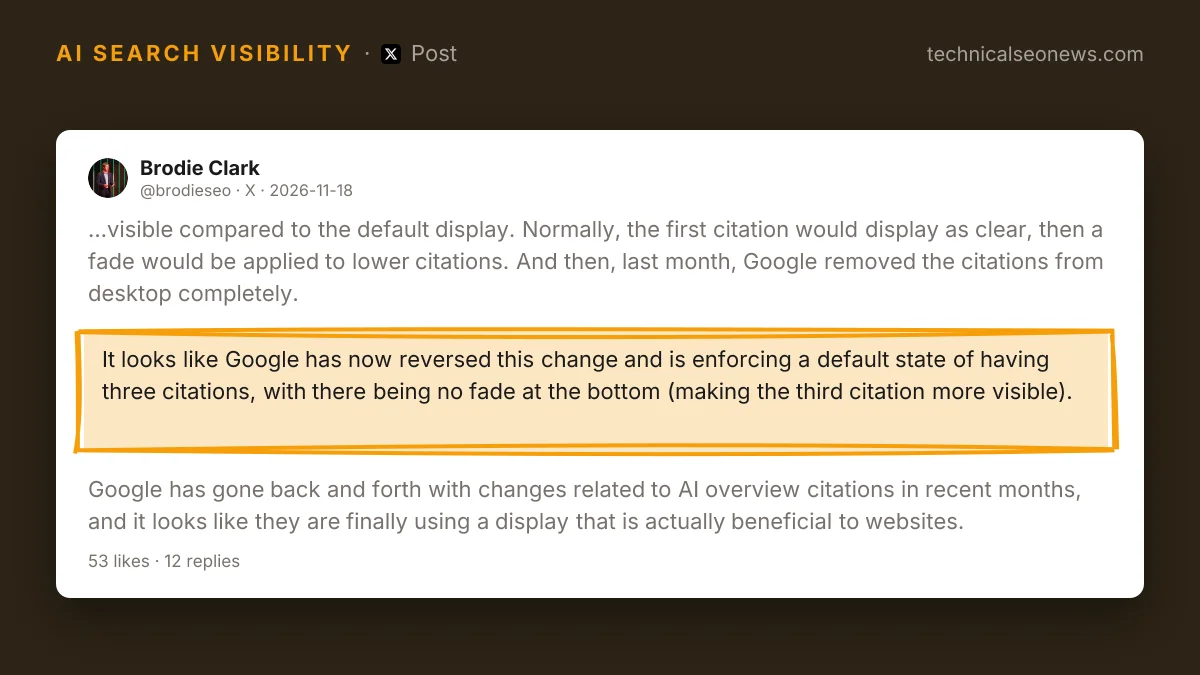
Google has dropped the fade from the lower citation cards in AI Overviews, and the default display now shows three cards that are all fully readable. Brodie Clark, who tracks Google’s search result features, posted the change on X, writing that Google “has now reversed this change and is enforcing a default state of having three citations, with there being no fade at the bottom (making the third citation more visible).” Search Engine Roundtable wrote it up on 17 November.
The block behaved differently until a few days ago, going by the before-and-after screenshots in the Roundtable post. Clark’s description of the old default is that the first citation displayed clear and a fade was applied to the citations below it, and that last month Google removed the citations from desktop completely. He called the current state “the first time in a while that they have made an update that actually makes the citations more visible compared to the default display.”
What changed is the value of a citation that is not the first one. A faded card is easy to skip, while three clear cards put all three domains in front of everyone who reads the answer. Clark’s post does not measure the effect, and the likelier result is more exposure for the second and third slots than a visible click change. Search Console will not separate it out either, because AI Overview clicks already sit inside total Search clicks.
The more useful warning is how fast this element moves. A clear first card with a fade, then no desktop cards at all, then three clear cards: two changes inside roughly a month, and that is before the tests running alongside it. Barry Schwartz, who runs Search Engine Roundtable, reports a Show All button that expands the cards, which he says is not new and does not always appear. Search Engine Watch, another trade site, spotted a version where the citations stay on screen as the user scrolls. None of this has come with an announcement from Google, and Schwartz writes that Google seems to have rolled out the unfaded cards, which leaves a test or a partial rollout open. Placement has been in flux for a while, including an earlier test that moved the source links under the answer.
What to do
- Log the slot, not just the fact of a citation. A domain in position three is worth more than it was before this change, and a tracker that records only “cited” will show no change at all.
- Re-check desktop specifically. The removal last month hit desktop, so any conclusion drawn from mobile screenshots in October says nothing about what is live now.
- Leave the pages alone. This is a display change on Google’s side, so there is no markup or content work attached to it.
- Keep it out of anything durable. Reporting a layout that has changed twice in a month as a trend is how a quarterly deck ends up describing a SERP nobody is seeing by then.