Google re-indexed the old domain four months after a site move
Summary
A domain move that looked finished can come apart months later, with the new site's pages dropping to Crawled, currently not indexed and the old domain ranking again.
File Change of Address separately for every host variant verified in Search Console, keep the redirects live well past the point the move looks done, and treat mass crawled-and-not-indexed as a content judgment rather than a redirect bug.
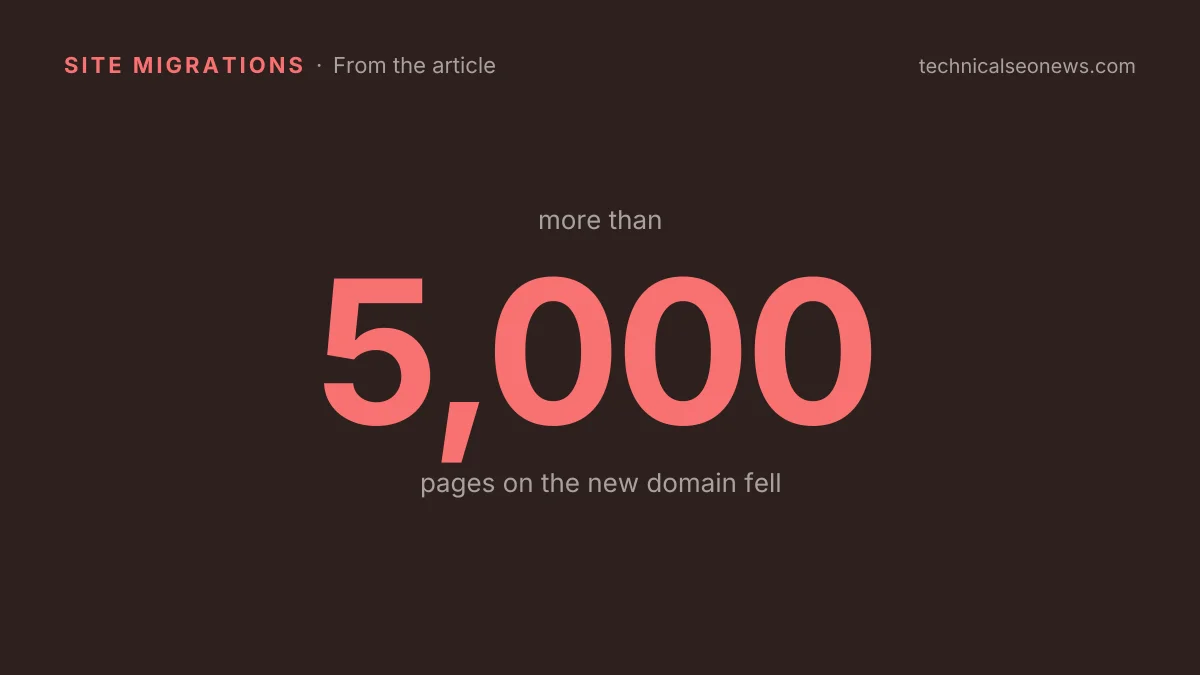
Four months after a domain migration Google had already processed, more than 5,000 pages on the new domain fell to “Crawled, currently not indexed” and the old domain came back into the index. Search Engine Roundtable picked up the case on October 13 from a Reddit thread. The site owner changed domains at the start of the year, set up redirects and used Search Console’s Change of Address tool, and by April was seeing about 5,000 impressions a day on the new site. New-domain impressions now run around 20 a week, and the clicks are showing up under the old domain in Search Console.
Google’s John Mueller replied in the thread asking the owner to send a direct message, and gave two general answers. The first is that “sometimes things just take a particularly long time to be fully processed.” The second is more specific: Change of Address has to be set up for both the www and non-www versions of the old domain, “so that it can fully migrate the domain,” a point Google added to the Change of Address tool documentation a while back.
That documentation goes further than www and non-www. It says to use the tool for all subdomain variants of the old domain, “even if you’re not actively using these variants currently.” The tool only moves the property it is run from and nothing below it, so a request filed from example.com does not cover www.example.com or any other subdomain. Every old-domain property in the account needs its own request, including the ones nobody has opened since verification.
Whether a missing filing explains this particular case is doubtful. The move worked for four months: Google indexed the new domain, served it, and sent it real traffic. A host variant that never got its own Change of Address is a gap in how signals consolidate, not a mechanism that un-indexes thousands of pages that were already earning impressions. Barry Schwartz, who runs Search Engine Roundtable, is skeptical of the explanation in the post itself.
Marie Haynes, a consultant who tracks Google’s quality and algorithm changes, offered a different account in a post quoted in the same article: a site migration triggers a new quality assessment, and Google has become stricter about what it indexes. The sites Haynes has seen go wrong show the same crawled-and-not-indexed state, which means Google fetched the pages and declined them. Haynes describes most of those as decent sites whose content offers nothing original against what is already in the index. Glenn Gabe, an SEO consultant who publishes detailed algorithm-update analysis, is reporting the same run of migrations coming apart months after the fact.
Haynes calls it a theory, and it is one. It is also the only account on the table that fits a reversion arriving four months after the signals had already moved. The practical conclusion for anyone mid-migration is that redirects and a Change of Address filing transfer signals. They do not buy a permanent indexing decision for each URL. Google has published its own timing ranges for site moves, and this case is worth reading alongside them before setting a monitoring window.
What to do
- File Change of Address from every verified old-domain property, not just the one in active use. That means non-www, www, and any subdomain variant in the account, including variants that were never serving pages.
- Keep the redirects running well past the point where the move looks finished. Google’s documentation says at least 180 days, and longer while the old URLs still get traffic from Google Search. A move that can reverse in month four argues for the longer end.
- Check the redirects and Change of Address filings once more, then treat mass “Crawled, currently not indexed” on the new domain as a judgment on the content. Re-filing a Change of Address is unlikely to move pages Google crawled and chose to skip.
- Keep the old domain’s Search Console property open after the move. Impressions reappearing there are the sign to watch, as they were here.
- Separate a real reversion from normal behavior before raising an alarm. Searching for the old domain by name will often surface it, which is not the same as the old domain taking back the rankings.