Mueller says indexing changes show in performance reports first
Summary
Google's John Mueller told a site owner with a frozen Page Indexing report that index changes show up in Search Console's performance reports first, so the stale report is not worth watching.
Check impressions for the pages in question instead of waiting for the indexing graph to move.
Google’s John Mueller told a site owner whose Page Indexing report had been frozen since October 16 to “save your energy,” in a Reddit reply written up by Search Engine Roundtable. His reason was that indexing does not change quickly, and when it does, the change shows up in the performance reports before the indexing report catches up.
That answer came with a condition that is easy to skip. Mueller told the poster the site looked relatively new with relatively stable numbers, then asked what refreshed data was supposed to show. The rest of the reply was about Google’s priorities rather than this freeze: the reports carry dates so nobody has to ask, Google does not plan to comment on the freshness of every report, and faster refreshes go where Google judges them useful. There was no fix, no timeline, and no acknowledgement that anything is broken.
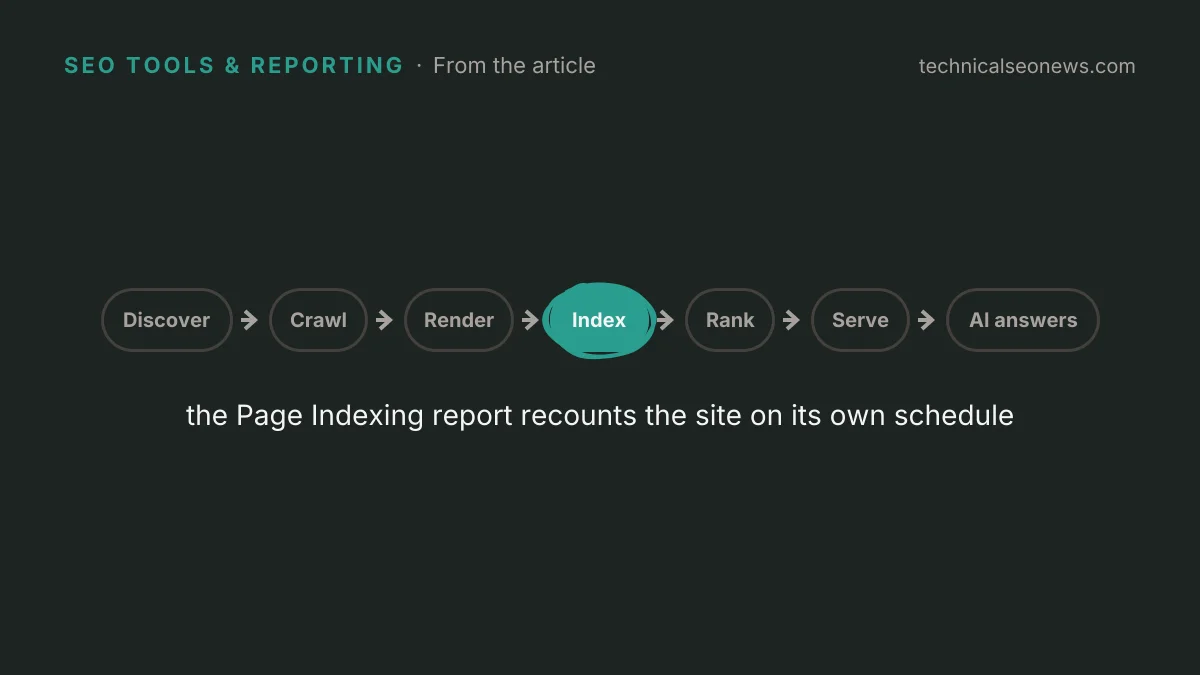
Mueller’s reply does not explain why performance data moves first, but the claim is usable. The likelier explanation is that a page can start collecting impressions as soon as it is eligible to appear in results, while the Page Indexing report recounts the site on its own schedule. Watching impressions for the pages in question gets an answer sooner than waiting for a graph to move.
Where impressions fall short
Impressions only stand in for index state where the pages already have queries to rank for. Search Engine Roundtable’s write-up points out that the delay bites hardest for SEOs checking whether a new section got indexed. That is where the advice is thinnest: pages that rank nowhere yet produce a flat impressions line whether Google indexed them or not. The two readings can also disagree outright. One site’s impressions hit zero while its live URL tests still passed, so flat performance data is not evidence of a deindexing either.
What to do
- Read the date stamp on the Page Indexing report before treating a flat graph as a symptom. A stale date explains the flatline without any crawl theory, and the stamp is what Mueller is pointing at.
- Inspect the specific URL instead of reading the property-level chart when the question is whether one page is indexed.
- For a new section, watch impressions for its pages, and treat zero impressions as inconclusive until those pages have something to rank for.
- Do not wait for Google to comment on the freeze. Google has not called it a bug, and Mueller’s reply is the closest thing to a status update on offer.