Search Console click spikes from 31 October are bot traffic
Summary
Search Console clicks jumped on several sites in the first days of November while impressions stayed flat, and Marie Haynes traced the extra clicks to automation hitting results on page 2 and deeper.
Filter the Pages tab for Position over 10 before presenting any November click number as a gain.
Google Search Console clicks jumped on several sites between 31 October and 2 November 2026 while impressions and rankings stayed flat. Marie Haynes, an SEO consultant who has researched Google’s ranking systems for more than 15 years, documented the pattern in Search Engine Journal across monitored properties in unrelated industries and concluded the clicks are not human traffic.
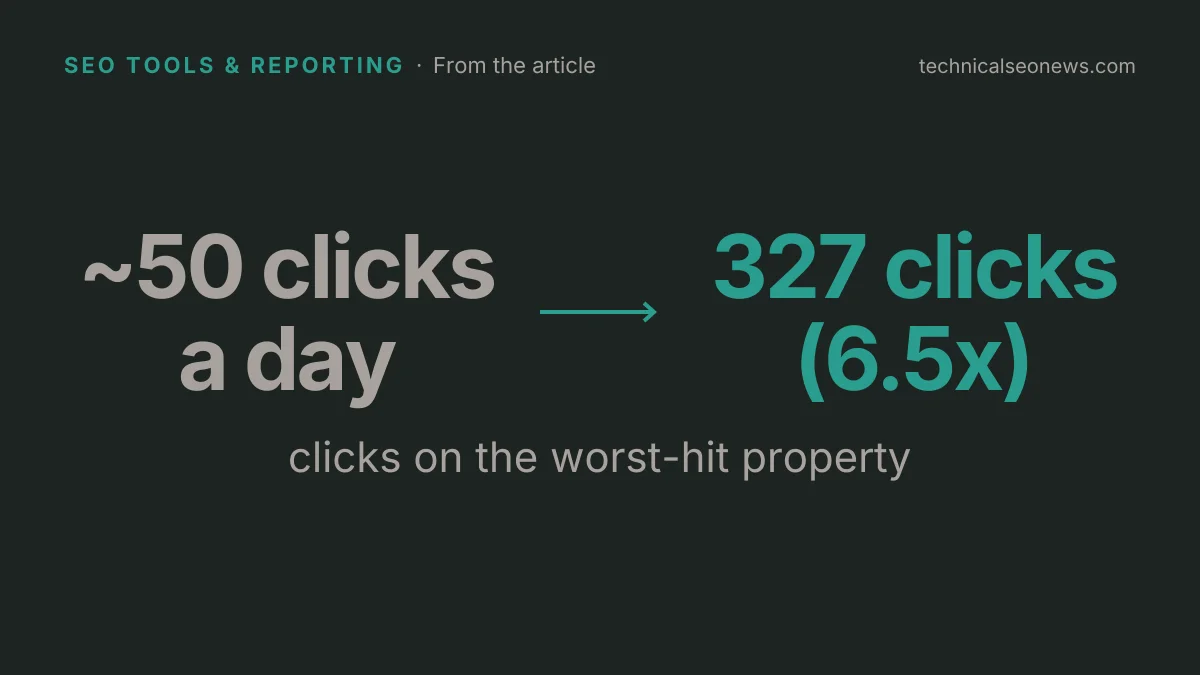
Organic clicks normally land in the top three to five results. The new clicks landed on results from page 2 through page 6. Click-through rates on those deep listings ran between 45% and 100%. On the worst-hit property, more than 40 city and service pages that had gone a week without a single click each logged three to 16 clicks. One city page took nine clicks on 13 impressions, from an average position of 15.5.
The three properties Haynes documented differ in size and sector and broke the same way:
| Property | Prior 7-day average | 2 November | Where it concentrated |
|---|---|---|---|
| Multi-location service business | ~50 clicks a day | 327 clicks (6.5x) | US, 91% desktop, 120 pages |
| Regional service business | ~16 clicks a day | 66 clicks (4.1x) | US, 83% desktop, 36 pages |
| Technical Q&A site | ~68 clicks a day | 144 clicks (2.1x) | Canada, 40 clicks on one page |
Desktop carried almost all of it. The worst-hit property logged 297 of its 327 clicks on desktop. Mobile clicks stayed at 30, inside their ordinary daily range. Real demand does not skip mobile, which makes the mobile trendline the fastest check available before a report goes out.
Flat impressions are what make this easy to miss in a monthly review. The worst-hit property takes around 18,000 impressions a day, so a few hundred automated ones move that line by about 1.5%. The same few hundred clicks, against a baseline near 50 a day, are the vertical spike.
On the technical Q&A site, one troubleshooting page that normally gets zero or one click a day took 40 clicks on 2 November, all of them from Canada. The queries behind them were 23 reworded variations of the same troubleshooting question, including systematic number permutations such as three times, four times and ten times, nearly all with as many clicks as impressions. The better bet is that an automated research agent worked through variants of the question, rather than 23 Canadians finding the same page 2 listing on one day. Haynes stops short of naming a cause. Her four candidates run from scrapers that resolve Google’s click-tracking redirects, the same wrappers that show up as google.com in SERP API exports, to a gap in Google’s own bot-click filtering.
Most properties Haynes monitors were unaffected, which matches what Glenn Gabe and Joy Hawkins reported in Barry Schwartz’s Search Engine Roundtable post. Schwartz, who runs that site, had asked on X how people were filtering the report. A clean chart on one property says nothing about the next one, so every account needs its own look.
What to do
- In the Pages tab, filter for Position greater than 10 and sort clicks descending. The affected URLs are the deep-ranking ones with click-through rates of 30% or more. Use Pages rather than Queries, since Search Console hides most single-impression queries for privacy.
- If one URL or subfolder absorbed the spike, exclude it with the top-bar Page filter.
- If the clicks came from a single country, filter that country out in the Countries tab.
- When dozens of pages were hit, no control in Search Console removes only the bot clicks, because the top chart cannot be filtered by position or CTR. Switching Device to Mobile gives a clean trendline, but it also hides genuine desktop traffic, so say where the filter was applied.
- Annotate early November 2026 in whatever reporting system the client sees. The inflated days will sit in next month’s comparison baseline, so a normal December reads as a decline unless the note is already there. Nothing on the pages needs changing and there is nothing to disavow; Haynes expects the clicks to drop back to baseline on their own.