Position 4 to 3 is worth 19 clicks per 1,000, 8 to 7 is worth one
Summary
A one-position gain near the top of Google's results adds about 19 clicks per thousand impressions, while the same gain in the middle of the page adds about one, in iPullRank's Search Console data.
Spend ranking work on pages already at positions 4 and 5 with real impressions.
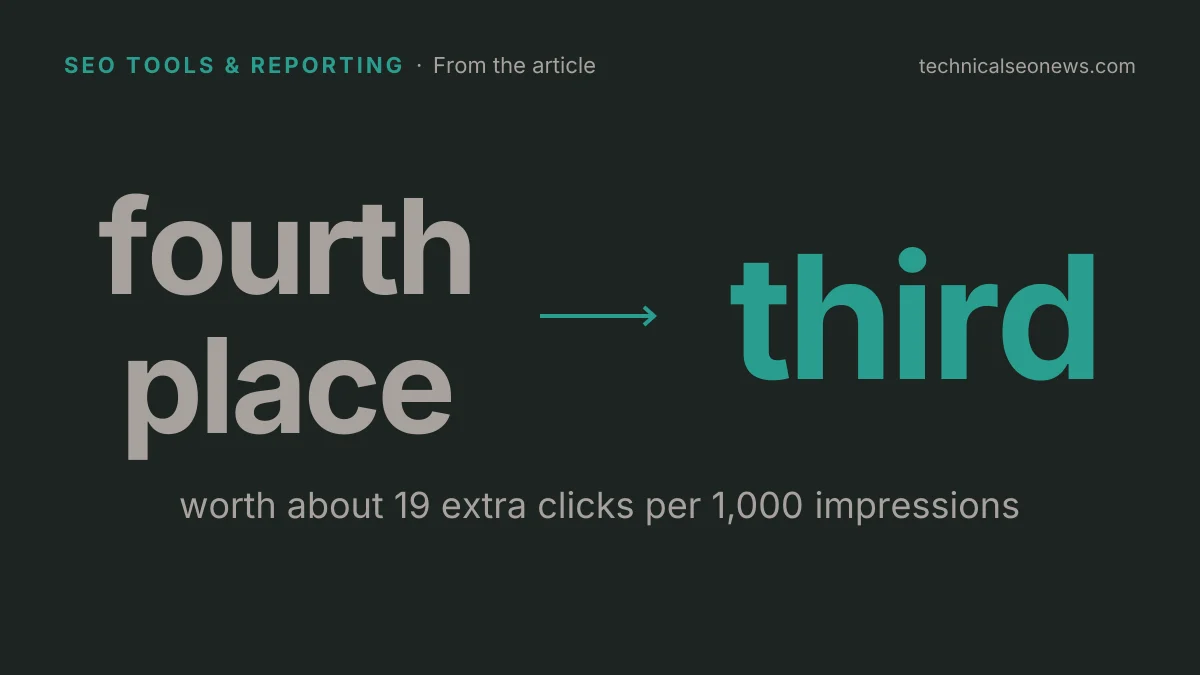
The jump from fourth place to third is worth about 19 extra clicks per 1,000 impressions. The jump from eighth to seventh is worth about one. Both numbers come from a study of 16 months of Google Search Console data by the SEO agency iPullRank, published on 12 November.
Michael Tandoh, who works on data science and AI visibility at iPullRank, drew the figures from 166 brands sending about 9.5 billion impressions a month. He tested every pattern twice, once across sites and once within single sites over their own history, and kept a finding only when the real ranking event clearly beat two controls: the opposite event and random dates with no event at all.
Clicks are concentrated in the top four positions, and almost nothing moves between the middle ones. A page at 8 that reaches 7 gains about one click per 1,000 impressions. A page at 4 that reaches 3 crosses into the part of the curve where the clicks actually live.
The top of that curve is also where the click rate is falling fastest. On unbranded queries, the year-over-year change splits sharply by position:
| Position | 2025 | 2026 |
|---|---|---|
| 1 | about 7% | about 5% |
| 2 | about 6% | about 4% |
| 3 | about 3.5% | under 2% |
| 4 and below | little change | little change |
Position three lost more than half its click rate in a year. The 19-click figure is therefore measured against a moving baseline, and Tandoh says as much: a click curve has a shelf life, and a rate measured a year ago overstates the visits a position will bring today. He names the likely cause as the results page answering more searches on its own, through snippets, answer boxes and AI summaries, which matches site-level measurement since the AI Overviews rollout, where clicks fell on three of five sites in France.
Both findings argue against treating “improve rankings” as a single task. Two pages the same distance from the top are worth different amounts of work: the one at 4 is one move from the steep part of the curve, the one at 9 is several moves from anywhere. Tandoh’s advice is to push only pages that can realistically reach the top four for a query they already rank on, and to rewrite titles and snippets to earn more of the clicks the position can bring, starting with pages that under-earn their expected click rate.
Tandoh’s piece does not spell out what the falling curve does to traffic forecasts, but the consequence follows from the table. Any projection built on last year’s click rates promises visits the position will not deliver, and the error is largest at positions one through three, where forecasts are usually most ambitious. A page ranking third today gains less from reaching first than the same move returned in 2025.
What to do
- Re-sort the backlog by position band first. Pages at 4 or 5 with real impressions go to the top; pages at 8 and below come off the list unless the work plausibly lands them in the top four.
- For pages already in the top four, treat the click rate as the lever rather than the position. Compare each page’s CTR against the average for its position and start with the ones under-earning it.
- Rebuild the click curve from your own Search Console data rather than a published benchmark, and segment it by branded against unbranded queries. The decline above was measured on unbranded queries, so a blended curve would likely understate it.
Watch out for
- Impression volume, not just position. Nineteen clicks per 1,000 impressions is nothing on a page that gets 200 impressions, so filter the backlog by impressions before sorting by rank.
- Contaminated click data. Spikes of clicks at high CTR below position 10 turned out to be bot traffic in Search Console reports from 31 October, and anything like that in the sample will inflate the curve you fit.