Brand position in AI answers changes on two days in three
Summary
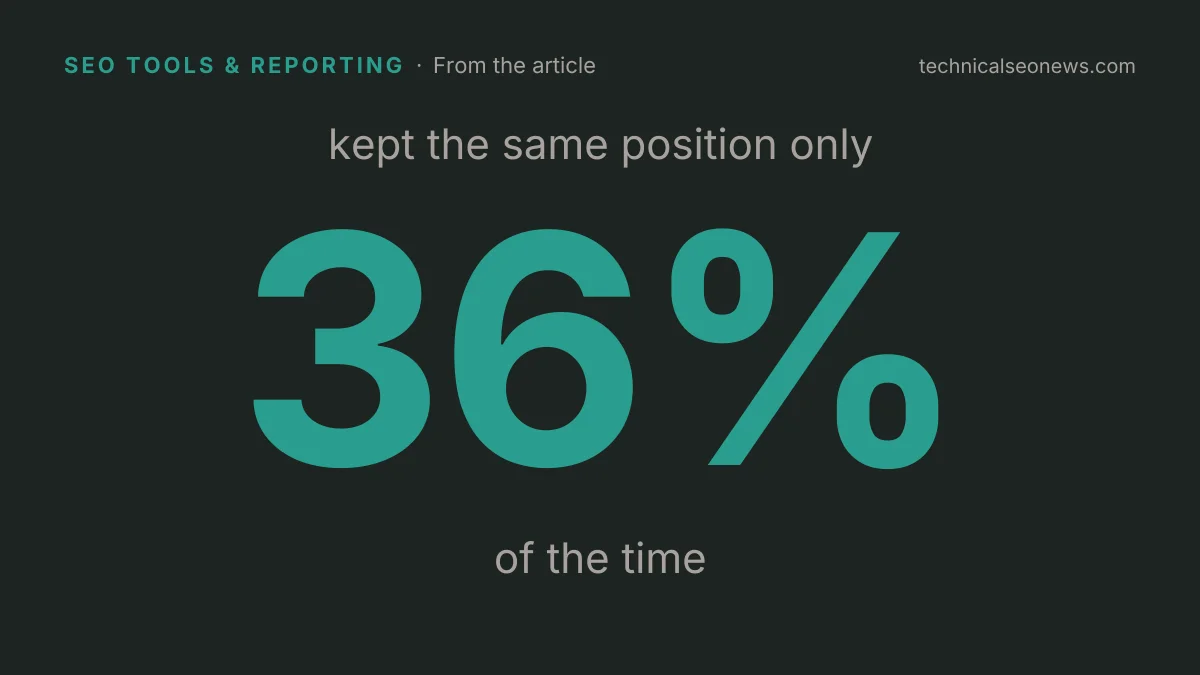
Average position in AI answers moves too much from day to day to report on its own: Ahrefs found a tool held its position on only 36% of consecutive days.
Make mention rate the headline AI visibility metric and show average position next to it.
A brand that AI answers mentioned on two consecutive days kept the same position only 36% of the time, so the position changed on close to two days in three. The figure comes from Ahrefs’ comparison of eight AI rank tracking tools, published November 16.
The study behind it ran 15 “best tools” prompts across seven AI platforms for 76 days. The dataset is 6,790 answers that named at least three tools. Mateusz Makosiewicz, an SEO educator at Ahrefs, ran the research and wrote the post.
Mentions held still while positions moved. Most prompts had around three tools that appeared in nearly every answer, and when one of those appeared, it was named again the following day 98% of the time. Instability was worse on some platforms than others: rankings changed on 77% of days in Gemini, against 53% in Google AI Overviews, the steadiest of the seven.
That gap is the reason to stop putting average AI position at the top of a client report. A number that survives from one day to the next a third of the time is more likely tracking which answer the model happened to sample than whether the brand gained ground. Classic rank tracking earned its place in reports because position maps to traffic: one place higher near the top of Google is worth about 19 extra clicks per 1,000 impressions. AI answers have no comparable curve, so a one-place move carries no known consequence even when it is real.
Position still carries signal, over weeks
Across the dataset, position and mention frequency moved together. Tools mentioned most often sat in the top three positions in 61% of the answers that named them. For tools mentioned only occasionally, the figure was 12%. The ordering is not random. It just does not resolve day by day.
Neither metric works alone, and the post’s own example shows the failure in both directions. Ahrefs appeared in only 30% of answers for its tracked prompts, but when it did appear, its average position was number one. Reported as position alone, that reads as market leadership. Reported as mention rate alone, it reads as a visibility problem. Both are true: strong standing in the answers that include it, absence from most of them.
Cost per prompt is not a like-for-like number
The post also prices eight tools by monthly plan divided by daily tracked prompts, with pricing checked November 3. The catch sits in the fourth column, because the cheapest figures buy one platform rather than all of them.
| Tool | Plan | Daily prompts | Platforms in that price | Cost per daily prompt |
|---|---|---|---|---|
| Ahrefs Brand Radar | $50 Basic | ~83 | 1 of 7 | $0.60 |
| Rankscale | $99 Pro | 160 | 1 of 17+ | $0.62 |
| SE Visible | $89 Basic | 75 | all 5 | $1.19 |
| Peec AI | $95 Brands Starter | 50 | 3 of 6 | $1.90 |
| Otterly AI | $29 Lite | 15 | all 4 | $1.93 |
| Nightwatch | $99 Starter | 50 | 1 of 5 | $1.98 |
In Brand Radar one check is one prompt run on one platform in one location, so a team that wants three platforms covered needs roughly three times the allowance the headline number suggests. Scrunch’s $250 plan is not comparable either. Its 125 daily prompts run for only 14 days, and Profound quotes custom pricing.
Ahrefs sorted that table by cost per daily prompt, which puts its own product first. The post does say platform coverage differs and the figures are not directly equivalent, and that is the sentence to carry into a procurement spreadsheet: rebuild the comparison around the platforms the brand actually needs covered, at which point the order changes.
What to do
- Report mention rate as the headline number and average position beside it. Makosiewicz’s advice is to track position over at least a week and never report it on its own, and the 36% figure is why.
- Stop alerting on single-day position moves. Compare averages over a week or more instead, and if an alert is needed, fire it when a brand drops out of a prompt’s answers rather than when it loses a place.
- Price tools by platform, not by prompt. Then test two or three of them on the same 10 prompts, which is the post’s own suggested shortlisting method.
- Check how each tool collects answers. Scraping the chat interface captures what users see; API calls may not match it. Brand Radar uses Claude’s API and scraping for the other six platforms. A Claude answer costs eight checks against the allowance rather than one.
- Pair any of it with first-party data where it exists. OpenAI is building impression and click reporting into ChatGPT, which will beat a scraped position estimate for the one platform it covers.