llms.txt showed no link to AI citations across 300,000 sites
Summary
A study of close to 300,000 domains by the SEO software company SE Ranking found no link between serving an llms.txt file and how often AI models cite a site.
Check that the retrieval bots behind AI answers can crawl the pages you want cited before spending any time on the file.
SE Ranking’s study of close to 300,000 domains, published October 15, found no relationship between having an llms.txt file and how often AI models cite a domain. SE Ranking, which sells SEO software and runs regular industry data studies, tested the question with both standard correlation analysis and a machine learning model, and neither turned up an effect.
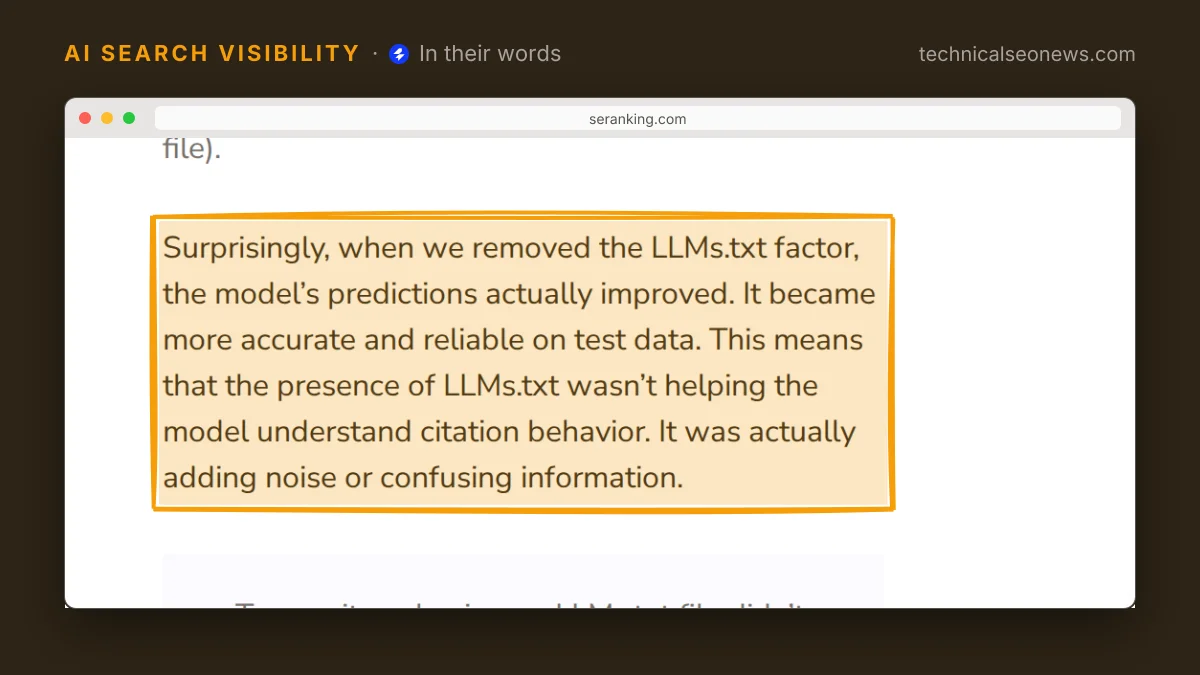
The model was built to predict how often a domain gets cited by LLMs, using a set of site factors that included whether the domain served an llms.txt file. Removing that factor made the model more accurate on test data. A variable that improves predictions when it is deleted is noise. Llms.txt told the model nothing about citation behavior that the other factors did not already explain.
Few sites serve the file, and the biggest sites are no more likely to serve it than small ones. Only 10.13% of the domains in the sample had one, against the near-universal use of robots.txt and XML sitemaps. Adoption by traffic tier is flat:
| Monthly traffic | Share with llms.txt |
|---|---|
| 0 to 100 visits | 9.88% |
| 1,001 to 5,000 visits | 10.54% |
| 100,001+ visits | 8.27% |
The top tier uses the file slightly less often than mid-sized sites do, which is the opposite of what a working citation lever looks like after two years of discussion.
What the study cannot do is explain the result. It compares the presence of a file against citation counts across domains, with no crawler logs behind it, so it cannot say whether retrieval bots such as OAI-SearchBot or Claude-SearchBot ever requested those files. The safer read is that the study bounds the size of any effect rather than proving none exists. A lift big enough to matter to a content team would have left a trace in a model this size.
Tooling is currently sending the opposite message. Google’s PageSpeed Insights now runs an audit for llms.txt, which puts a pass or fail next to the file inside a Google-branded report, and that audit checks whether the file is there, not whether anything reads it. SE Ranking’s piece notes that Google has said AI Overviews and AI Mode still run on ordinary search signals rather than llms.txt, and that OpenAI’s guidance for appearing in ChatGPT answers points at allowing OAI-SearchBot in robots.txt.
The crawler evidence that does exist is weaker than it sounds. SE Ranking cites server logs that occasionally show GPTBot fetching llms.txt files. GPTBot gathers training data, while the bot behind the links ChatGPT cites is OAI-SearchBot, and no log evidence in the piece shows that one asking for the file.
What to do
Three things follow from the study, in order of how much time they are worth:
- Leave an existing llms.txt file in place. It costs nothing to serve, and nothing here argues for removing it, only for taking it off the list of things that earn citations.
- Check crawl access before anything else. Llms.txt is guidance and robots.txt is the rule, so a page disallowed in robots.txt stays unreachable no matter what the llms.txt file lists. Confirm the allow rules cover the retrieval bots that feed AI answers, then confirm the pages you want cited return 200 and are indexable.
- Ask for the test behind the next file-level claim that reaches you. The same gap showed up in the claim that URL paths change AI citation rates, which had no measurement behind it either.