No test behind the claim that URL paths change AI citations
Summary
An r/TechSEO thread argues that topic-based URL paths help AI systems group a site's pages and win citations. The thread contains no measurement, and the only reply disputes the mechanism.
The better-supported explanation is that citations follow organic rank, so a URL change should be justified by a crawl or navigation problem, not by hoped-for citations. When paths do change, 301 every old URL.
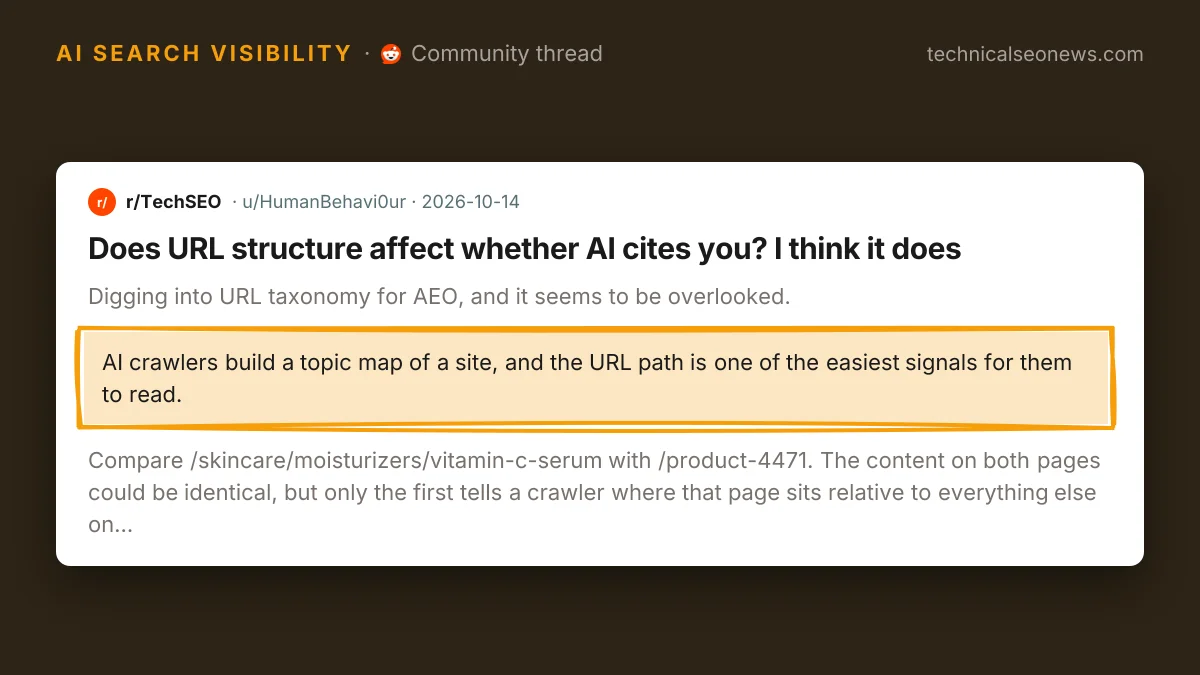
A post in r/TechSEO argues that URL paths decide whether AI systems cite a page, and it reports no test. The r/TechSEO thread, from a member posting as u/HumanBehavi0ur, sets /skincare/moisturizers/vitamin-c-serum against /product-4471 and says the content on the two pages could be identical while only the first tells a crawler where that page sits relative to the rest of the site. The post closes by asking whether anyone has changed their URL structure and seen a difference in citations. No reply reports one.
The one reply pushes back on the mechanism. A commenter posting as u/BoGrumpus answers that the URLs themselves are not what matters, that information structure is doing the work and can be indicated in other ways, and that reorganizing URLs tends to cascade through the rest of it. That cascade is the problem with reading any before-and-after as a URL effect. A site that ends up with topic-grouped paths usually got there by rebuilding navigation, internal links and templates, and those changes move organic rankings on their own.
What has been measured is the link between citation and organic rank. In a finance dataset, the top organic result was cited in AI Overviews about three times as often as rank 10, and ChatGPT has been seen running site: searches against brand domains to find candidate pages. If retrieval reaches a page through a search step, the likelier explanation for citation wins is rank on the queries behind the answer. A URL rewrite that leaves rank unchanged has no obvious channel through which to help.
The thread also treats one kind of bot as all of them. Its line that “AI crawlers build a topic map of a site” describes training crawlers such as GPTBot and ClaudeBot, which collect text for model training and never produce a citation. Citations come from the retrieval side, from search bots such as OAI-SearchBot and PerplexityBot and from user-triggered fetchers such as ChatGPT-User, which pull a handful of URLs chosen for one query. The better bet is that those URLs get picked by the query-time search rather than by a directory tree inferred from an earlier crawl.
One item on the post’s problem list holds up on its own. Restructuring without 301s, u/HumanBehavi0ur writes, wipes out the citations and links built on the old paths. That sets the asymmetry for anyone weighing a change, because a botched URL migration costs rankings that show up in Search Console, while the citation gain being chased has not been shown at all.
What to do
- Leave live URLs alone unless there is a crawl, navigation or analytics problem to point at. Better grouping for AI systems is not one of those problems on this evidence.
- Spend the conventions on new URLs instead. Lowercase with hyphens, topic words instead of IDs, one convention for singular and plural across sections, and no more than two or three levels of depth are all cheap at creation and expensive to retrofit.
- 301 every changed URL when a migration is already happening for other reasons, and keep the old-to-new map after launch so the redirects can be checked.
- Work on rank for the queries that produce the answers you want to appear in. That is the one input with published evidence behind it.