Vercel will start charging for Next.js cache reads and writes
Summary
Vercel is moving Next.js Data Cache into Runtime Cache, and the fetch and unstable_cache reads and writes it served free become billable once a team migrates, which for existing Hobby teams is November 29.
Check each project's Data Cache usage in Observability before that date arrives.
Vercel is taking Next.js Data Cache out of beta and folding it into Runtime Cache, and the reads and writes that were free under Data Cache become billable once a team moves across, according to Vercel’s changelog. Existing Hobby teams migrate on November 29, 2026, and Pro teams will be sent their own date. Teams created on or after October 30 use Runtime Cache from the start.
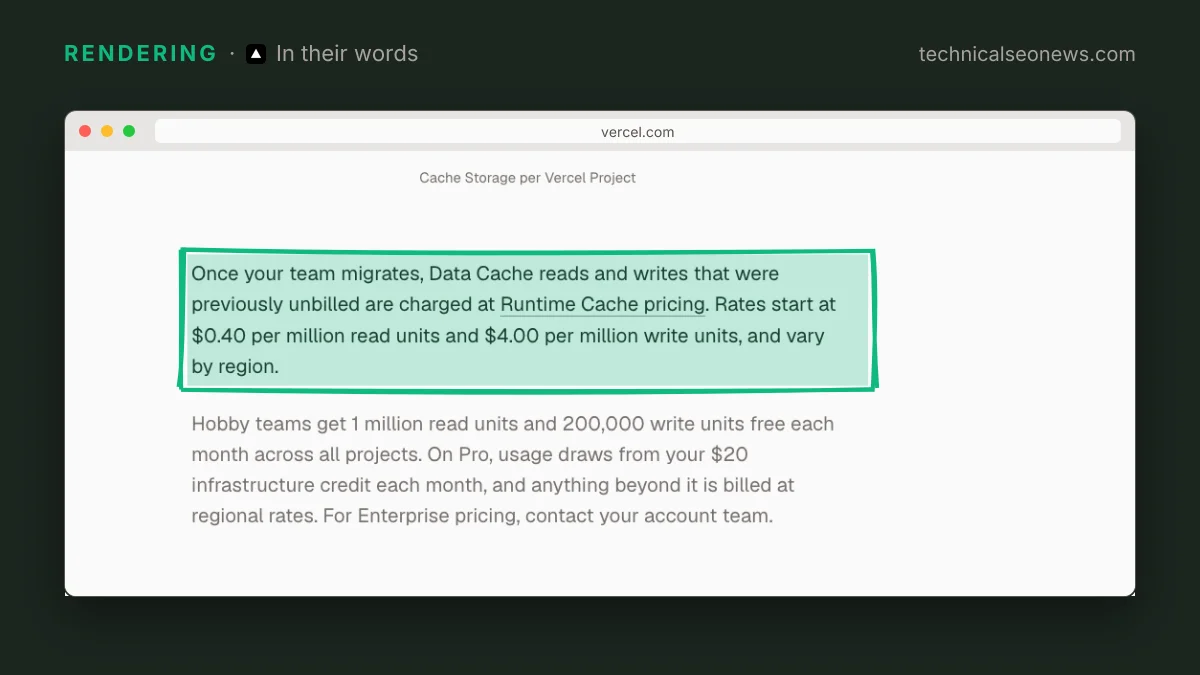
Application code stays exactly as it is. Next.js fetch caching and unstable_cache switch over on every version with no changes, so no deploy marks the day the bill changed. Rates start at $0.40 per million read units and $4.00 per million write units, and vary by region.
The ten-to-one gap between a write and a read is the part worth acting on. A cache that serves many hits from a small set of entries is cheap under this pricing, and one that keeps refilling itself is not. The likelier cost driver is how often entries get rewritten, rather than whether a project caches at all.
Storage went the other way. Pro projects now get their own Runtime Cache allocation per project and environment, with eight times the space of the old team-wide Data Cache pool, and Enterprise projects get ten times their previous storage.
What covers usage depends on the plan:
| Plan | Allowance | Migration |
|---|---|---|
| Hobby | 1 million read units and 200,000 write units free each month, across all projects | November 29, 2026 |
| Pro | the $20 monthly infrastructure credit, then regional rates | a date Vercel will send |
| Enterprise | quoted by the account team | account team will be in touch |
The tempting response is in the same changelog: fetch and unstable_cache caching can be switched off in the team’s CDN settings. It does not stop the migration, so the move to Runtime Cache happens regardless. It also, in Vercel’s own words, “sends more requests to your data sources”, which means those requests land on the page render path, where a slow database answer becomes a slow response to the visitor. The switch lives in a dashboard setting rather than a deploy, like Cloudflare’s opt-in range-request caching, so a toggle flipped in October is hard to connect to slower pages in December.
What to do
- Open Observability and read the Data Cache usage for each project before the migration date. That usage is what the new rates will be applied to, and reviewing it is the one thing the changelog asks for in advance.
- Leave the early opt-in alone until that audit is done. Runtime Cache pricing applies from the moment a team opts in through CDN settings, so going early only brings the bill forward.
- Bring down unnecessary writes rather than cache hits, given the rates. Vercel points at a guide for cutting reads and writes, a prompt that can be pasted into a coding agent, and an “Optimize with Vercel Agent” option in the Runtime Cache dashboard.
- Pro teams should watch the $20 infrastructure credit in the first full month after migrating. Usage draws from the credit before anything is charged, so the real figure only shows up once the credit runs out, and that is the point to compare against what the audit predicted.