Safari fixes aria labels that dropped table and list text
Summary
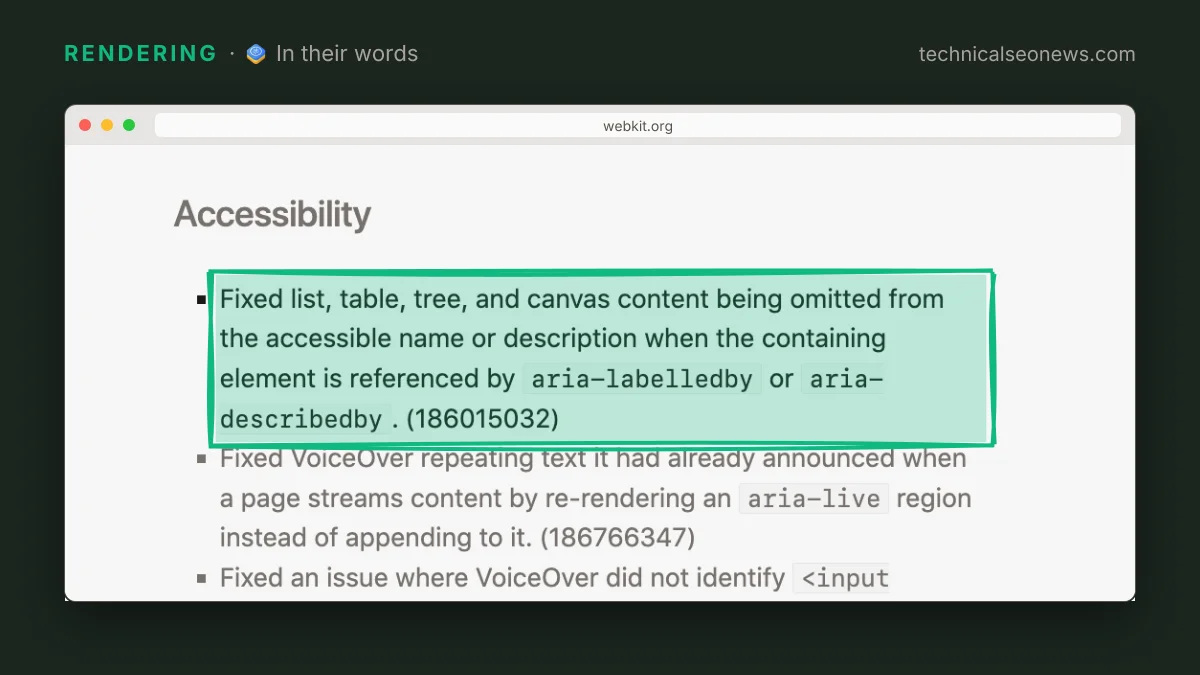
Safari 27.2 fixed a bug that left list, table, tree and canvas text out of an accessible name built with aria-labelledby or aria-describedby, so screen readers and agents reading the accessibility tree got an incomplete label.
Read the computed name of every aria-labelledby or aria-describedby target that wraps a table or list instead of trusting the markup.
Safari 27.2 shipped on October 26 with a fix for accessible names: when aria-labelledby or aria-describedby pointed at an element containing a list, table, tree or canvas, that content was left out of the name or description the browser computed. WebKit’s release notes, written by Jen Simmons, a web evangelist on the WebKit team, list it first among the release’s accessibility fixes. The same release renames the Grid Lanes flow-tolerance property to fit-tolerance.
The accessible name is the string a browser hands to anything reading the page through the accessibility tree rather than the DOM. Take a made-up case: a pricing panel whose aria-describedby points at a <div> holding one sentence of explanation and a table of plan limits. Before 27.2, Safari built the description from the sentence and left out every figure in the table. Nothing errored, nothing logged, and the markup looked correct in the DOM view of Web Inspector.
A VoiceOver user is no longer the only reader of that name. Meta’s shopping agent Muse reads the accessibility tree instead of running the page’s JavaScript, and agents built that way inherit whatever their engine computes. Muse ran on Linux Chrome, so this particular WebKit bug was not hitting it, and the WebKit post does not mention agents at all. The point that carries across engines is that a label assembled by reference is not markup the reader controls, it is output the engine produces, and at least one shipping browser was producing it wrong. Training crawlers and retrieval fetchers parse the HTML and have no known reason to compute an accessible name, so the exposure here belongs to agents that drive a real browser.
The rename is the other item worth acting on. The CSS Working Group decided fit-tolerance describes the property’s job better than flow-tolerance, and Safari 27.2 follows, keeping the old name working as a deprecated alias and marking the declarations that need changing in Web Inspector. Grid Lanes only shipped in Safari 26.4 in March, so most sites have nothing to rename and the ones that do should move while the alias holds. The property decides how close two columns have to be in height before the browser treats them as tied and fills the first one, and its default of 1em is tight enough that consecutive items hop across the page. WebKit’s advice is to raise it significantly, which is itself an accessibility fix: sighted keyboard users watch focus jump column to column when the tolerance is small.
What to do
- Find every
aria-labelledbyandaria-describedbywhose target element wraps a table, list or canvas, and read the computed name back in the accessibility pane of the inspector, in Safari and in Chrome, rather than trusting the markup. - Where a label depends on the engine pulling text out of a container’s descendants, put the words the label needs in the referenced element directly. That removes the dependency instead of waiting for each engine to get the computation right.
- Rename
flow-tolerancetofit-tolerancein any Grid Lanes code, and while the declaration is open, consider a value well above the1emdefault. - Expect the fix to reach users slowly. Safari 27.2 arrives with the iOS, iPadOS, visionOS and macOS 27.2 updates, and older macOS versions take it as a Safari-only update, so some visitors stay on the old name computation for a while.