Sites left 43% of agent questions unanswered in one vendor's logs
Summary
LightSite AI, which runs WebMCP tools on client sites, logged what AI agents asked those sites and found 43% of the calls returned no recorded result or link.
Log your own agent tool calls so that a blocked request and a missing answer do not land in the same count.
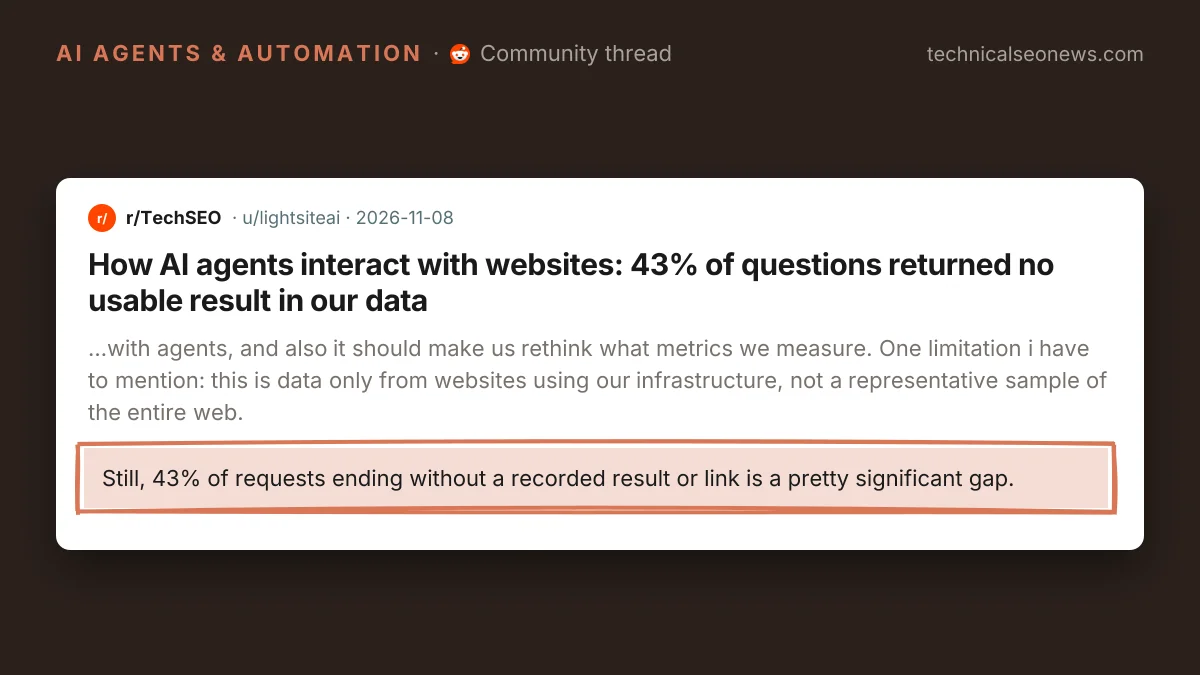
LightSite AI, which runs WebMCP tools on its clients’ websites, says 43% of the questions AI agents asked those sites came back with no recorded result or link. The company posted the figure in a thread on r/TechSEO, drawn from three to four weeks of logged tool calls across its client base. The other 57% returned business information, matching results, or a relevant page link.
WebMCP is a browser API that lets a page offer AI agents a set of tools to call instead of leaving them to read its HTML. LightSite’s logs show what agents use those tools for: “Do you have an office in Spokane?”, “How far in advance can I book?”, and searches for a car part or clothing item that matches a user’s requirements. These are not crawl requests. The agent wants one specific answer for one user, and the site either supplies it or does not.
What the 43% does and does not say
The post flags two limits of its own. The data covers only sites running LightSite’s infrastructure, so it is not a sample of the web, and the post gives no count of sites or requests. A failed request also does not prove the information was missing. In some cases the agent was blocked from reaching the site at all, which the poster shows in a screenshot of a technical block.
That second limit decides whether the number is useful. One commenter on the thread points out that the 43% pools at least three failures with three different fixes. The agent was blocked by bot rules, a WAF challenge or rate limiting. The agent got through but nothing usable came back. Or the information is not on the site. One blended rate cannot say which of those to work on, and a site with aggressive bot protection drags down a metric that is supposed to describe its content. The commenter asked for a breakdown, and the thread had no reply from LightSite at the time of writing.
A second commenter adds the step between reaching the site and answering. A page can hold the detail and still fail when it is buried, split across several pages, or not in a form the agent can match to the user’s constraint. For product sites, the commenter notes, the data being present is not the same as the agent being able to solve the task with it.
The fairest conclusion is that the 43% is real as a count of unhelpful outcomes and unusable as a diagnosis. It says agents are asking sites concrete questions and often leaving empty-handed. It cannot say whether the fix is a firewall rule, a page template, or new content.
What to do
Treat the figure as a prompt to measure your own rate rather than as a benchmark.
- Log agent tool calls alongside the server or CDN response for the same sessions. Count requests that got a 403, a 429 or a challenge page on their own. Keep them apart from requests that got a 200 and still returned nothing, and keep both apart from confirmed content gaps.
- Keep blocked sessions out of any answerability figure. Otherwise bot protection, not content, sets the number.
- Review WAF, rate limiting and bot rules against agents acting for a user, not only against named crawler user agents. Bot protection has blocked AI crawlers that robots.txt allowed before.
- Give each repeat question (service areas, booking lead time, part fitment) one retrievable answer instead of prose spread across pages.
- If the tool log is empty, check registration before reading it as an answerability problem. Tools built on WebMCP’s older API may register nothing after the move to document.modelContext.