AI Overviews opt-out also cut regular organic clicks in one test
Summary
Opting a site out of Google's AI Overviews and AI Mode also cut its regular organic clicks, in a small case study by SEO consultant Cyrus Shepard, who had measured those AI impressions at a 0.9% click-through rate.
Baseline regular organic clicks per URL before any opt-out, because a sitewide average can improve while the pages that earned AI citations slip.
A site that opted out of Google’s AI Overviews and AI Mode lost regular organic clicks along with its AI impressions, in a small case study Search Engine Roundtable reported on October 30. Cyrus Shepard, founder of the SEO consultancy Zyppy, posted the test on LinkedIn and put the click-through rate on the site’s AI impressions at about 0.9%.
That 0.9% is an estimate rather than a reported metric. Shepard calculated it from the site’s overall click-through rate and impressions, subtracting the AI impressions that vanished during the opt-out window. The test also says nothing about what a results page with no AI Overview on it does to clicks. Shepard told Search Engine Roundtable that AI Overviews appeared for those queries before, during and after the test, and only the site’s own presence in them changed.
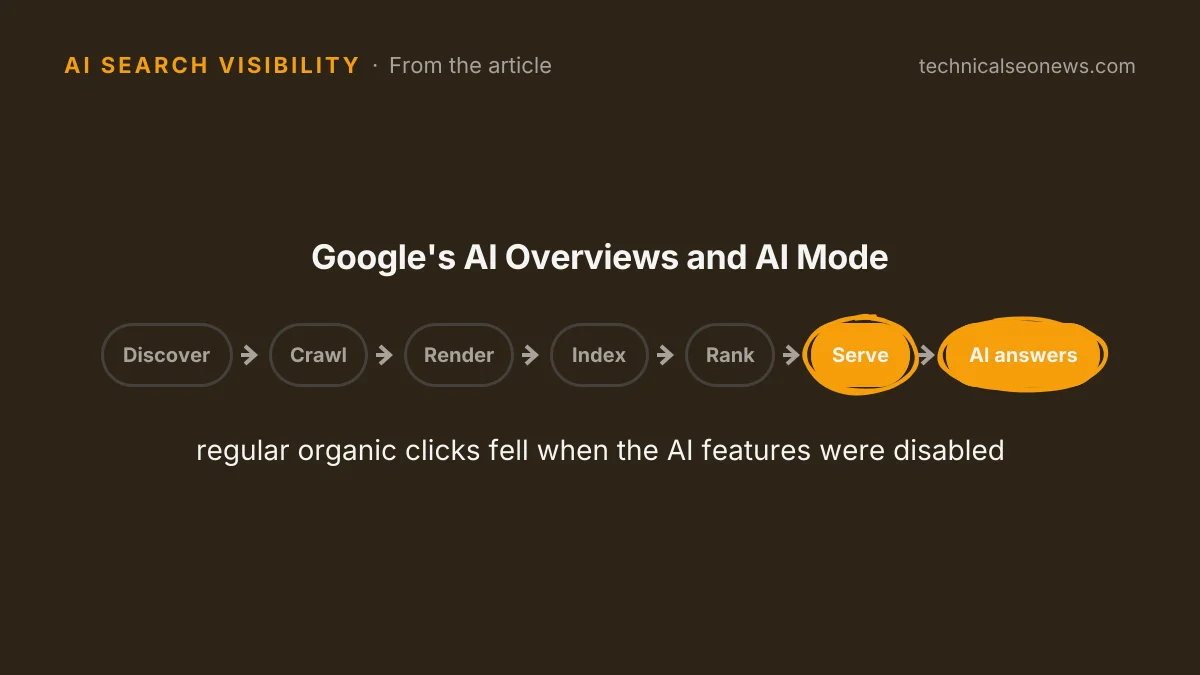
The organic drop is the part worth planning around. Shepard reported that regular organic clicks fell when the AI features were disabled, which he said surprised him. AI impressions had been roughly 8% of the site’s total impressions. Sitewide average position improved over the same window, lifted by a couple of new posts and brand search, so anyone watching the site-level chart alone would have seen nothing wrong. On the individual URLs with the most AI visibility, position dropped and then rose again once AI visibility was switched back on.
Shepard called that a search SERP halo effect: the more places a brand appears on the page, the more likely a user clicks one of them, so an AI citation may lift clicks on a blue link further down. Greg Sterling, co-founder of the research firm Near Media, wrote in the comments that Near Media’s research shows AI Overviews create a kind of brand lift that turns into later searches and clicks, though not consistently. One site over one window cannot settle that mechanism. The recovery on the most-cited URLs once AI visibility returned is the strongest evidence in the test.
What to do
Baseline regular organic clicks before touching the opt-out controls, and baseline them per URL. Shepard’s sitewide figures moved for reasons unrelated to the experiment, and the damage showed up only on pages that had been earning AI citations. Pull those pages into their own segment first, then compare them against pages with no AI visibility across the same dates.
Treat the AI impression count as a switch rather than a measurement. It goes to zero immediately, so it tells you nothing about what the opt-out is doing to the rest of the page. If the point of the exercise is weighing AI visibility against organic traffic, the organic side is where the revenue has been: Google organic drove 27x more conversions than all LLMs combined across 100 GA4 properties.
Run the before and after on your own data rather than reading an AI visibility tracker, since the trackers disagree with each other about how often AI Overviews even appear. And give the test a reversal, as Shepard did. Turning AI visibility back on is what separates a real cost from a seasonal dip.