Affiliate pages cited in AI answers name competitors more often
Summary
Affiliate pages cited in AI answers usually name a competitor, about three in four of them in Semrush's review of its own partners' articles.
Brief affiliate partners to write comparisons and roundups that name specific rivals.
Affiliate pages that get cited in AI answers usually put the brand next to a competitor, and listicles and comparisons are cited most often, according to Semrush’s analysis of its own affiliate program, published November 3. About 22% of the partner articles written about Semrush were cited in at least one AI answer the company tracks.
The competitor numbers are the part to brief partners on. Semrush read the 302 cited web pages in full, and about three in four of them name at least one Semrush rival, with 60% naming two or more. Among the partner pieces that went uncited, 42% mentioned a competitor.
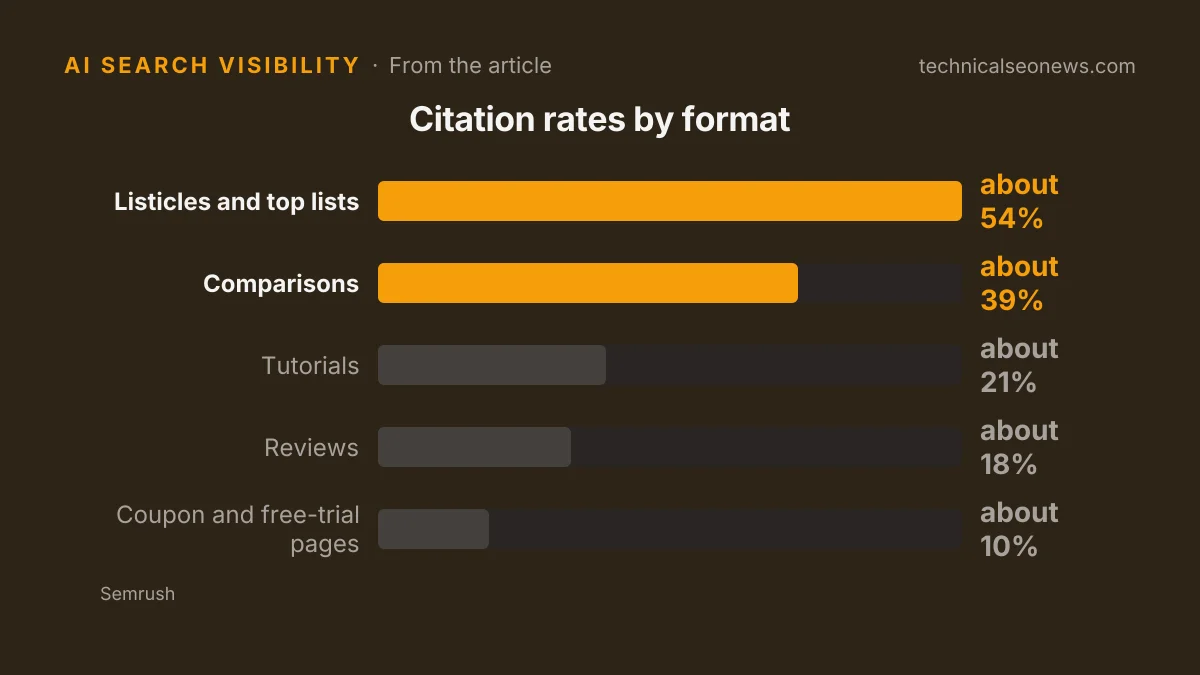
Format sorts the cited pages the same way. Citation rates by format, from Semrush’s program data:
| Format | Share cited in AI answers |
|---|---|
| Listicles and top lists | about 54% |
| Comparisons | about 39% |
| Tutorials | about 21% |
| Reviews | about 18% |
| Coupon and free-trial pages | about 10% |
Semrush’s post presents those as two findings. The likelier reading is that they are one finding seen twice: a roundup or a head-to-head names rivals because that is what the format is, and a coupon page has nothing to name them in. Either way the instruction to a partner is the same, which is to compare the options and to say when someone should pick a competitor. Naming rivals joins a small set of page-level traits that track with AI retrieval, alongside answering the question in the opening lines.
Coupon and free-trial pages came last at about 10%, which follows from what is on them. A discount code says nothing about who the product is for or why to choose it. Coupon and cashback partners still close sales, so keep them in the mix and judge them on conversions rather than mentions.
Roundup publishers are not the whole recruitment list. Ignacio Miñana Roser, who leads Semrush’s affiliate marketing team, said in the same post that four of the program’s 25 top-performing pieces are tutorials.
Google’s AI surfaces cited far more of the partner pieces than ChatGPT did. About 8% were cited in AI Overviews and 7% in AI Mode. ChatGPT cited 1%, so these pages are mostly feeding Google’s answers. Semrush does not say whether that gap reflects where buyers ask or what its own tracker covers.
Disclosures and link attributes did not cost pages their citations. Among the cited pages, 74% carry affiliate links and about 40% tag those links sponsored or nofollow, and Semrush found no drop in citation for either. There is no case for asking a partner to strip a disclosure to chase a mention, so the FTC’s disclosure rules and Google’s guidance on qualifying outbound links stay in the brief.
Semrush measured citations of content about Semrush, which caps what the numbers prove. The pieces came from partners who joined its program, the answers came from its own AI visibility monitoring, and the window was September 14 to October 7, 2026. So 22% is not a market citation rate for affiliate content. The ordering between formats is the part likely to hold on another brand’s program.
What to do
- Brief editorial, review, and video partners to publish comparisons and “best [category]” roundups that name specific alternatives and say when a reader should choose one of them.
- Recruit partners who write how-to content, not only the ones who run roundups.
- Leave disclosures and
rel="sponsored"in place on partner links. - Keep coupon and cashback partners for the sales they close, and stop counting them toward AI visibility.
- Pull the pages your own AI visibility tracker shows cited for your brand and read them. The rates here are one brand’s, and only the format ordering is likely to carry over.