Google organic drove 27x more conversions than all LLMs combined
Summary
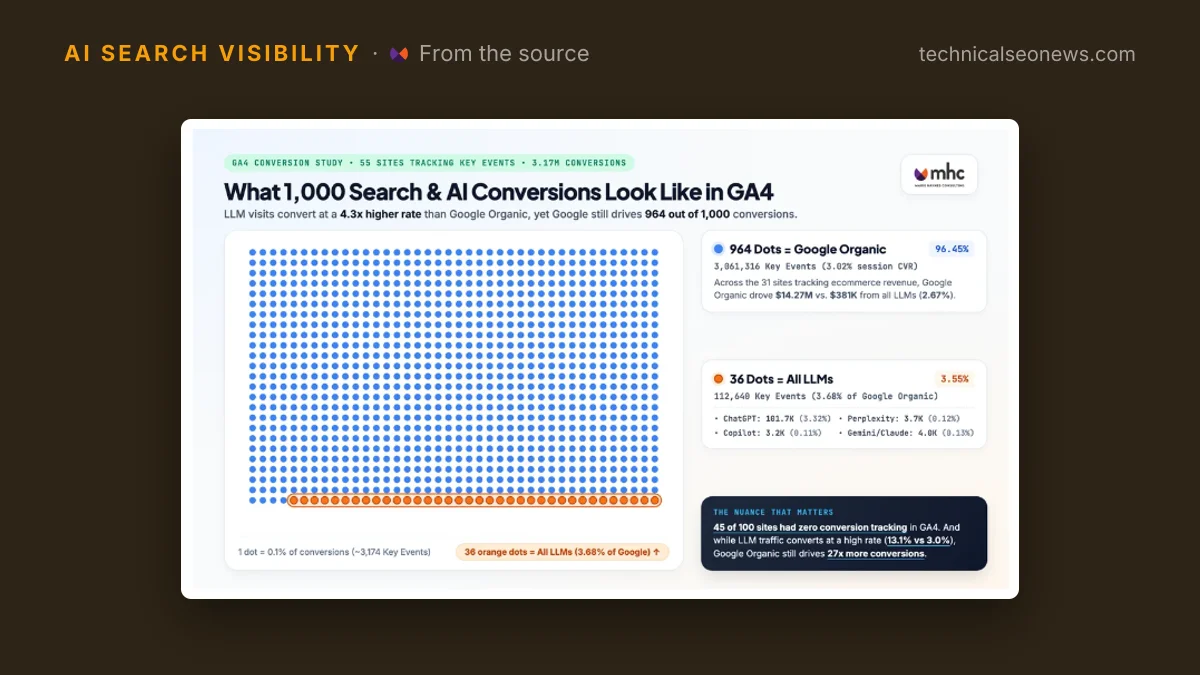
Google organic drove 27 times more conversions than every LLM tool combined in 12 months of GA4 data across 100 websites, measured by SEO consultant Marie Haynes.
Measure your own site's LLM share of Google organic sessions and its conversion rate by channel before funding work aimed at LLM visibility.
ChatGPT and every other LLM tool together sent under 1 percent of the visits that Google organic did across 100 websites, according to a year of Google Analytics 4 data published by Marie Haynes, an SEO consultant who tracks Google algorithm updates and AI search.
The dataset covers 12 months and 145 million sessions. ChatGPT alone came to 0.62 percent of Google organic volume, and adding every other LLM tool lifts the share to 0.73 percent.
The conversion rates run the other way. Only 55 of the 100 sites tracked conversions in GA4. Within that subset, ChatGPT visitors converted at 13.8 percent against 3.02 percent for Google organic. Google organic still produced 27 times more conversions than every LLM tool combined, and 96.5 percent of all conversions across every channel Haynes measured.
A visit from ChatGPT was worth more than a visit from Google organic, and there were too few of them to move a revenue number. The likelier conclusion is that LLM referrals belong on a dashboard rather than in a budget. Haynes makes the same point about GEO, generative engine optimization, the practice of chasing mentions in ChatGPT and similar tools: the money raised by companies that track those mentions is running ahead of the traffic they report on.
A figure like 0.73 percent is worth reproducing on your own site rather than adopting. Haynes describes the 100 properties as a random sample of varying sizes, and the post does not break the share down by vertical or country. One property’s LLM share can sit well above or below that average.
GA4 also does not see every LLM click, so 0.73 percent is a floor. During ChatGPT’s utm outage in early October, its links arrived with no campaign tag and no referrer, so those sessions were filed as direct traffic. Haynes’s post does not account for gaps like that.
The growth has stopped too. ChatGPT sessions across these properties grew exponentially until August 2025, around the GPT-5 release, and have fallen since. The early forecasts that LLMs would overtake Google on referral volume extrapolated that first curve, which Haynes says she did herself.
Her conclusion is that the AI search sending people to businesses today is Google’s own: AI Overviews, AI Mode, and a ranking system driven largely by deep learning, none of which appear in analytics as an LLM referrer. The opportunity she points at next is agentic commerce, including Google’s new shopping cart, Universal Cart, the Universal Commerce Protocol behind it, and WebMCP, which lets a site expose booking forms and calculators to AI agents.
What to do
- Run the two measurements Haynes ran against your own property over 12 months: sessions from LLM referrers as a share of Google organic sessions, and conversion rate by channel.
- Set up key events before judging any channel. 45 of the 100 sites in the dataset tracked none, which leaves the conversion question unanswerable for them.
- Read your LLM session count as a minimum, and watch direct traffic next to it rather than in isolation.
- Hold new spend on mention-tracking tools until your own two numbers justify it. A high conversion rate on under 1 percent of your Google organic volume does not.