Google tests moving AI Overview source links below the answer
Summary
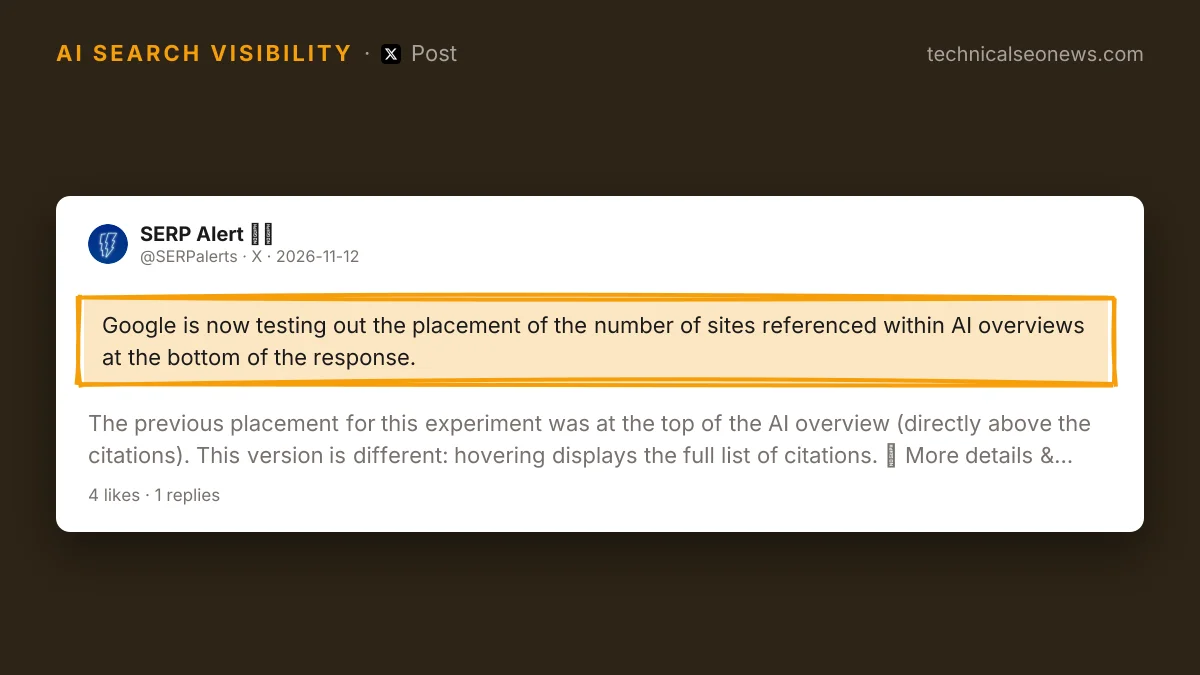
Google is testing an AI Overview layout that puts the count of cited sites at the bottom of the generated answer instead of the top, with the citation links showing only when a user hovers.
Track clicks at the page level for the URLs Google cites, since Search Console still has no AI Overview filter.
Google is testing an AI Overview layout that moves the number of cited sites from the top of the generated answer to the very bottom. Brodie Clark, an SEO consultant who tracks changes to search results, logged the desktop test on 12 November with a video.
The element is the indicator counting how many sites the answer drew on. An earlier version of the same experiment put that count at the top of the AI Overview, directly above the citations. In the version Clark recorded in his running notes on SERP changes, the count sits below the response, and “hovering displays the full list of citations”.
Barry Schwartz, who runs Search Engine Roundtable, wrote up the test and said that in this format the sources show at the bottom and not at the top. His question was the obvious one: “Why would Google move these source links to the bottom when it will result in even fewer clicks?”
Neither page carries a comment from Google, so the intent is a guess. The likelier outcome is that this placement sends fewer visitors to cited pages than the top one did. A hover target is not a link until someone hovers over it, and a reader who already has the answer has little reason to work down past it. This is still an experiment rather than a change, and Google runs plenty of layouts that never ship.
Proving the effect on a single site is the harder part. Search Console has no AI Overview filter: Google counts AI Overview clicks inside your total Search clicks. A drop caused by this test would land in the same number as every other Search click. The timing makes attribution worse, because the November core update is still rolling out and AI impressions in Search Console were already undercounted as that update began.
What to do
- Identify the pages Google cites in AI Overviews for your highest-value queries, and track clicks and CTR for those URLs in Search Console weekly rather than daily. Page-level data is the closest proxy available while there is no AI Overview filter.
- Record which queries cite you and which layout they show, through a SERP monitoring tool or manual checks, so a later click drop can be matched to a layout change instead of a ranking change.
- Change nothing on the page. Nothing in this test alters eligibility or which sources get picked, only where the citation sits.
- Hold the core update and the layout test as competing explanations for any click drop in the next few weeks, rather than settling on one.