French sites lost CTR in proportion to their AI Overview exposure
Summary
France gave the cleanest before-and-after test of AI Overviews yet, and the CTR loss tracked exposure closely. The share of a site's queries that trigger an AI Overview is a usable first estimate of the click-through rate it stands to lose.
Measure that share for your own site and sort the exposed queries by whether a short answer satisfies them. Expect the loss to grow over the coming months rather than fade.
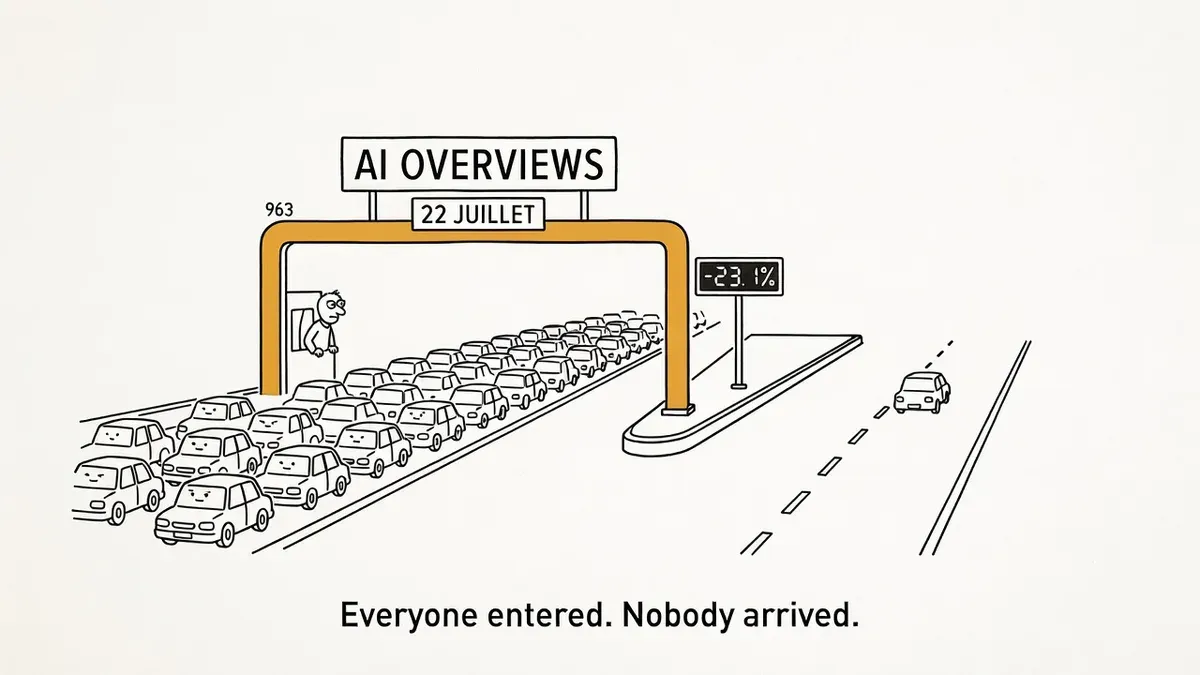
Google launched AI Overviews in France on July 22, 2026, and Ahrefs’ study of the French rollout had Search Console data for 963 French domains on both sides of that date. Ahrefs compared each domain’s daily averages for the 28 days before the launch with the 9 days after. Click-through rate fell by roughly 1% for every percentage point of a domain’s queries that showed an AI Overview, a slope of −0.9 across the whole panel.
The single launch date is what makes the study useful. In most markets AI Overviews arrived gradually, mixed in with core updates and seasonal swings, so their cost could never be separated cleanly from everything else. In France, Ahrefs could compare highly exposed domains, where more than 20% of queries trigger an AI Overview, with a control group where fewer than 2% do.
| Group | CTR change after launch |
|---|---|
| Highly exposed (over 20% of queries) | −23.1% |
| All 963 domains | −3.4% |
| Control (under 2% of queries) | +2.3% |
The loss was widespread inside the exposed group, with 82.2% of those domains losing CTR. Ahrefs reports the −23.1% as a raw change with no control adjustment. Since the control group gained CTR over the same late-July period, the real gap between exposed and unexposed sites is wider than the headline figure.
Rankings held while clicks fell
Almost no domain lost rankings in late July. Pages kept appearing as often as before, sometimes more often, and simply got clicked less. In Search Console the damage shows up as flat or rising impressions next to falling clicks. The most extreme domain in the panel gained 183% in impressions while its clicks fell 1.9%, which cut its CTR by roughly two thirds. A team that reads that pattern as a title or ranking problem will spend its time fixing the wrong thing.
Health, the most exposed sector, lost about what the slope predicts. Health domains had the highest AI Overview rate in the study, 22.2%, and their CTR fell 20.4%. Ahrefs ties the result to intent: a health question usually has a short answer and no purchase behind it, so the AI Overview can answer it completely. Ahrefs’ earlier study of what triggers AI Overviews found that 44.1% of medical queries show one. Ahrefs concludes that intent matters more than vertical. A query one paragraph can answer is exposed, while a query that needs a tool, an account, a price, a purchase or a human opinion holds up far better.
The first nine days are probably the mild part
Ahrefs’ global research points the same way, and it found the click loss growing over time. In spring 2025, an AI Overview cut the top-ranking page’s CTR by 34.5%. By December 2025 that cut had reached 58%, as the feature triggered on more queries and users got used to not clicking. Exposure in France has room to climb too. The median AI Overview rate in the panel is 5.4%, and 29% of domains are already above 10%. The safer read is that the French figures are a floor.
Ahrefs adds its own caveat: the slope is a risk factor, not a forecast for any one site. Some heavily exposed domains are doing fine, and some barely exposed ones are falling for reasons unrelated to AI.
What to do
- Find your AI Overview rate, meaning the share of your queries that trigger one. Ahrefs points to the Organic keywords report in Site Explorer with the AI Overview option selected in the SERP features filter. Its own worked example: if 15% of your queries trigger an AI Overview, plan for losing around 15% of your CTR.
- Sort the exposed queries by intent. Queries a single paragraph can answer are the ones to expect to lose. Queries that end in a tool, a price, a sign-up or an opinion are the ones worth defending.
- Separate CTR loss from ranking loss in reporting. Before changing a page, check whether its impressions held while its clicks fell.
- Re-measure over a longer window. Nine days of data sets the direction, not the final size of the loss.