OpenAI is building impression and click charts into ChatGPT
Summary
OpenAI is building a Search Console equivalent inside ChatGPT that will chart a verified business's daily appearances in responses and clicks to its site, but it reports no prompts, users or competitors.
Work out now how the business would prove ownership to OpenAI, since the only path named so far is connecting a store account such as Shopify.
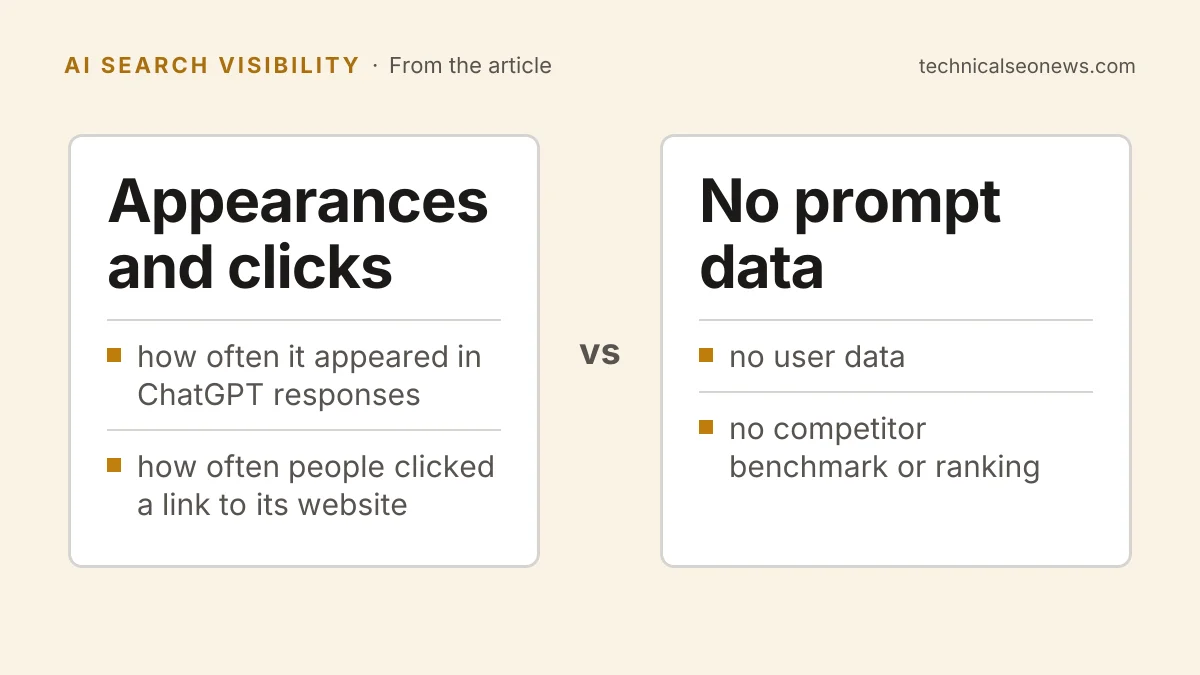
OpenAI is building a Search Console equivalent inside ChatGPT, according to Search Engine Roundtable’s November 6 report. A business that claims and verifies ownership gets a daily chart of how often it appeared in ChatGPT responses and how often people clicked a link to its website. Juozas Kaziukėnas, founder of the e-commerce research firm Marketplace Pulse, spotted the feature and posted a screenshot of it on LinkedIn. He said he first saw pieces of it in August and that a banner he has now seen suggests launch is close.
What the tool leaves out decides how much of the measurement problem it solves. Per Search Engine Roundtable’s write-up, Kaziukėnas says it carries no prompt data, no user data, and no competitor benchmark or ranking. A fall in mentions will arrive with no reason attached to it, and so will a rise.
The count is still worth having. Most AI-visibility numbers in circulation today come from vendors sampling prompts and extrapolating, so a first-party tally of appearances and clicks settles arguments that inference cannot. It also resets the baseline, because once OpenAI publishes a number, that is the number clients and executives will ask about.
The chart and the trackers answer different questions, which is why the better plan is to keep paying for both. Kaziukėnas makes a version of the same point, that paired with external tools that track prompts the hub will show accurate first-party data on whether AI visibility work is paying off. OpenAI’s chart will say the number moved; a prompt set will say which of the questions people actually type moved it.
Verification is the gate, and the only route named so far is connecting a commerce account, with a Shopify store as the example. Search Engine Roundtable’s piece describes no path for a business that sells nothing online, so a lead-gen site or a publisher should not assume one exists at launch. The useful work this week is finding out who inside the business holds platform admin access and who controls the company’s OpenAI account, since those are the people who will be asked to prove ownership.
Claiming the business also opens a publishing surface, not just a report. The same profile is where a business adds products and keeps its details current, and where its business agent answers customer questions with context the business controls, which carries the usual risk of stale prices and dead products. Search Engine Roundtable notes the hub seems to be separate from ChatGPT ads and built for organic responses.
What to do
- Settle the ownership proof before the feature ships. Name the person with admin on the commerce platform and the person who owns the company OpenAI account, and get them in the same thread.
- Record a baseline from current third-party tools this month. The hub starts with no history, so the only way to know whether a launch-week number is good is to have something to compare it against.
- Read the chart weekly rather than day over day. One tracking study found half of AI citations drop by day two and about 75% come back, so a one-day dip in a daily chart is mostly noise.
- Check that retrieval is not blocked. Search Engine Roundtable’s report does not discuss crawler access, but ChatGPT can only mention a site it can fetch. OAI-SearchBot pulls pages for ChatGPT’s search answers and ChatGPT-User fetches a page when someone asks about it. A block on either in robots.txt or at the WAF caps the impression count before it is counted. GPTBot, the training crawler, plays no part in that path.
- Keep the prompt-level tool in next year’s budget. The hub measures whether visibility changed, not which questions or which competitors caused the change, and nothing announced so far closes that gap.