Google now shows AI Overviews for most big brand names
Summary
Branded searches were the last query class most teams treated as safe from AI Overviews. They are not, though the panel usually sits below the brand's own result rather than above it.
Position decides how much the click loss hurts. The more useful check is what the AI Overview says about the brand and which pages it cites, since neither is under the brand's control.
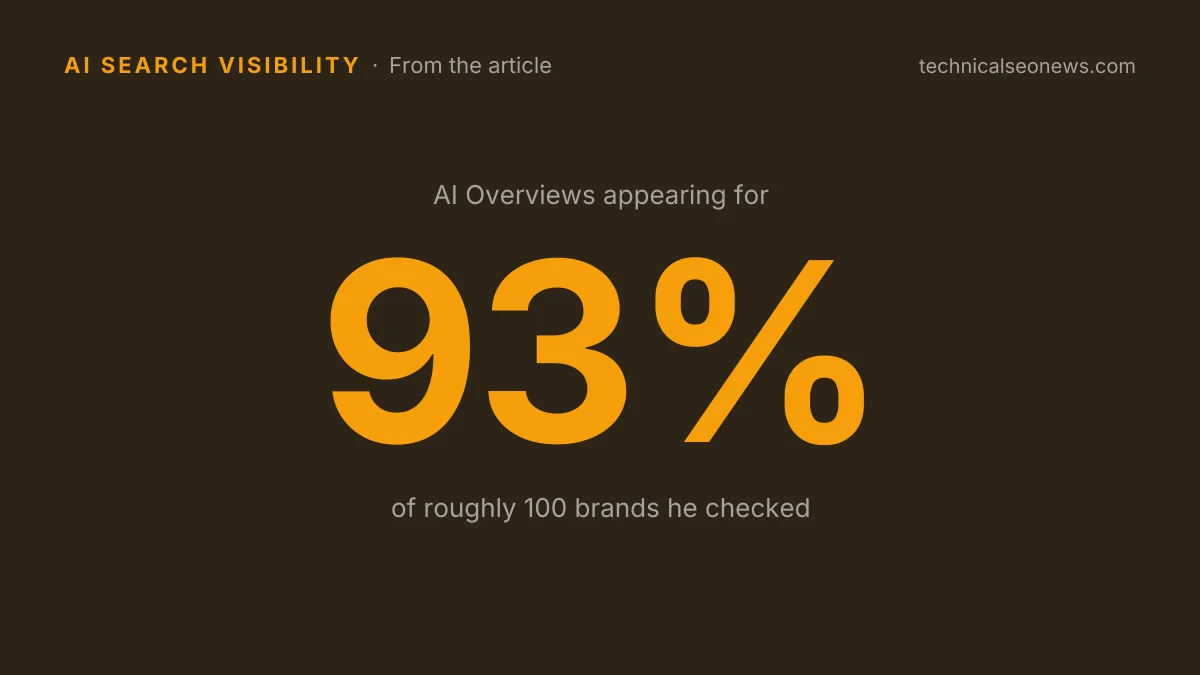
Google is now putting AI Overviews on plain brand-name searches. Search Engine Roundtable reported on September 30 that SEO Chris Long, who ran the test and posted the results on X, found AI Overviews appearing for 93% of roughly 100 brands he checked, naming Reddit, Salesforce, Amazon and Adobe among them. Two groups sat outside the pattern: Google’s own name, and news publications.
Where the panel landed matters more than the fact that it appeared. Barry Schwartz, who writes Search Engine Roundtable, ran his own spot checks and had to scroll down in most cases, which puts the AI Overview below the company’s own result rather than above it. Adobe was the exception he found at the top of the page. Schwartz said a mid-page overview on a navigational query bothers him far less than one sitting above the main company’s snippet, and that ordering is right. French sites lost clicks in proportion to their AI Overview exposure, so a panel most searchers never scroll to is a much cheaper problem than one that owns the top of the page.
DemandSphere, an enterprise SEO data platform, posted its own tracking data the same day and said AI Overviews on branded queries tripled in September. Long had reported something similar in July 2026, per the Search Engine Roundtable post, but AI Overviews now cover far more queries than they did then. Two independent measurements point the same way, so this is likelier a real trend than one unlucky sample.
A branded query is the one search where the brand used to supply the whole answer. Someone typing a company name got the company’s homepage, its sitelinks, and perhaps a knowledge panel. Now they may also get a generated paragraph describing the company, assembled from pages the company did not choose and may never have read. Whether that paragraph is accurate, current, and cites the brand’s own site is part of the brand SERP now, and none of it is directly editable.
Smaller brands are not automatically exempt. Schwartz noted that his company, RustyBrick, gets no AI Overview for its name while Search Engine Roundtable does, and Schwartz’s guess is that the publication triggers one because it has a search profile. That is a hypothesis rather than a confirmed trigger. If it holds, the dividing line is entity coverage rather than brand size. A mid-sized brand with solid entity data could get an AI Overview on its own name while a larger one with thin entity data does not.
What to do
Add the brand name itself to whatever AI Overview monitoring is already running. Most setups track commercial and informational keywords and skip navigational ones, on the assumption that a branded search is settled ground.
Record position, not just presence. An “AI Overview present” flag is close to useless on a branded query, because the difference between an overview above the company’s listing and one four scrolls down is most of the commercial impact.
Read the overview for the brand name and write down which URLs it cites. If it cites a competitor’s comparison page, a stale directory listing, or a three-year-old review instead of the brand’s own pages, that gap is the part worth working on, and it is fixable in a way the existence of the panel is not.
Watch out for
A single check does not establish a pattern. AI surfaces vary enough between runs that small differences are noise, so a brand name with no overview today may have one tomorrow, and the reverse. Repeat the check over several days before calling anything a change.
The news-publisher exemption and the Google exemption are current behaviour, not stated policy. Neither Long’s test nor Schwartz’s spot checks establish why those categories are excluded, and nothing in the Search Engine Roundtable post suggests they will stay excluded.