Rank trackers and Search Console both lag the core update
Summary
A week into Google's November core update, its effects are still hard to measure because rank trackers are struggling to read the changes and Search Console is running days behind.
Fix your comparison window to dates and wait for Google to confirm the rollout is complete before reading the numbers.
Six days into Google’s November 2026 core update, Barry Schwartz’s roundup at Search Engine Roundtable describes industry chatter that has been “more muted than most” and blames the third-party rank trackers, which he says are struggling to monitor the ranking changes. Search Console’s performance reporting has also been laggy, Schwartz wrote on Monday. The update started on 10 November, and Google said the rollout may take up to two weeks to complete.
A quiet week does not mean a mild update when the measuring tools are what went quiet. The volatility trackers in aggregate showed more movement on Saturday 14 November than on any other day since the rollout began, and the complaints picked up over the same weekend. Schwartz reads that as the update kicking in three or four days after it was announced. Glenn Gabe, an SEO consultant who publishes analyses of Google updates, wrote in a post quoted in the roundup that the picture is clearer after the weekend “based on how the visibility tools are filtering and checking the data”. The likelier explanation is that the tools are trailing the update rather than measuring it as it happens.
The site-level reports do not agree with each other either. One owner quoted by Schwartz is “afraid I am seeing more than 20% down from last week due to this update”. Another had reported a 5% drop three weeks earlier. That site recovered and then gained 10% over the weekend. A repeated report in the WebmasterWorld thread Schwartz drew from is traffic rising while conversions do not: “Rankings are good, but no conversions again,” one poster wrote.
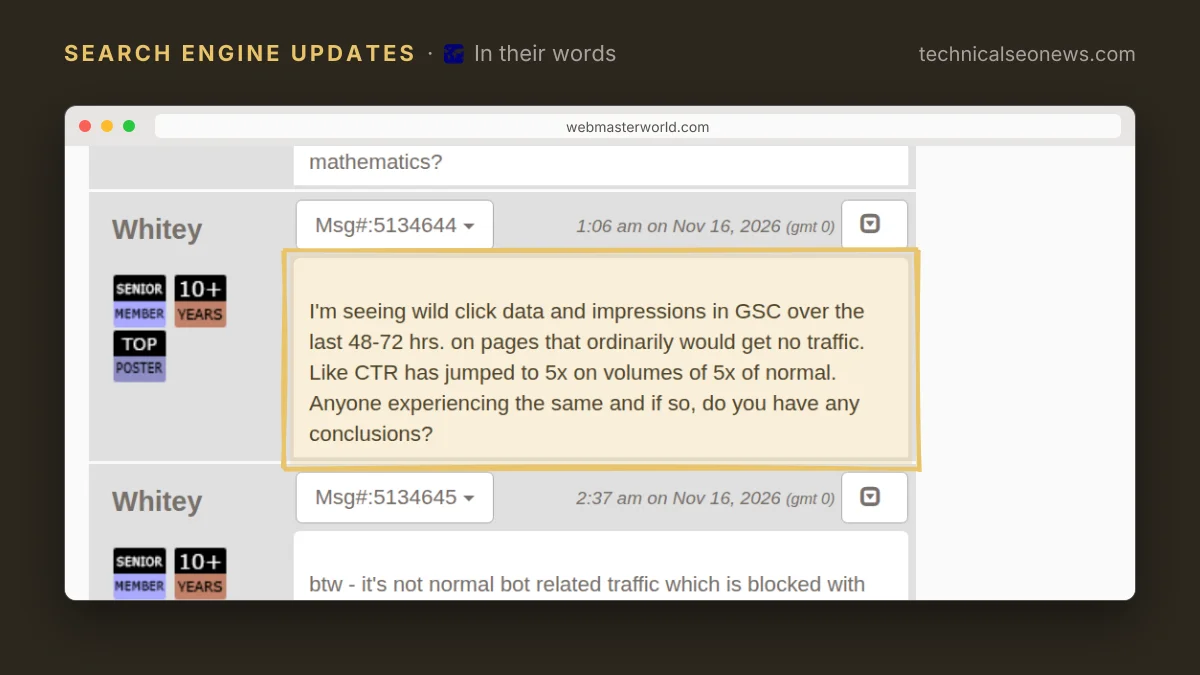
Search Console is the weakest tool to reach for this week. A poster in that thread said its data was running four days behind. Another described “wild click data and impressions in GSC over the last 48-72 hrs” on pages that would ordinarily get no traffic, with click-through rate at five times normal. The likelier explanation for that one is not the core update: a click spike on pages that should not earn clicks turned out to be bot traffic at the end of October, and the poster’s own follow-up describes the clicks arriving from scattered countries that are getting past Cloudflare’s challenges.
Some of the charts being offered as evidence do not cover the update at all. When Schwartz asked on X for screenshots with dates visible, the replies “included charts and data from well before the core update started”.
What to do
Google has not called the rollout complete, so there is no diagnosis to make yet. Until it does:
- Fix the comparison window to dates rather than to “last week”. End the before period on 9 November. Do not close the after period until Google confirms the rollout is finished, which on its own two-week estimate is 24 November at the outside.
- Expect that after period to land on Black Friday week, so compare it with the same week a year ago rather than with early November.
- Read Search Console’s most recent days as incomplete, and split Discover out before attributing anything to the core update. Posters in the thread describe Discover flat since 1 November, which is before the update started.
- Treat tracker volatility scores as timing, not magnitude. A low reading this week is as likely to mean the tool cannot see the changes as it is to mean there were few.
- Pull conversions by landing page before calling a traffic rise a recovery.