Google's spam update may take two weeks instead of three days
Summary
Google has not said what the September spam update targets, and it will not confirm the rollout is finished for days yet. Ranking volatility began before the announcement went out.
Date-stamp Search Console and rank-tracker baselines now, and hold any diagnosis until Google closes the rollout on its status dashboard. Whether competitors moved at the same time is the first thing to check.
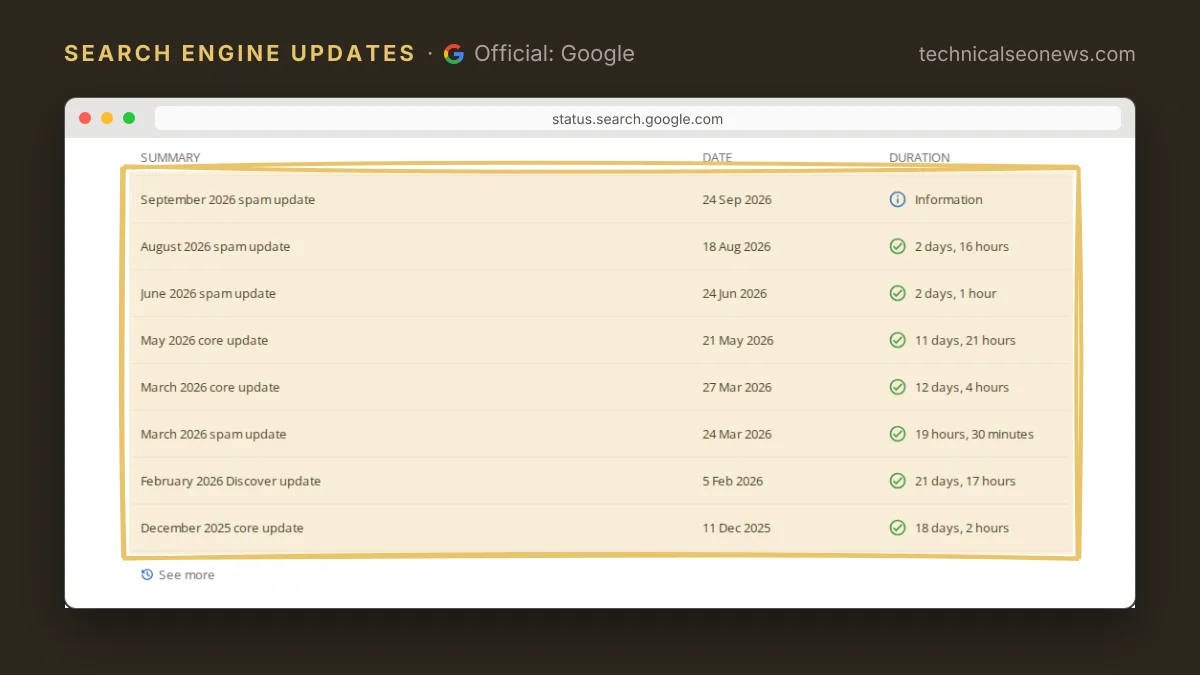
Google released the September 2026 spam update on September 24, worldwide and in all languages. Google says the rollout may take up to two weeks. Semrush’s writeup of the update points out that the previous three spam updates each finished in under three days, and that Barry Schwartz, who writes Search Engine Roundtable’s daily search coverage, asked Google whether the two-week estimate was a typo. Google’s John Mueller answered on Bluesky that this rollout is “likely to take longer than some of the previous ones.”
Google has not said what the update targets. It is the first spam update since Google revised its site reputation abuse policy on August 28, and Google has not connected the two, so there is no published list of behaviors to audit a ranking drop against. Any diagnosis this week therefore rests entirely on before-and-after numbers.
Those numbers are weaker than usual. Search Engine Roundtable logged ranking volatility from around September 23, a day before the announcement, so the days immediately preceding the rollout were already moving. Rank trackers have a second problem, which is that they have been reporting degraded and missing Google data since September 13. A site that pulls a trailing two-week chart today is comparing one unstable period against another.
The better use of this week is measurement, not remediation. Export Search Console performance data for a window ending before September 23 and save it with the date in the filename, so a clean comparison file exists before more movement piles on top of it. Semrush’s post recommends checking whether competitors moved over the same dates and whether visibility changed anywhere outside Google, including citations in ChatGPT, Google AI Mode, Gemini and Perplexity. Neither check depends on Semrush’s own tools. Rankings that fell while AI assistant citations held steady point at a Google-specific cause; a whole competitive set moving together makes any one site’s pages unlikely to be the cause.
There is also no reason to rush a fix. Google’s spam policies are the recommended reading for sites that do see changes, and Google says that when a site changes to comply, its automated systems may take months to learn that. A remediation shipped now against a contaminated baseline could strip out something that was never the problem, and months would pass before the ranking data said anything either way.
What to do
- Export a dated Search Console baseline today for a period ending before September 23, and keep the file. It is the only clean “before” this rollout will have.
- Treat everything until Google marks the update complete on the Search Status Dashboard as a watch period rather than a diagnosis window.
- Pull competitor visibility over the same dates before concluding a drop is yours.
- Compare the Google trend against non-Google visibility, including AI assistant citations, before naming a cause.
- Read Google’s spam policies against your own site and act only on something you can name. Do not ship changes on a guess about what this update hits.