Google Discover drops stale pages before ranking scores them
Summary
Google Discover has run a filter for two years that drops stale pages before ranking ever scores them, so past engagement cannot save a page the filter flags.
Update aging pages in place with new substance, or retire them, because a changed date on its own clears neither check.
Google has been pruning stale items out of Discover for two years with a filter that runs before ranking, according to a Google research paper on Supersession-Decay Filtering (SDF) covered by Search Engine Journal. Two checks decide eligibility: one for content that newer information has superseded, one for content whose usefulness has decayed with nothing replacing it. Failing either makes a page ineligible for Discover ranking.
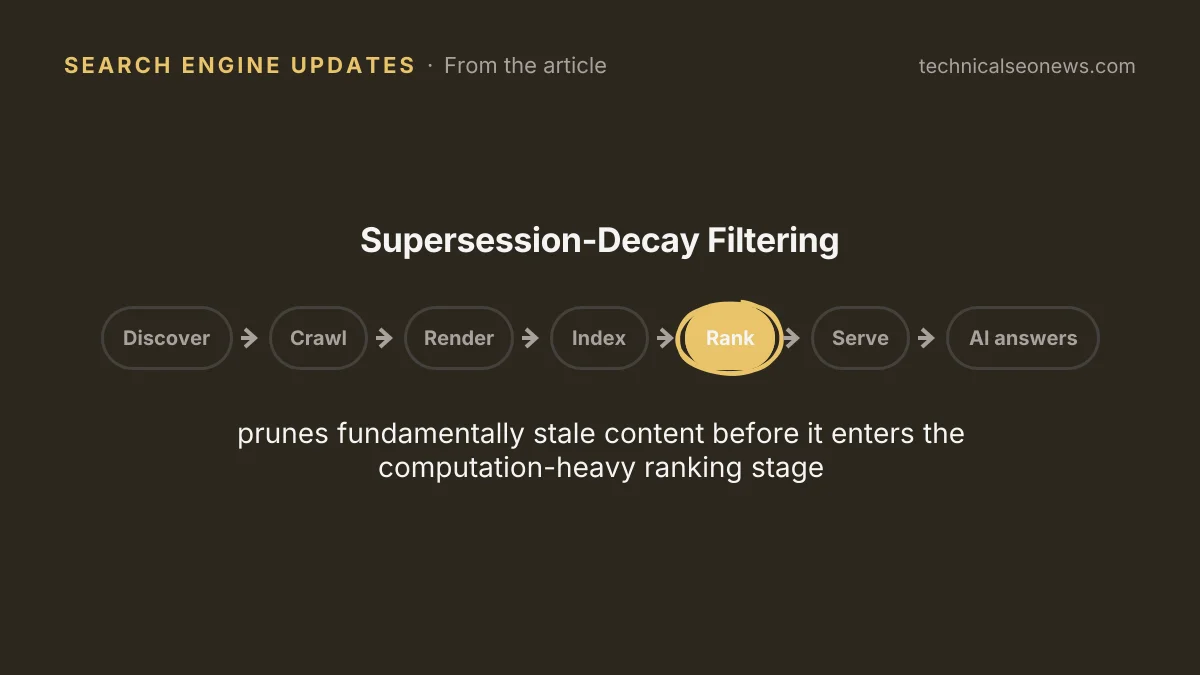
The order of operations is the part that changes planning. SEJ quotes the paper describing SDF as a layer that “prunes fundamentally stale content before it enters the computation-heavy ranking stage,” handing a smaller candidate set to ranking systems that stay engagement-based and trend-aware. Engagement cannot rescue an item that never reaches the stage where engagement is counted.
The paper’s case against publication date is that a date records when something was published and nothing about whether it has been superseded or is still useful. Date cutoffs also suppress evergreen pages that still deserve to be shown. Its case against engagement signals is that they arrive late: by the time the numbers drop, users have already decided the content is old.
A refresh that moves the date without changing the substance therefore addresses neither filter. Take a made-up case: a site publishes an explainer on a Google feature in 2024, then publishes a fuller rewrite covering the same ground at a new URL in 2026. The supersession filter is what decides between those two, because it evaluates whether the earlier page’s information still holds up next to the newer one, and the older URL’s engagement history never gets a vote.
Over two years of deployment, the paper reports a 54.9% drop in user complaints about stale content, plus modest engagement gains and more diversity in what the feed shows. That figure measures what Discover stopped surfacing, not what any one publisher gained.
What to do
SEJ’s write-up argues publishers now need an answer for what share of their content is evergreen, what share has a limited window, and what share is news. The share matters less than knowing which bucket each page sits in, and then:
- Give the limited-window pages a review date and a named owner. These are the pages SDF is built to catch, and nothing in the system rewards a page for having been touched, so the review has to produce new substance or a decision to retire the page.
- Update in place when the newer piece covers the same ground. A second URL on the same topic gives the supersession filter two candidates, and the older one is the likely loser.
- Check what the automated internal links point at. Many interlinking plugins pick targets on semantic similarity alone, so they keep sending links to the page that was the best match two years ago. SEJ’s piece makes the same point: freshness is now a second dimension in that calculation.
Watch out for
Search Console’s Discover report shows impressions and clicks, not eligibility decisions, so there is no way to see a filter verdict directly. The signal available is a page that goes quiet in Discover while its Search performance holds steady, and the first thing to check is whether something newer on the same topic has arrived, on the site or anywhere else.