Consultants report a jump in Google manual action penalties
Summary
Google appears to be issuing more manual action penalties than it was a few months ago, mostly against long-standing businesses, and one consultant's caseload went from essentially no requests to several per week.
Open Search Console's Manual Actions report before starting any cleanup, because an empty report means no penalty was issued and there is nothing to file.
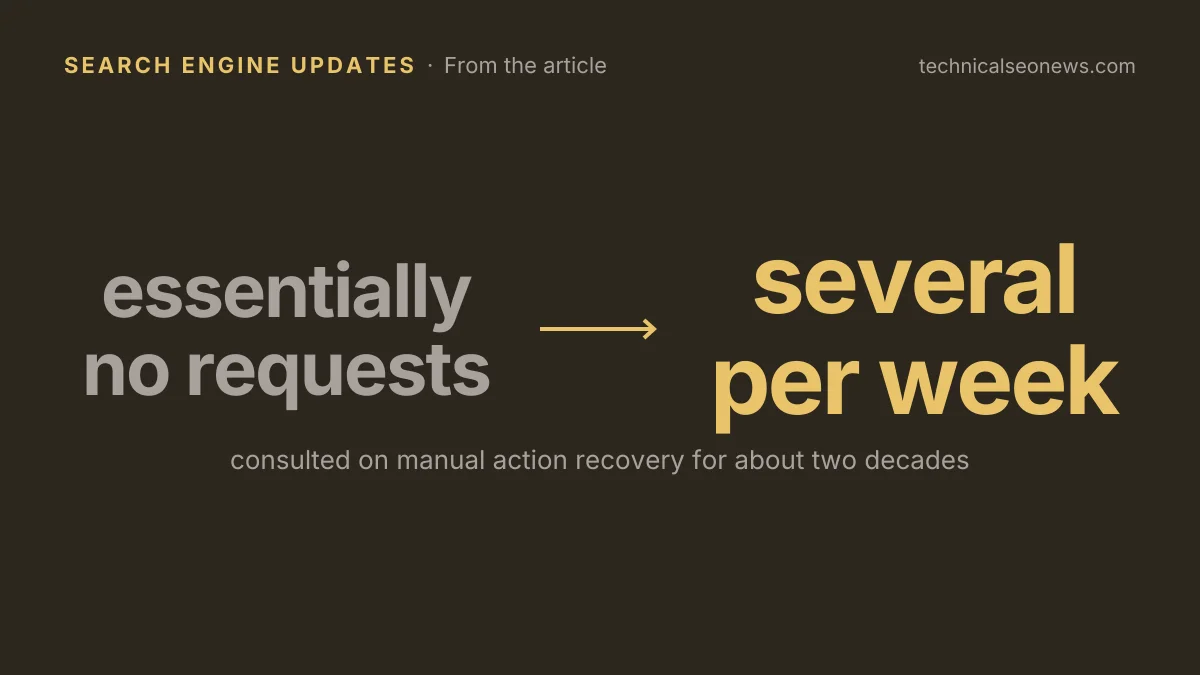
Google may be issuing more manual action penalties than it was a few months ago, according to Search Engine Roundtable’s October 8 report, which gathered consultant accounts alongside recent Google Webmaster Help Forum threads. Marie Haynes, who has consulted on manual action recovery for about two decades, told Search Engine Roundtable her caseload “went from essentially no requests to several per week.”
The actions she is seeing are thin content, pure spam and scaled content, and most of the affected sites, she said, are “legitimate long standing businesses.”
A long-standing business that loses traffic will usually reach for the nearest algorithmic explanation. September’s spam update is the obvious candidate, and its rollout may run two weeks instead of three days, which blurs attribution further. But an algorithmic demotion and a manual action need entirely different work. A manual action is a reviewer’s determination against a named policy. It is listed in Search Console’s Manual Actions report, and lifting it takes a reconsideration request. An algorithmic drop appears nowhere in that report and has no reconsideration path at all. Filing one against an algorithmic hit achieves nothing, and running a penalty cleanup for an action nobody issued costs weeks.
Daniel Foley Carter, an SEO consultant who does penalty cleanup work, attributed the rise to cheap work: businesses cut SEO spend because AI could do it, the lower end of the market turned to scale, and the penalties are landing now. Some sites, he said, lose more than 90% of their traffic overnight. The direction fits what Google has said about its priorities, given that scaled content has already overtaken link spam as its biggest spam problem.
How large the rise is remains unclear. Barry Schwartz, who edits Search Engine Roundtable, asked ChatGPT and Gemini to count manual action complaints in the help forums. Both said there were more complaints but no large spike, and the charts the two produced disagreed with each other. The usable signal is consultant caseload, not a count.
The forum threads themselves are more instructive than the volume question. Several describe cleanup at scale that did not clear the action. One asks for help with a “thin content with little or no added value” action taken after the owner removed 4,000 URLs. Another reports three reconsideration rejections following a cleanup of more than 6,000 URLs. The likelier explanation is that the number of deleted pages is not what a reviewer is judging. A site that deletes 4,000 thin pages and keeps publishing the same kind of page at a slower rate has not changed the practice the policy describes.
What to do
- Open the Manual Actions report in Search Console before diagnosing anything else. If it is empty, no penalty was issued: the loss is algorithmic or technical, and there is no request to file and no reviewer to convince.
- Read which policy is named and how much of the site it covers. Several of the threads Schwartz collected describe actions scoped to
/blog/rather than the whole domain, which narrows the work considerably. - Fix the practice that produced the pages, not the page count. Deleting URLs helps only if whatever generated them has stopped.
- Write the reconsideration request around that change in practice. The thread reporting three rejections leads with its deletion count, which is the pattern to avoid.