A 63% Search Console drop was not one EEA shop's real loss
Summary
An EEA shop's merchant listings clicks in Search Console fell about 63%, while Merchant Center showed a single-digit drop for the same free listings.
Check both reports side by side, filtered by country, before treating the Search Console figure as the size of the loss.
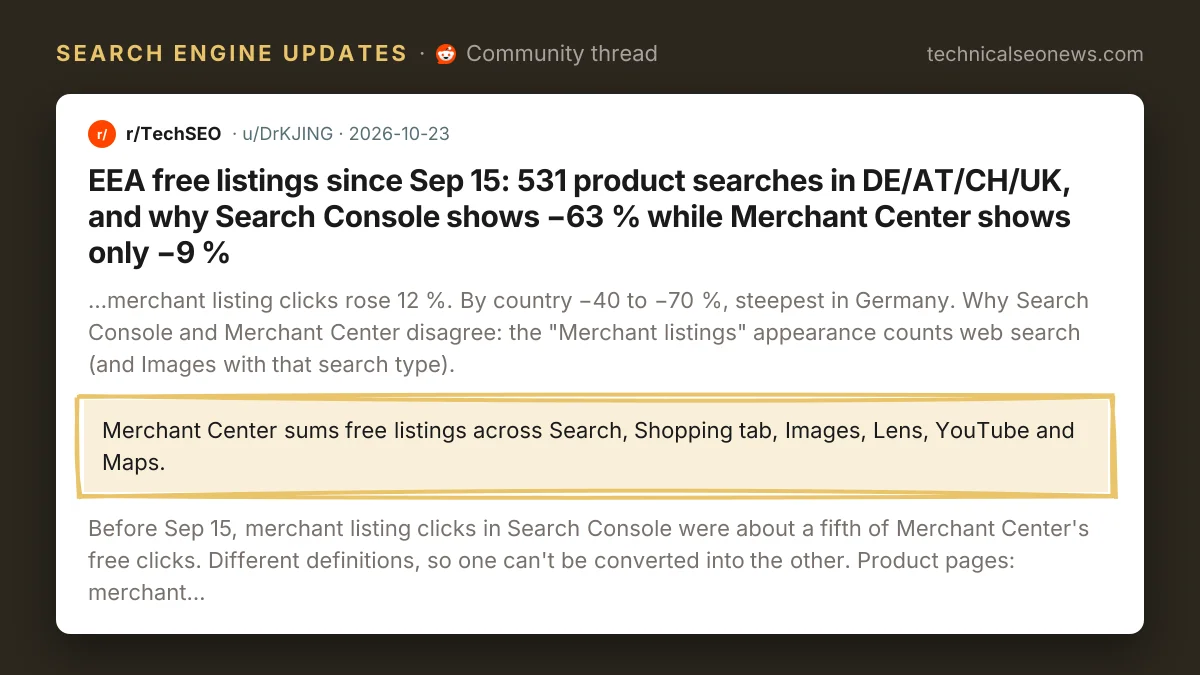
Search Console’s merchant listings report fell about 63% for one shop selling into the EEA after September 15, while Merchant Center showed a single-digit drop in free listing clicks for the same shop over the same two weeks. The figures come from a post in r/TechSEO by an SEO who works with the shop and published relative changes only.
The two reports do not count the same thing. The “Merchant listings” appearance in Search Console covers web search, plus Images when the search type is set that way. Merchant Center sums free listings across Search, the Shopping tab, Images, Lens, YouTube and Maps. Before September 15, merchant listing clicks in Search Console ran at roughly a fifth of Merchant Center’s free clicks for this shop, so neither number converts into the other.
September 15 is not an arbitrary date. Google documented the new EEA product units on September 8, and the thread cites a Search Engine Roundtable report from September 18 in which Google’s Ads Liaison confirmed free listings were removed in the EEA because of the DMA, the EU’s Digital Markets Act. Merchant listing clicks for this shop outside the EEA rose 12% over the same period. Inside it, the decline ran between 40% and 70% depending on the country, steepest in Germany.
The shop’s total loss is much smaller than its Search Console chart. Merchant listings had been about 15% of the web search clicks on its product pages, and organic clicks on those pages rose 6.5% once the listings went. Across the whole site, clicks from web search fell 3.5%, while visits arriving from comparison sites rose 13.3%.
Who fills the product block now differs sharply by country. The post’s author ran 531 non-brand product searches signed out over four days in October, with location set per country, and counted where every item in the block led.
| Country (mobile) | Product items leading to comparison sites |
|---|---|
| Germany | 90% |
| Austria | 46% |
| Switzerland | 0% |
| UK | 0% |
In Switzerland and the UK, every counted item led to Google Shopping instead, and fewer than 1% of items in any of the four countries led straight to a merchant. Germany’s grid is spread thin, with six to eight groups per search. No single site held more than about 10% of the German items counted. Archived captures of the same German terms from April to June showed a product carousel 95% to 98% of the time.
Switzerland and the UK sit outside the EEA, which fits the DMA explanation, though Austria’s near-even split shows the replacement is not uniform across EEA countries either.
Before reading your own merchant listings chart as a loss of the same size, note that the report has drawn doubt before, with desktop merchant impressions running 3 to 7 times high in one SEO’s data. These are also one shop’s figures and a four-day SERP sample, which makes them a prompt to check rather than a market measurement.
What to do
- Open the merchant listings report in Search Console, filter by country, and look for a step on September 15 rather than a slope. A step dated to that day points at the EEA removal; a slope points at something of your own.
- Put Merchant Center’s free listings figure beside it and track the two as separate channels. Merchant Center changed its counting on August 24 and recalculated from July 1, so any comparison against 2025 that crosses that date mixes two methods.
- Check that product pages carry complete Product markup, price, availability and variants included. That is the web search surface still under your control.
- Keep srsltid parameters through redirects on product URLs. Merchant Center’s auto-tagging adds them, and dropping one on a redirect makes the free listing channel hard to measure.
- Treat comparison-site placement in Germany as a budget decision rather than an SEO one. Those sites charge per click, and 90% of German product items in the sample led to one.