Google is swapping the results it serves to rank trackers
Summary
Rank tracker drops recorded since mid-September may be Google's doing rather than the algorithm's. Nozzle, which sells rank tracking, found scraped result pages that looked ordinary but had a project's own site stripped from the top 10, then restored within days.
Any October drop needs a second opinion from Search Console impressions and average position before it becomes a diagnosis.
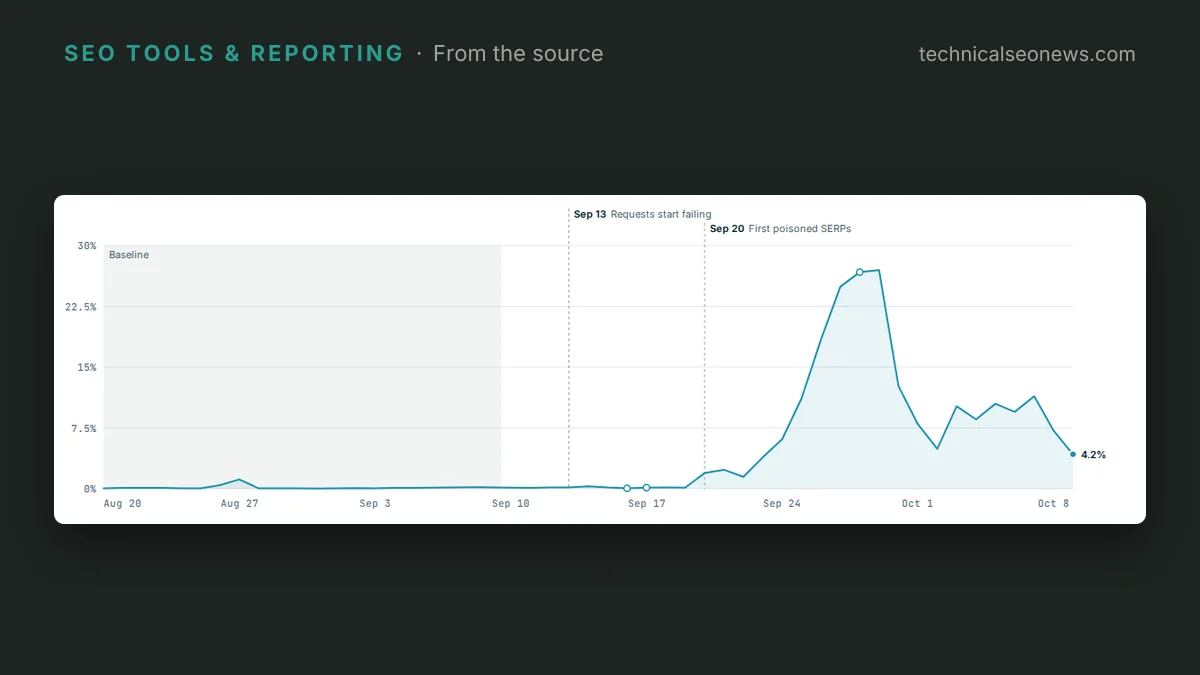
Google has been swapping the organic results out of the search pages it serves to rank-tracking scrapers since the second half of September, and nothing on the swapped page shows that it happened. Derek Perkins of Nozzle, a rank tracking vendor, measured it at 8.0 percent of the search pages Nozzle collected from September 13 onward, in research Nozzle published and in an interview with Search Engine Roundtable. The same measure ran at 0.17 percent in the three weeks before.
Perkins told Search Engine Roundtable that Google is working on three fronts: wide IP blocking aimed at the big residential proxy networks, a sharp increase in captchas, and bad data injected into the result pages it judges to be scraped. The first two fail loudly. A blocked fetch or a captcha leaves a hole in the dataset, and a tool can tell its customers that positions are missing, which is roughly what Sistrix, DataForSEO, SE Ranking, Advanced Web Ranking and Morningscore have posted in recent weeks. Blocking came first. Nozzle’s requests started failing on September 13, and from September 20 the pages that got through began coming back poisoned, so September’s missing tracker data was the first phase of the same push.
Injected data fails quietly instead. The page arrives complete and ordinary, ten results with the usual features, and the only way to catch it is to compare it against what that keyword returned on other days. Nozzle counts a page as poisoned when fewer than half of the keyword’s usual sites, the ones holding a top-10 spot on most of its earlier collections, appear anywhere on the page, and those sites then come back.
Forums and social profiles fill the vacated slots. Reddit turns up on poisoned pages eight percentage points more often than on clean ones, with Facebook and LinkedIn also gaining ground. The number that matters most to a practitioner is about the tracked site itself. It is missing from the top 10 on 58.6 percent of poisoned pages, against 2.7 percent before the poisoning began.
Then the page repairs itself. Nozzle found the keyword’s usual sites back within three days on more than three quarters of affected pages, and the median was two days. Most incidents were a single bad collection rather than a run of them. The daily share of poisoned pages peaked in late September and was still above 4 percent on October 9.
That recovery pattern is the dangerous part. A steep drop followed by an unexplained bounce two days later is also what a volatile update week looks like, and late September had a confirmed spam update running through it. Poisoned data is a problem because it is plausible, not because it is broken: a tracker will chart it as a ranking change, and somebody will diagnose it. Until Search Console agrees, any drop recorded only by a tracker since mid-September is unproven.
Poisoning is also not the only reason trackers disagree right now. In posts Search Engine Roundtable collected, Glenn Gabe, an SEO consultant who tracks Google updates, compared three tools against a site whose owner confirmed to him that it was hit on September 29 during the spam update. Ahrefs caught the drop, Semrush caught it late, and Sistrix still had not shown it when he posted. A tracker can invent a drop that never happened and miss one that did, in the same month.
Barry Schwartz, who edits Search Engine Roundtable, reads the campaign as aimed at AI scrapers and at Google’s dispute with SerpApi rather than at the tools SEOs buy. That is probably right, and it is also the reason not to expect relief. If rank trackers are collateral damage in a fight over AI scraping, the blocking and the injected data will get better at their job, not worse.
Search Console is the one position dataset Google hands over rather than one somebody scraped, which is why it has to be the anchor. It has a hole worth naming: no clicks and no queries for AI Overviews or AI Mode, so AI-surface visibility cannot be checked there, although some AI Overview links arrive with a parameter that separates them in server logs.
What to do
- Pull Search Console impressions and average position for the affected queries before treating an October tracker drop as real. Search Console reports position as an average, so compare date ranges rather than single days.
- Check whether the keyword’s usual competitors vanished alongside your site. On a poisoned page most of the regular top 10 is gone and forum or social results sit in those slots. If your site is the only one that moved, the movement is more likely genuine.
- Hold any drop that recovered within two or three days without intervention. Treat it as a collection artifact until Search Console shows the same dip.
- Ask your vendor the specific question: do they detect swapped results, or only failed fetches. Several of the notices posted recently describe July’s goto redirects or missing positions, which is the blocking problem rather than this one.
- Keep late-September and October tracker charts out of client reports and update post-mortems unless a Search Console figure sits next to them. Spot-checking a handful of queries by hand remains the fastest sanity check, and one practitioner replying to Schwartz said it is the only movement signal they trust right now.