Google scraper blocking cuts Nozzle's SERP data by 80%
Summary
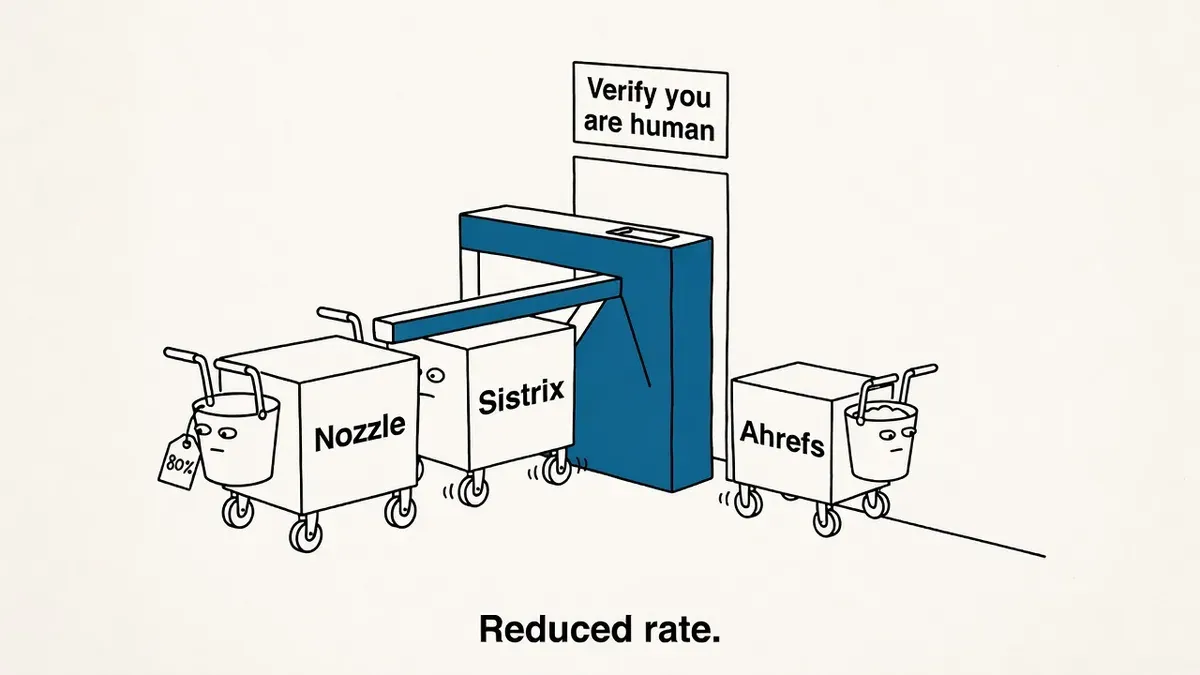
Nozzle told Search Engine Roundtable it is retrieving about 80% less data from Google since around September 13, and Sistrix says its collection is running at a reduced rate.
The blocking overlaps the September 4 and 12 reversals, so tracker movement this week may be sampling loss. Check Search Console impressions before acting.
What happened
Google appears to be blocking search scrapers far more effectively since around September 13, according to Search Engine Roundtable. Derek Perkins of Nozzle told the site that most of his tooling’s attempts to pull data from Google Search are now blocked. He put the loss at about 80% of what he used to retrieve. He reported the same pattern in data coming from DataForSEO.
Sistrix logged the problem on its status page on September 16. The note says Google “has made further changes to the way search results are delivered” and that Sistrix data collection is “currently running at a reduced rate.” Steve Paine of Sistrix told SE Roundtable that Google has been changing result delivery for about a year and is moving fast right now. Data is still flowing and the Toolbox is still updating, per Paine.
Glenn Gabe posted a sharper test on X, which Barry Schwartz embedded in the same post. Gabe took a site he knew had dropped by nearly 100% and then fully recovered around the September 4 unconfirmed update. He confirmed the swing against the site’s own traffic, then checked three trackers. Ahrefs showed the recovery, Semrush showed it but lagged, and Sistrix did not show it at all.
Schwartz wrote that he contacted a dozen or so other vendors and had not heard back. The same post notes Google is testing several ways to verify that a visitor is human, though the goto URL redirects seem to have died down.
Why it matters
The blocking overlaps the September 4 and September 12 reversals and the September 15 update, all of which practitioners are measuring with these tools right now. A tracker line that falls this week has two candidate explanations that look identical on a chart. One is a ranking change. The other is a vendor that sampled your keyword set less often, or not at all.
Agencies sending weekly client reports are exposed first. So is anyone sizing the impact of this month’s updates, because the measurement window sits inside the degraded period.
Share-of-voice and competitor tracking have no first-party fallback. You cannot check a competitor’s positions in your own Search Console, so those reports have nothing to reconcile against.
The vendor spread is the useful signal here. Ahrefs, Semrush and Sistrix disagreeing about the same site in the same week is a statement about collection, not about ranking.
What to do
Start in Search Console. Impressions and average position come from Google directly rather than from scraping, so the blocking does not touch them. If GSC shows a flat line across the same date range where your tracker shows a cliff, the tracker is the story and no site change is warranted.
Then work through the rest in order:
- Pull the vendor status pages. Sistrix has published a note. Check whether yours has, and when it was last updated.
- Run the same keyword set through a second tracker. Disagreement on identical keywords points at collection rather than at Google.
- Annotate reports from September 13 onward. Clients reading a drop without that context will ask for work the data does not justify.
- Hold any rollback that rests only on tracker data. Reverting a template change or a redirect map because of a sampling artifact costs more than waiting a week.
If Search Console and your tracker agree, treat the movement as real and proceed as normal. The blocking degrades third-party data. It does not change what Google is doing in the SERP.
Watch out for
Reduced rate is not an outage. Sistrix says data is still flowing and the Toolbox still updates. A chart built from thinner sampling still looks complete, and nothing on the graph marks which points are stale.
Recoveries disappear too. In Gabe’s example the site fully recovered and Sistrix never showed it. Alerting that fires on drops will miss the opposite error, and teams keep working on a problem that already fixed itself.
“Independent” tools can share one pipeline. Perkins saw the same drop in DataForSEO, a SERP data API that other tools build on. Cross-checking two products that buy from the same supplier proves nothing.
Silence is not evidence. Only Sistrix has said anything publicly so far. Schwartz’s outreach to roughly a dozen other vendors has gone unanswered, so a vendor without a status note is not necessarily unaffected.