Bing now shows AI queries where rivals are cited and you aren't
Summary
The Topics Portfolio beta sits in Bing Webmaster Tools' AI Performance report and clusters grounding queries into themes, with counts for total citations, competing sites and queries per theme.
No clicks are attached and every number is approximate, so the usable output is a content gap list rather than a performance report. Read Top Opportunity Queries first and check those themes against what the site already publishes.
Bing Webmaster Tools can now tell a site which AI answer queries its competitors are cited for when it is not. Krishna Madhavan, Saral Nigam and Vivek Jain of the Microsoft Bing team announced the beta, called Topics Portfolio, on the Bing Webmaster blog on October 13, and Search Engine Roundtable published screenshots of each view the same day.
Topics Portfolio lives inside the existing AI Performance report and groups grounding queries, the searches Bing runs behind the scenes to pull sources for an AI answer, into broader themes such as football, taxes or AI chatbots. The main table carries four columns:
- Topic: the thematic cluster of related grounding queries where the site appears.
- Topic Size: the approximate total citations across all sites in that topic over the selected period, which Microsoft treats as a measure of how much AI Search demand the theme represents.
- Sites Cited: the approximate number of sites appearing for queries in the topic, as a measure of how crowded it is.
- Queries: the approximate number of distinct grounding queries in the topic.
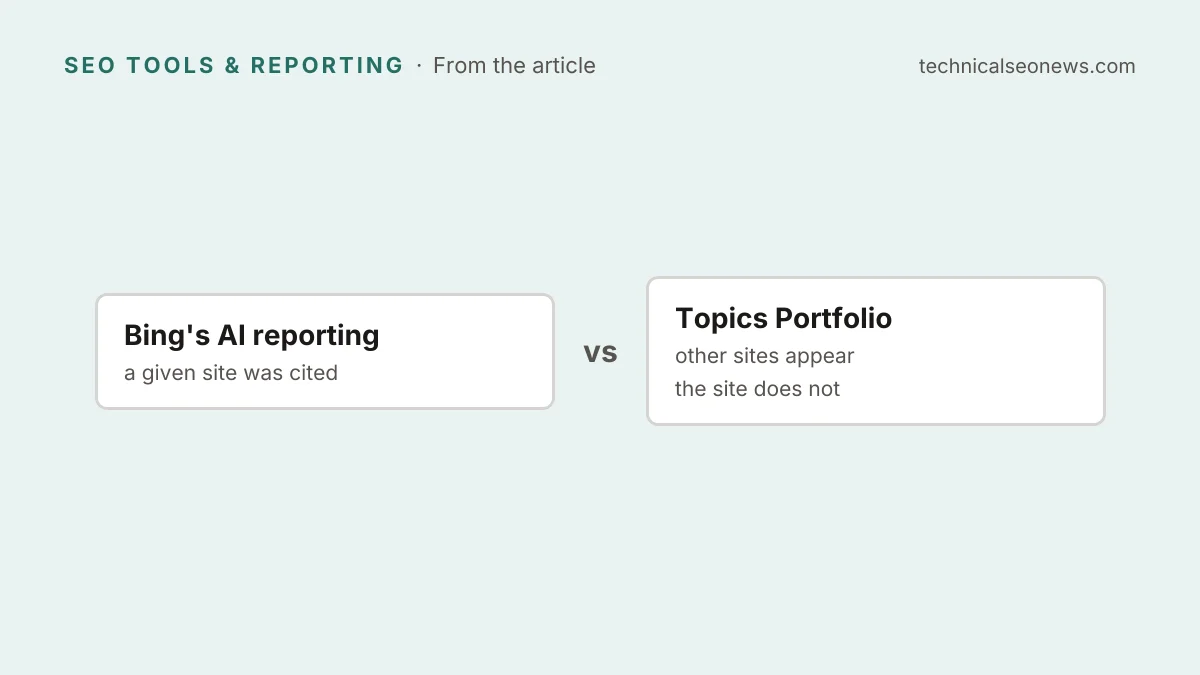
Two of those columns count other people’s sites. That is the change worth noticing, because Bing’s AI reporting has so far answered only where a given site was cited, and Topics Portfolio adds how many citations a theme produces in total and how many sites are splitting them. A large topic with few sites cited is a theme with a short winners list; the same volume spread across many sites is a crowded one.
Top Opportunity Queries applies the same comparison one level down. It lists the strongest queries across the whole portfolio where other sites appear and the site does not, with citation volumes given as ranges rather than exact numbers. Clicking into a single topic opens a deep dive showing topic size, the site’s own citations within that topic, and the query count, with the queries themselves split into two tables underneath.
Nothing in the report counts clicks, as Barry Schwartz, who runs Search Engine Roundtable, points out in his write-up. A citation is a visibility number and not a traffic number, so Topics Portfolio is better used as a content gap list than as a performance report. Where AI citations do pay, the return often lands somewhere other than the referral line: Ahrefs traced one in five of its signups to ChatGPT or Claude while referral sessions stayed small.
The approximations matter for how the numbers get used. Microsoft labels topic size, sites cited and query counts as approximate, and the opportunity volumes as ranges, which makes month-over-month deltas unreliable and the ordering of themes the thing to read. Access is gated too. Microsoft says the report appears only when there is sufficient data for a site, and gives no threshold, so a smaller site seeing nothing under AI Performance is not looking at a bug.
What to do
Open the AI Performance report in Bing Webmaster Tools and check whether Topics Portfolio is present. If it is, read Top Opportunity Queries before the topic table, and mark the queries that sit inside subjects the site already covers credibly. Those are the briefs; a theme nobody on the team can write about is not an opportunity.
Organic rank still matters. Citation rate in Google’s AI Overviews falls sharply with organic position, and Microsoft has published no equivalent breakdown for Bing, though the likelier case is that grounding favors pages Bing already ranks.
Keep the report out of client reporting for now. Citations without clicks cannot be valued, and quoting an approximate count as a performance metric invites a question about revenue that the data cannot answer.