Bing now lists AI queries rivals are cited for and you aren't
Summary
Bing's AI Performance report now clusters the queries behind AI answers into themes and reports, per theme, how many citations they draw across all sites and how many sites get cited. A per-topic view adds the site's own citation count and lists the queries in that theme where rivals are cited and the site is not.
Used well, it ranks content work by AI demand rather than keyword volume. The figures are approximate, the opportunity queries come as ranges, clicks are missing, and the report shows up only for sites Bing judges to have enough data.
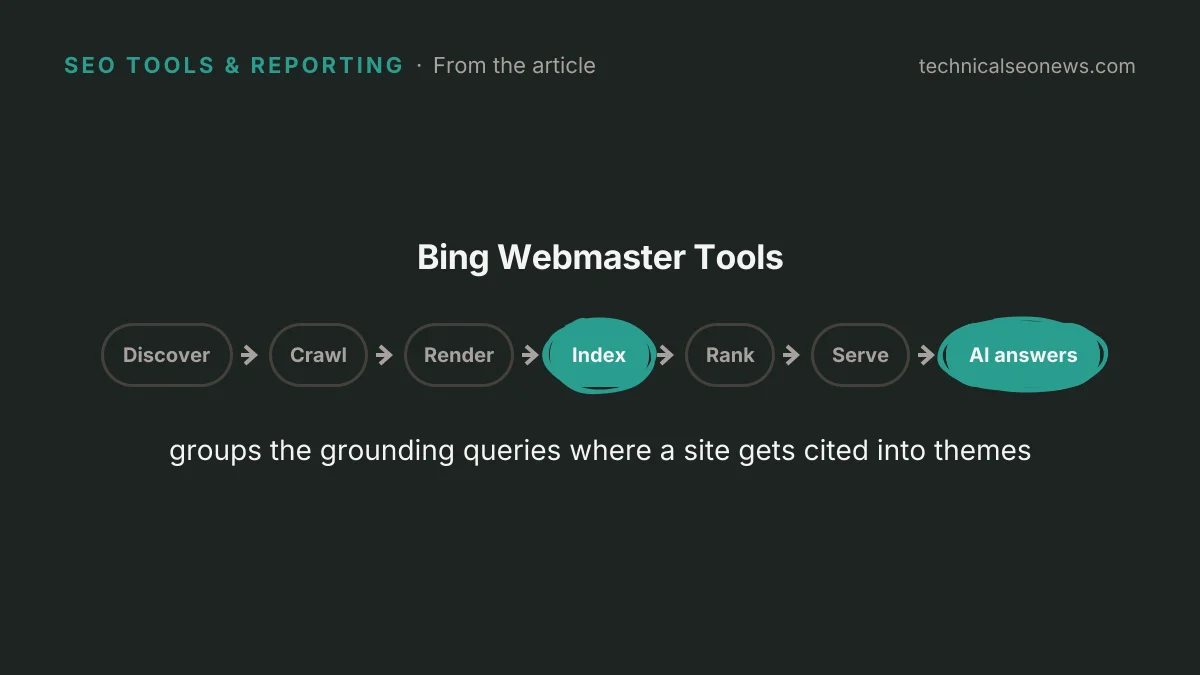
Microsoft has added a beta report called Topics Portfolio to the AI Performance section of Bing Webmaster Tools, and it groups the grounding queries where a site gets cited into themes such as football, taxes or AI chatbots. Krishna Madhavan, Saral Nigam and Vivek Jain of the Bing team announced it on the Bing Webmaster blog on 13 October, and Search Engine Roundtable’s write-up carries the screenshots. Grounding queries are the searches an AI answer sends to Bing to gather its sources, so every figure in the report counts citations, not positions.
Each row in the topic table describes the theme, not only the site. Three numbers sit against every topic:
- Topic Size is the approximate total citations across all sites in that topic over the selected period, which Bing calls a measure of AI Search demand.
- Sites Cited is the approximate number of sites appearing for queries in the topic, which indicates how crowded it is.
- Queries is the approximate number of distinct grounding queries in the topic.
Two of those three describe other people’s sites. Bing is reporting demand and competition for a theme rather than the rows a site already holds, which is what makes the second table the one to open first. Top Opportunity Queries lists the strongest queries across the whole portfolio where other sites appear and yours does not, with citation volumes given as ranges instead of exact counts. The better use of that list is as a content gap report, because these are queries AI answers actually ran, so the demand is observed rather than estimated from keyword volume. Clicking into a single topic shows Topic Size, the site’s own citations inside that topic and the query count. Beneath those sit two tables: Your Grounding Queries, the queries in the topic where the site already appears, and Opportunity Queries, the ones in the same topic where other sites appear and yours does not.
What the report will not tell you is what any of it is worth. There is no click data in it, as Search Engine Roundtable notes, so a topic that drives sales and a topic that drives nothing look alike. Pricing a citation stays an in-house problem: Ahrefs traced about one in five of its signups to ChatGPT or Claude without matching referral traffic to show for it. Topics Portfolio can order the work; the payoff question belongs in your own analytics.
The other limit is access. The report appears only if “there is sufficient data for your site,” in Microsoft’s wording, and the threshold is not published. A site with few AI citations is the one that most needs a gap list and the least likely to be shown one.
What to do
- Open AI Performance in Bing Webmaster Tools and check whether Topics Portfolio is listed. If it is absent, the likelier reason is too little citation data for your site, not a rollout that has yet to reach you.
- Read Top Opportunity Queries first, then weigh each topic’s size against its Sites Cited count. A large topic with few sites cited is a cheaper target than a large crowded one.
- Copy down the topic rows and the opportunity queries for this period. Beta reports get rebuilt, and approximate counts and ranges are not figures you can reconstruct later.
- Hold off on rewriting a content plan around it. Microsoft’s own post says to treat the numbers as directional signals for planning, not a precise ledger, and approximate citations with no clicks support a decision about order of work, not about budget.