Google's unrelated results stayed out of the top five in a study
Summary
Google's unrelated results to rank trackers never reached the top five in SE Ranking's study of 10,000 keywords, so top-five positions reported since mid-September still hold.
Confirm any drop at position 9 or lower against Search Console impressions before reporting it as lost visibility.
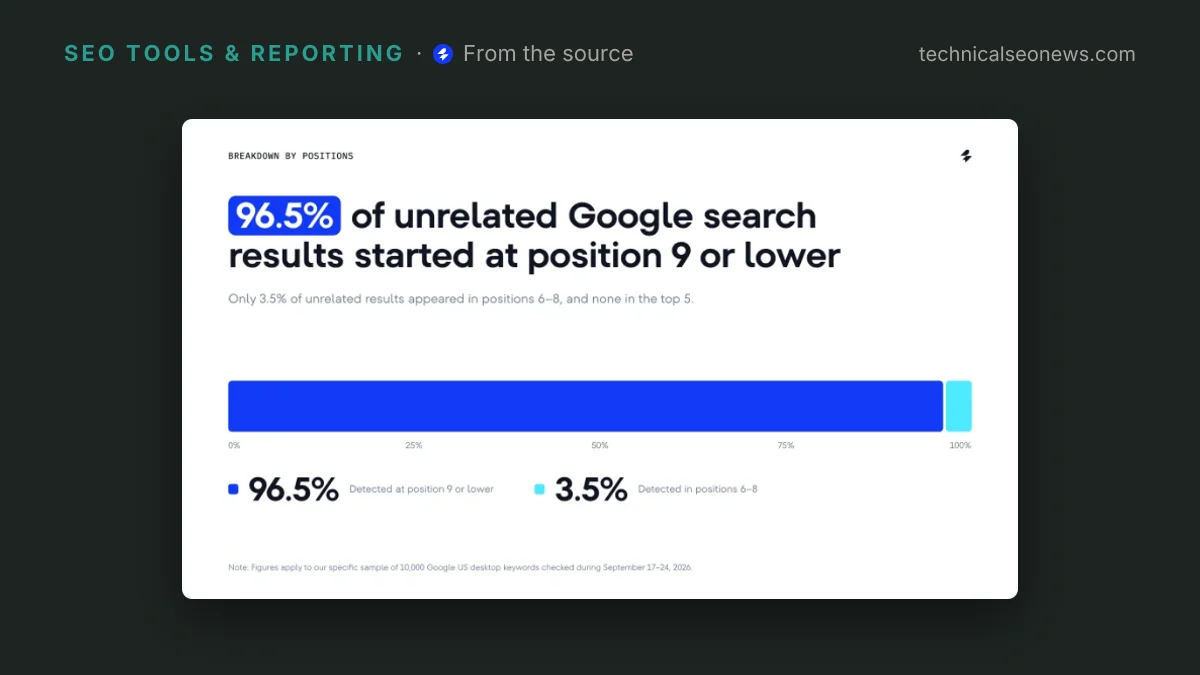
Google returned unrelated results to rank tracking checks for more than half of tracked US keywords starting September 17, per a study from rank tracking platform SE Ranking published Tuesday. The junk listings almost never started inside the top eight positions, and never in the top five.
The sample was 10,000 keywords from SE Ranking’s research index, checked daily on Google US desktop through September 24.
| Date | Keywords with unrelated results |
|---|---|
| September 16 | 0.09% |
| September 17 | 57.3% |
| September 24 (peak) | 67.2% |
An unrelated result is a listing Google hands back to an automated check that looks valid and has nothing to do with the query. The pages are sometimes called poisoned SERPs. In 84% of SE Ranking’s cases the junk listings matched a single word from the search. One tracked query, “business bank line of credit”, returned Chase, US Bank, PNC and LendingTree across the first nine positions, then filled page two with the LINE messaging app, The LINE Hotel and music videos. None of those page-two results appeared for the same query in SE Ranking’s reference checks.
From the tracker’s side the check worked. Google returned a page, the page had organic results, the tracked site was not among them, and the tool recorded a drop that never happened in the live results. Nothing errors out, so a rank tracker quietly losing data and a rank tracker faithfully recording a poisoned page produce the same red number in a client report.
Almost none of the unrelated listings appeared high in the results.
| Where the unrelated block started | Share of blocks |
|---|---|
| Position 9 or lower | 96.5% |
| Positions 6 to 8 | 3.5% |
| Top five | None |
On that distribution, top-five positions reported from that window can be trusted and anything from position 9 down cannot. A keyword sitting at three through late September is probably really at three. A page that vanished from the second page in the same week is unconfirmed until another data source agrees.
SE Ranking’s rate is not an industry-wide figure. Two other rank trackers, Nozzle and Keyword.com, measured far lower shares over overlapping dates.
| Provider | Share of checks classed as poisoned |
|---|---|
| SE Ranking | 57.3% |
| Nozzle | 22.6% |
| Keyword.com | 13.1% |
Each provider sampled different keywords on different days through different collection setups, so the only rate that describes your data is the one your vendor publishes. Vendors are also handling the pages differently: Semrush drops clearly invalid results from its rank data rather than reporting them.
Google has not explained the results. The theory SE Ranking relays from other vendors is that Google serves misleading pages to traffic it reads as automated instead of blocking it outright, on the reasoning that a plausible wrong answer is harder for a scraper to detect than a refusal. Rank trackers collect results automatically too, which would catch them in defenses aimed at AI scrapers.
What to do
SE Ranking’s own guidance for a suspicious drop is to check whether one keyword moved or several moved at once, confirm the movement persists past a single day, then pull Search Console impressions and clicks for that query and page before treating the drop as real. Three things worth adding:
- Spot-check deep positions by hand. One SEO quoted in the study runs queries in an incognito window and trusts no reported move without that check.
- Caveat any September-to-October comparison. Month-over-month visibility charts built on position data now span the contaminated window, and that belongs in the deck rather than in your head.
- Do not discount gains in the top five. That is the one part of the dataset the study found untouched, so a jump into the top three is as real as it looks.
Read what the results are about, not just whether your domain is in them. A page of listings that all share one word with the query is the signature here, and it is visible in a single manual check long before it shows up as a pattern in a report.