Translated titles missed the phrase local searchers type
Summary
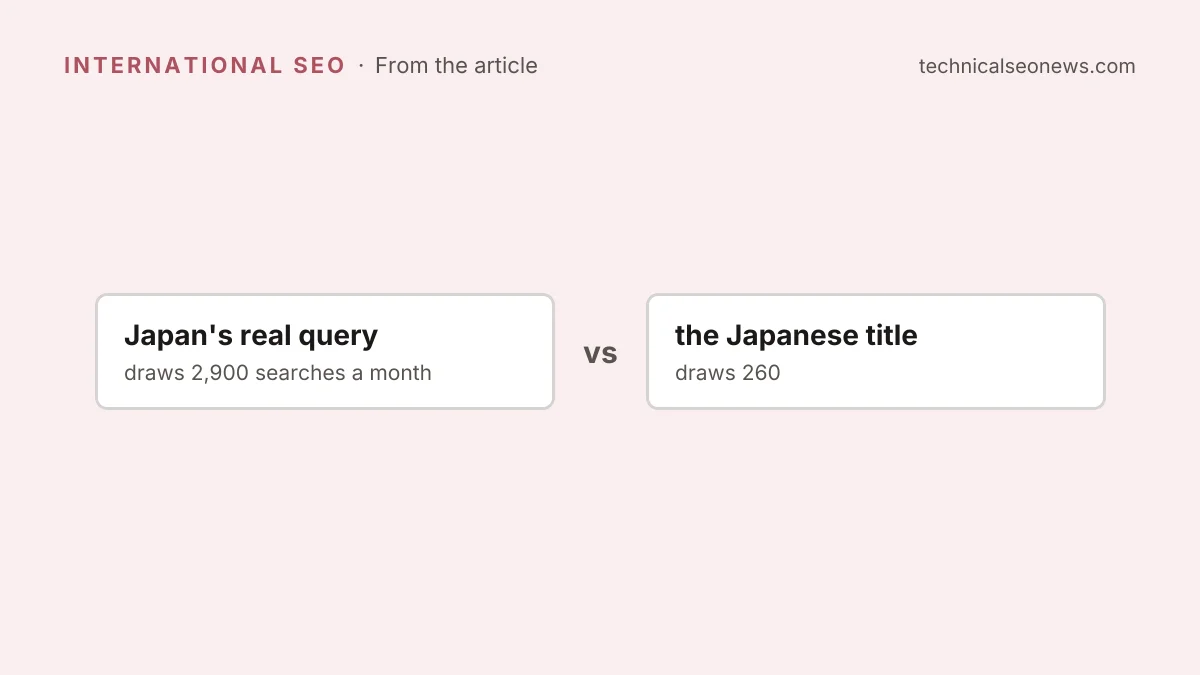
A developer who translated a file transfer site's page titles carefully into 13 languages found they target phrases almost nobody searches, with Japan's real query drawing eleven times the volume of the translated title.
Pull country-level volume for the native phrasing before localizing a title, instead of translating the English one.
A developer who maintains BIShare, a free open-source file transfer app, spent a Semrush trial week auditing the app’s site in 13 languages and found that the translated page titles were aimed at phrases almost nobody types. Japan’s real query, “ipad usbメモリ” (iPad USB stick), draws 2,900 searches a month according to the write-up posted to r/TechSEO, while the Japanese title already on the page, “iPad ファイル 転送”, draws 260.
Indonesia produced a wider gap from a smaller error. Indonesian searchers say “dari HP ke laptop”, phone to laptop, which the report puts at 3,600 searches a month. The title on the page used “PC”, at 20. Both titles were accurate translations of the English original, and that accuracy is what pointed them at the wrong phrase.
Vocabulary was not the only thing that moved across borders. In Germany, France, Spain and Russia, the developer reports that the phone-to-computer search is about photos first and files second. A title translated from an English string built on “files” is therefore correct and still aimed at the smaller query. A translator working from that string cannot see the difference, because it only shows up in volume data pulled per country rather than per language. The same split shows up in AI assistants, whose brand recommendations change with the language a question is asked in.
The retitling was deliberately limited. Nine localized pages that had almost no clicks got new titles, and every title that was already earning clicks was left as it was. That restriction is the part most worth copying. A title rewrite on a page that already ranks spends a working asset to test a hypothesis, and on a site in 13 languages the rewrite is hard to evaluate afterwards because the per-page click volume in any one market is too small to read quickly.
No results have come back from those nine pages yet, and the trial does not show that closing a volume gap produces clicks. The site’s Google clicks did roughly triple in the weeks before the trial, but the developer attributes that to a mid-September rebuild of about 260 landing pages and says plainly that the growth came first. The account is also first-party: the poster built the app and flags that in the thread.
The country keyword rows were the part of the trial that held up. The rolled-up country traffic estimates in the same tool did not. The developer’s India figure showed 471 while the keyword rows behind it added up to about one. Treating the estimate as a measurement would have pointed the next month of work at a market that is not sending anyone.
What to do
- Pull search volume by country for the two or three ways the thing is actually said locally, then write the title from the winner. Translating the English title gives a phrase that is correct and unsearched.
- Check whether the local query swaps the noun. “Photos” for “files” and “laptop” for “PC” were the two that cost the most here, and both survive a careful translation untouched.
- Limit retitles to pages with no clicks. Leave the earning titles alone until a no-click page proves the new phrasing works.
- Read keyword-level rows rather than the country traffic estimate. The developer’s US estimate fell from 303 to 6 between one week and the next, driven by a keyword or two each time.
Watch out for
Site audit warnings behave differently on non-Latin pages. The developer’s “low word count” flags on Japanese and Chinese URLs came from a checker that counts words by splitting on spaces, which those languages do not use. The pages were not thin. Before acting on any audit flag that is raised mainly in one language group, confirm the check works in that writing system.