Claude's brand picks change with the language of the question
Summary
Claude recommends different brands depending on the language of the question, the SEO agency SALT.agency found across 1,650 test responses, and the swing was widest in categories where no single brand dominates.
Run the buying questions your customers ask through each model in every target-market language before trusting an English-only visibility check.
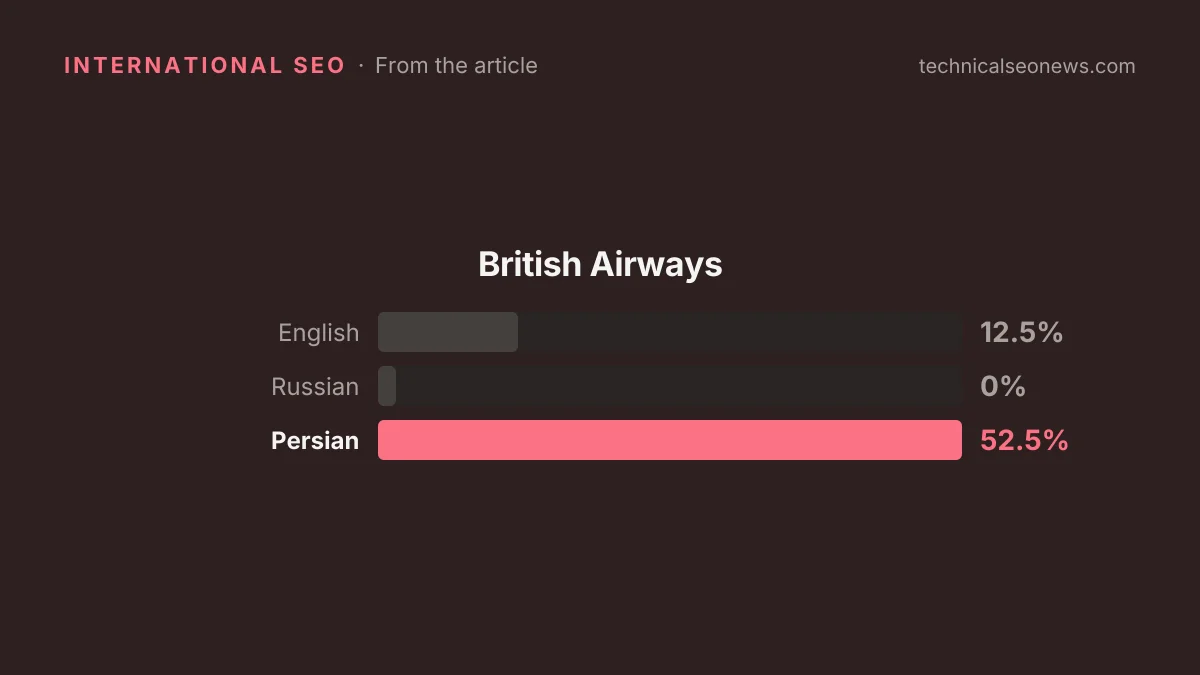
Claude recommends different brands depending on which language it is asked in. Reza Moaiandin, co-founder of the SEO agency SALT.agency, put the same six buying questions to Claude Sonnet 5 in five languages and published the results in Search Engine Journal on October 13. Asked in Persian which return flight to take from London to Tenerife, Claude picked British Airways 52.5% of the time. Asked the same question in Russian, it never picked the airline once.
The core dataset is 1,200 responses, 40 runs per scenario per language, collected with web search turned off through the LLM Responses API from DataForSEO, an SEO data vendor. The rest of the 1,650 responses repeated two of the scenarios with search turned on, and then in ChatGPT and Gemini.
Language moved the pick most in the categories where no brand owns the field. The airline question produced the widest spread of the six, and these are the recommendation shares for the London to Tenerife flight in three of the five languages tested:
| Airline | English | Russian | Persian |
|---|---|---|---|
| British Airways | 12.5% | 0% | 52.5% |
| easyJet | 35.0% | 72.5% | 12.5% |
| Jet2 | 45.0% | 25.0% | 32.5% |
Jet2 was the steadiest of the three, between 22.5% and 45% across all five languages, while British Airways and easyJet swapped places entirely.
Categories with one dominant brand barely moved. Roborock took between 87.5% and 97.5% of the robot vacuum picks in every language, and Monday.com led project management software in all five. Headphones sat in between: Sony won every Persian and Russian pick, while Bose held 42.5% of the English ones and nothing in either of those languages. A brand that is one of three credible options in its category is the one whose recommendations move when the question changes language.
Nothing in the tests explains the mechanism. Moaiandin points to Anthropic’s July report on Claude’s values across languages, which sampled just under 310,000 real conversations and found the model leaned warmer in Hindi and Arabic and more rigorous in English and Russian. That report did not test brand mentions and the SALT.agency runs did not test values, so the connection between them is unproven. Moaiandin himself says the regional, cultural and linguistic factors behind the gaps will not be easy to unpick. The likelier explanation is plainer: with web search off, the model answers from what its training data associates with each language, and a Russian-language corpus about flights out of London does not carry the same brands as a Persian-language one.
Turning web search on changed the answers, and that is the half of this a marketing team can act on. With search off, Claude named an Iberostar Grand hotel just twice in 198 responses. With search on, JOIA by Iberostar, the newer name Claude found online, became the most recommended hotel at 31% overall and 60% in English. Moaiandin suggests a marketing team might influence future responses by publishing content for each region. The narrower conclusion the data supports is that search-on results show what published content can reach, and search-off results show where the brand already stands.
One model is also not a proxy for the others. For project management software, ChatGPT recommended Wrike in four of the five languages, while Claude and Gemini both led with Monday.com. Claude is not officially offered in mainland China, Russia, or Iran either, so the Russian and Chinese answers describe diaspora and expatriate users rather than those domestic markets.
What to do
Run the test rather than reasoning about it. Moaiandin’s own recommendation is to take a handful of questions customers ask before they buy in your category, then put them to multiple models in each of your target-market languages. The mentions are worth counting because they convert: Ahrefs traced one in five of its signups to ChatGPT or Claude.
Treat any single run as a snapshot. Moaiandin is explicit that 1,650 responses is a blip against the volume of chatbot queries, and that there is no reason to assume the patterns hold from one week to the next. Record the model version and whether search was on for every run, because both changed the answers in these tests.