Google now accepts UGC posts by API from approved platforms only
Summary
Approved UGC platforms can send posts and engagement counts to Google through a dedicated pipeline ahead of any recrawl. Acceptance is not open, and nothing is guaranteed to show up in Search.
The eligibility list is the useful part. Per-post pages with stable URLs, public creator profiles and on-page DiscussionForumPosting markup are prerequisites, so build those before applying.
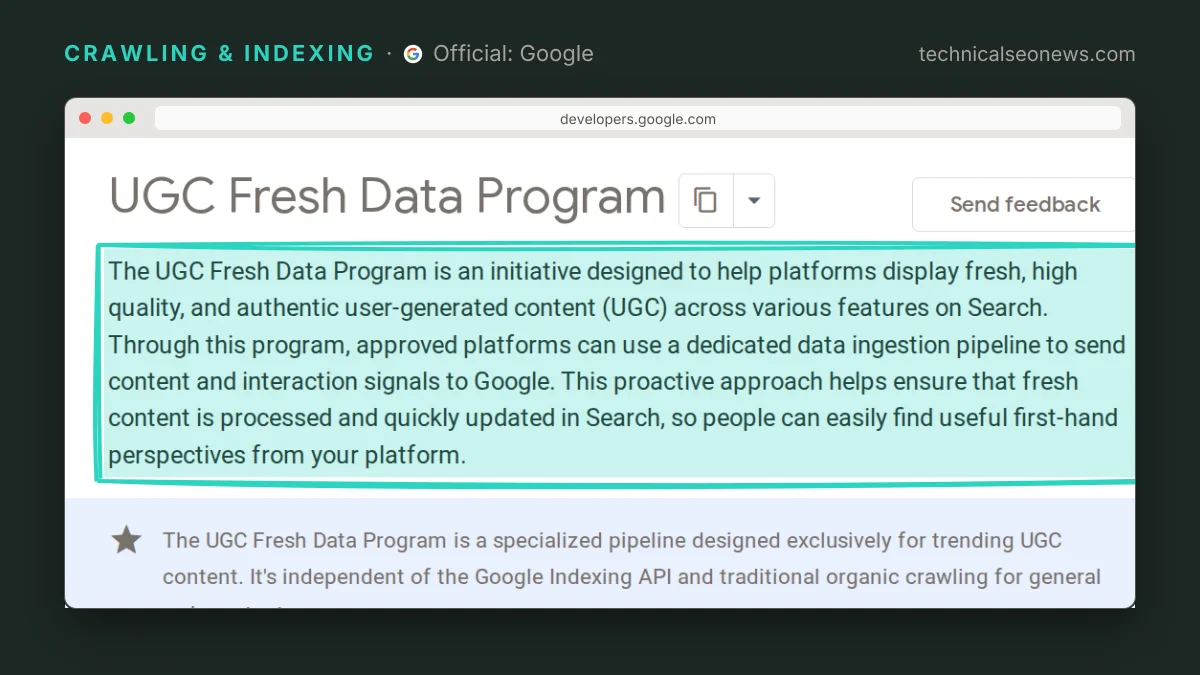
Google announced the UGC Fresh Data Program on October 8, a dedicated ingestion pipeline that approved platforms use to send posts and interaction signals to Google directly. Google’s documentation describes it as independent of both the Indexing API and ordinary organic crawling, and asks accepted platforms to submit content as fresh as possible, ideally within minutes. Search Engine Roundtable’s write-up, which spotted the launch, reads it as the API a site like Reddit would use to get posts into Search faster. Crawl latency is the problem being addressed, and Google has already put its own numbers on how long a recrawl takes.
The pipeline does not get a platform out of being crawlable. Google’s eligibility list requires content to sit on public web pages accessible to Googlebot and users, and rules out anything behind a login or a paywall. It also requires valid on-page schema.org markup across the platform’s URLs, not just inside the submitted payload. The likelier reading is that submission runs ahead of the crawl rather than instead of it: Google receives the post and its counters early, then confirms them against a page it can fetch for itself.
The requirement most likely to disqualify a platform is architectural. UGC has to live on dedicated pages with stable URLs, and Google explicitly excludes profile and feed pages. A forum clears this without trying, because a thread is already a page. A feed-first social product often does not, because its main surface is a scroll and a post’s permalink is a secondary one.
On the markup, Google names SocialMediaPosting or DiscussionForumPosting with interactionStatistic sub-fields, which is where likes, replies and view counts live. Engagement is not a one-time submission either. Google asks for regular updates to those counters within 72 hours of creation, so an integration needs a job that revisits recent posts rather than a hook that fires once on publish.
None of this buys placement. Google states that the program does not guarantee content will appear in Search, and that it will not accept every application. Applications go through a Google form, the response comes back in six to eight weeks, and the technical integration documents arrive only after acceptance, so there is nothing to build against in the meantime.
What to do
For a platform that plausibly qualifies, almost all of the work is prerequisite work that pays off whether or not the application lands:
- Give every post or thread a URL of its own that does not change, outside the profile and feed structure Google excludes.
- Remove any login requirement on the pages you would submit. Gated content is ineligible, and partial gating is the easiest way to fail that check.
- Make each post attributable to a creator with a public profile.
- Ship
SocialMediaPostingorDiscussionForumPostingmarkup withinteractionStatisticon the live pages before applying, since Google treats on-page markup as a condition of entry rather than something the pipeline replaces. - Keep active moderation and a user reporting mechanism running, and be ready to point to both.
For everyone else there is nothing to do. This is a closed program for large UGC platforms, not a new route to getting a blog indexed, and Google says it is separate from the Indexing API.