Login walls in front of staging 301s hide them from Googlebot
Summary
Indexed staging pages that collected real editorial links are recoverable, and the risk is operational rather than a percentage of lost equity. The redirect has to be reachable, has to land on the matching production page, and has to still be there in two years.
Outreach to the publishers is the only fix that removes the dependency. Nothing here calls for a disavow.
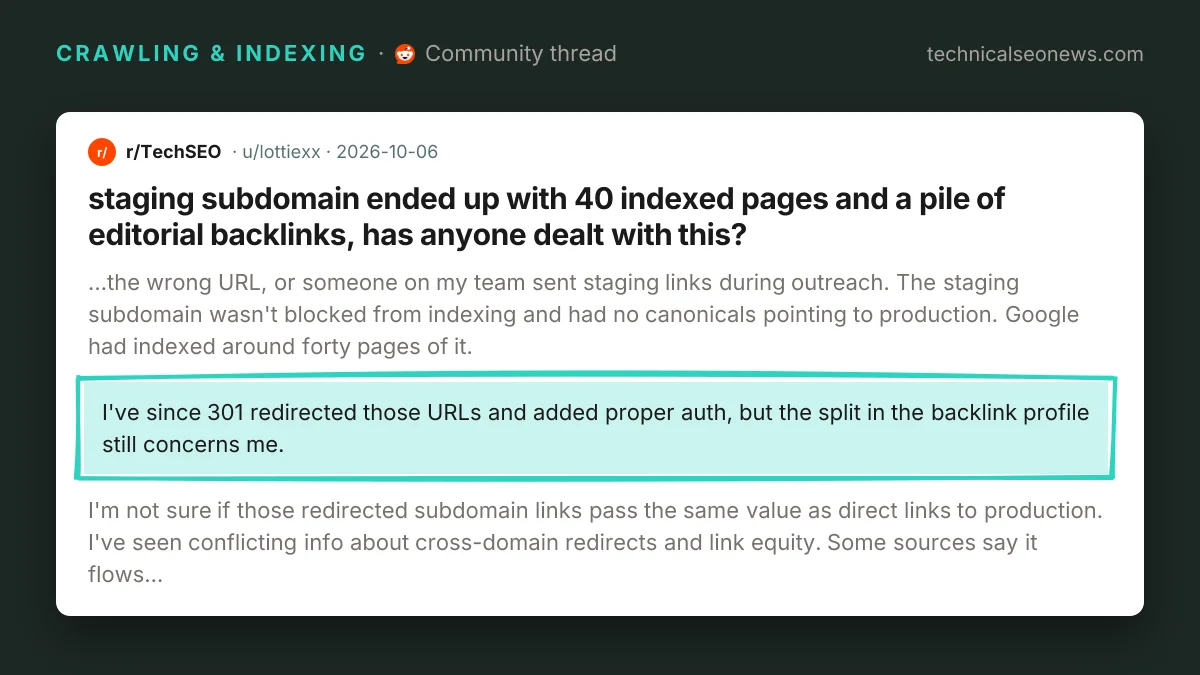
A backlink audit on a long-running site turned up editorial links pointing at a staging subdomain instead of production. In a thread on r/TechSEO, the site’s owner described a staging copy that had sat on a subdomain for years with no noindex and no canonicals back to production, until Google had indexed around forty of its pages and outside writers had begun linking to them. The owner has since 301 redirected the staging URLs to production and put the subdomain behind a login, then asked the thread whether redirected links carry the same value as direct ones, and whether a disavow was needed on top.
Putting the login in front of the redirect cancels the redirect. One commenter raised the sequencing: if the authentication check runs before the redirect rule, Googlebot requests a staging URL, receives a 401, and never sees the 301 waiting behind it. Nothing consolidates onto production, and the staging URLs sit in the index longer than they otherwise would. A login wall and a 301 are both sensible ways to stop serving staging to the public, but only the redirect moves anything, and the server applies whichever rule it reaches first.
A robots.txt disallow on the subdomain does the same damage for the same reason, as the same commenter noted: a crawler cannot see a redirect on a URL it is not allowed to fetch. The block looks like belated hygiene and instead stalls the cleanup.
The owner’s actual question, whether a redirected link is worth less than a direct one, drew consistent answers. A 301 passes the signals, with a small loss at most, so equity decay is the least useful thing to worry about. The real exposure is that the redirect stops existing. One commenter’s advice was to keep the 301s for good rather than until Google recrawls, because the value tends to go missing when somebody pulls old redirect rules during a cleanup two years later.
That permanence sits awkwardly against the other suggestion in the thread, which was to wait for the 301s to be picked up and then shut the staging site down, since keeping a host alive to serve page-by-page redirects gets messy. The thread does not separate the two, but they are separable: the staging application can be deleted while the hostname keeps answering with a redirect map, which is server config rather than a running environment.
Only outreach makes that map stop mattering. Asking the editors who linked to swap the URL to production yields a direct link, which the thread’s advice rates above a redirected one, and retires one dependency on a config file for every link fixed. Forty indexed pages produce a finite list of referring articles, which makes this worth working through in a way most link outreach is not.
A disavow has no role in any of it. These are editorial links from publishers who meant to link to the site and used the wrong hostname, which one commenter pointed out is the opposite of what the disavow tool is for. Nothing in the situation is a penalty, and disavowing the staging URLs would throw away the value the redirects were installed to collect.
What to do
- Fetch several staging URLs as Googlebot before changing anything else. URL Inspection works once the subdomain is verified as its own Search Console property. Confirm each returns a 301 to the matching production page and not a login screen.
- Map the redirects page to page. A blanket rule sending everything to the homepage can be treated as a soft 404, the same trap as indexed URLs that redirect to the homepage.
- Leave the subdomain crawlable while the redirects are doing their work, and stop publishing new content to it.
- Treat the redirect map as permanent infrastructure and document why it exists, so the next person cleaning up server config does not delete it.
- Email the publishers with the production URL and ask for the swap, starting with the strongest referring pages.
- Skip the disavow.