Semrush drops clearly invalid Google results from its rank data
Summary
Semrush says Google serves some automated search requests altered result pages, and that it now drops the clearly invalid ones while it collects rankings.
Check any unexplained ranking move against Search Console before acting on it.
Semrush, the biggest SEO tool suite, says Google is serving some automated search requests result pages that look normal but differ from what a typical user would see, and that its systems now detect clearly invalid results during collection and exclude them from its database. The company said so in a statement published on October 27. Google has not commented publicly.
Semrush calls the pages poisoned SERPs and frames the problem as industry-wide, affecting data providers across the SEO space rather than one vendor. This is not Semrush’s first word on it. On October 12 it told Search Engine Roundtable, the news site that covers Google’s search changes, that it had seen the issue since late summer and had put extra checks in place. Nozzle, a smaller rank tracking vendor, measured it at 8 percent of the pages it collected in the same piece. The new statement adds detail on what Semrush’s filter looks for, and that detail is the useful part.
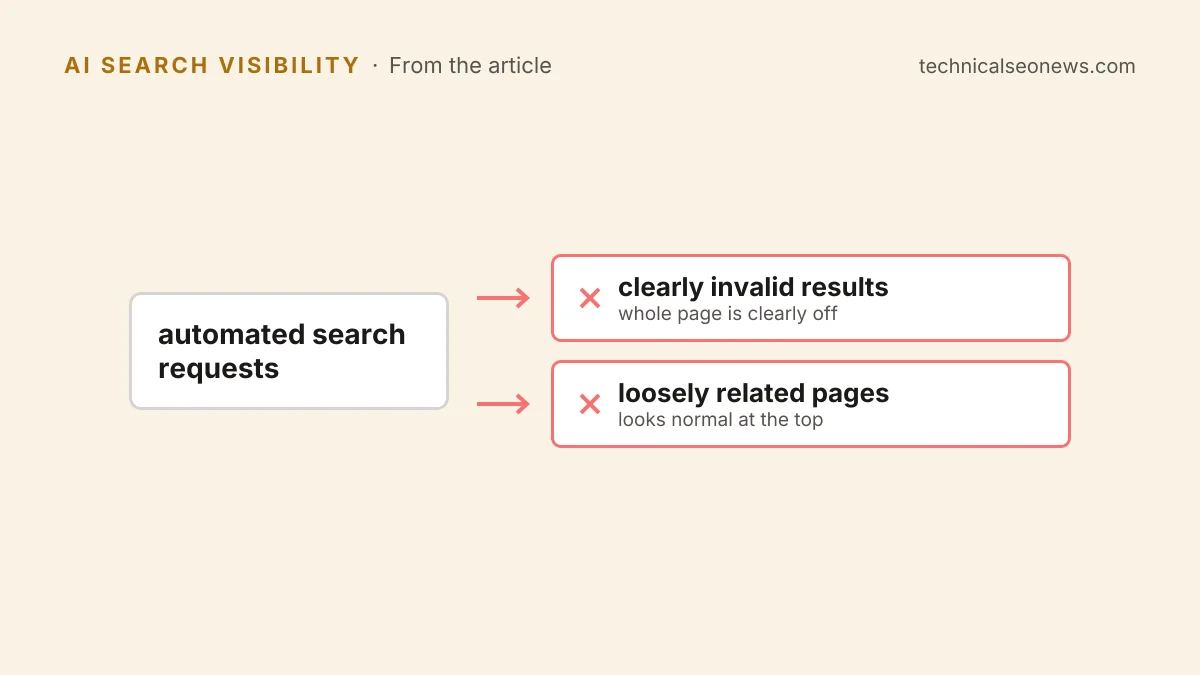
Semrush describes two forms. In the first, the whole page is clearly off, with results that do not match the query even on page one. In the second, the page looks normal at the top and carries only loosely related pages further down. Semrush gives one example of the second form: a search in Brazil for a specific baby stroller model returned a dental supply store’s equipment page, because both share the Portuguese word “carrinho.”
The difference between those two forms decides how much of this reaches customers. Semrush’s filter, by its own description, drops results that are clearly invalid, and a page whose first few results fit the query is not clearly invalid. The likelier outcome is that the obviously broken pages are thrown away during collection and the plausible ones are stored as rankings. Semrush says it has also added validation checks that flag potentially inaccurate results and collect them again, and describes that work as continuing, so the gap may be narrowing. Nobody outside Semrush can measure it.
For one site watching its own keywords, the effect is a rank report that can move for reasons that have nothing to do with the site. Semrush’s own advice covers it: when rankings change unexpectedly, especially for keywords unrelated to your pages, compare against first-party data such as Search Console, then contact support with the domain and keywords involved. A keyword surfacing where it has no business surfacing should be read as a possible collection error before it is read as a ranking event.
Aggregate research is the harder case, because nobody outside the vendors knows how much contamination survived the filter or how far back it goes. Any study that counts feature prevalence across a large keyword set inherits whatever collection produced, which hands the gap between trackers measuring AI Overview coverage one more candidate explanation next to different keyword panels and sampling dates.
On motive, Semrush points to industry discussion, including Search Engine Roundtable’s coverage, that reads the behaviour as an effort to limit large-scale data collection for AI systems. Rank trackers are not the obvious target of that effort, but the better assumption is that they issue the same kind of high-volume automated queries and draw the same response.
What to do
Treat third-party rank data as a signal that needs confirming rather than a record of what happened:
- Check unexplained movement in Search Console’s performance report before anything else, at query level, since those impressions and positions come from Google’s own logs instead of from scraping.
- Treat movement on keywords that have nothing to do with your pages as the strongest sign of a collection problem. That is the specific case Semrush names.
- Report it to Semrush support with the domain and the keywords, since Semrush says it will review the underlying data with you.
- Hold off on acting on single-day or single-keyword moves in any tracker until the next collection confirms them. Semrush says flagged results get collected again, so waiting costs little.
Switching rank trackers is not a fix. Semrush says the behaviour hits data providers across the industry, and Nozzle’s numbers earlier this month showed the same behaviour at a different vendor.