Botify launches AI Visibility, replaces rank with mentions
Summary
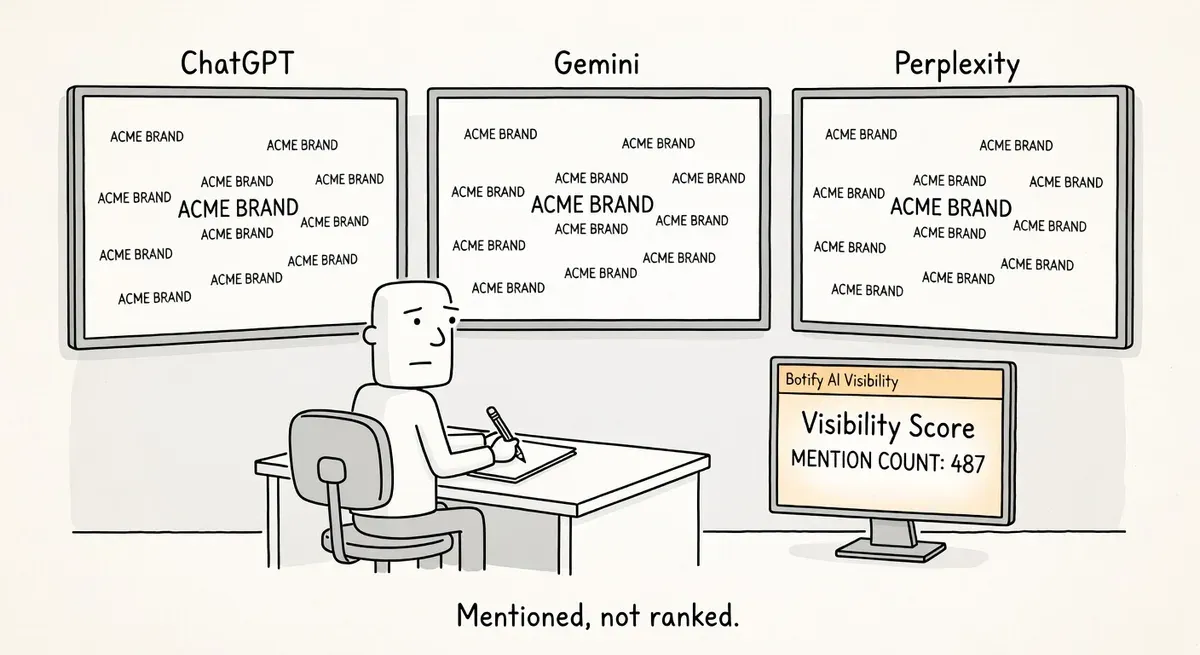
Botify launched AI Visibility out of beta, a tool tracking brand mentions in AI-generated responses across ChatGPT, Perplexity, Gemini, and other platforms. Traditional rank tracking doesn't work for AI search, so Botify replaced position with mention frequency, visibility score, and share of voice metrics. Start auditing your current AI measurement approach and shift toward tracking mention frequency and intent-based visibility instead of ranking positions.
What happened
Botify has moved its AI Visibility product out of beta and into general availability for all customers. The tool, first introduced in beta last October, tracks how brands appear in AI-generated responses across platforms like ChatGPT, Google AI Mode, and Perplexity, with Gemini support coming soon.
In a companion blog post, Botify’s Content Marketing Lead Felicia Crawford laid out the measurement framework behind the product. The core argument: traditional rank tracking doesn’t translate to AI search, and practitioners need new metrics built around mention frequency rather than position.
Botify CEO Adrien Menard framed the launch as a response to customer demand, noting the beta saw “the fastest and widest customer adoption with a new offering yet.”
Why it matters
The product reflects a growing industry consensus that AI search measurement requires different primitives than traditional SEO. Botify’s framework replaces position-based tracking with four core metrics:
- Visibility score: The percentage of time your brand, products, or URLs are mentioned in AI-generated responses over a given period. Frequency replaces position as the primary signal.
- Visibility by platform: The same mention percentage broken down by AI platform, showing where a brand has strong coverage and where gaps exist.
- Share of voice: How often your brand is mentioned compared to competitors across AI responses.
- Citations: The percentage of AI-generated answers that reference and link to your URLs. Botify frames these as both credibility signals and traffic drivers.
Crawford’s post also argues against keyword-only strategies for AI search. Because AI responses are personalized based on conversation history, user intent, and context, a specific input won’t produce a predictable output. Botify recommends tracking “intent visibility” instead, which segments brand mentions by user intent categories like transactional, informational, and navigational.
The shift from “what rank am I” to “how often am I mentioned” has practical consequences. Practitioners accustomed to monitoring position changes will need to adjust their reporting workflows. A brand disappearing from one prompt on one platform isn’t a red alert in Botify’s framework. It’s a single data point that only matters when aggregated over time.
For enterprise teams already using Botify’s crawl and indexability tools, the addition of AI visibility data creates a more complete picture. Teams can connect technical health issues (crawlability, rendering) with downstream visibility in AI responses.
What to do
Start by auditing what you’re currently measuring for AI search. If your reporting relies on prompt-level rank tracking or single-point-in-time snapshots, those metrics will be noisy and hard to act on.
If you’re a Botify customer, the AI Visibility module is now available without waiting for beta access. Explore the platform-level breakdowns to identify which AI surfaces mention your brand most and least frequently.
For non-Botify users, the measurement framework still applies. Track mention frequency across AI platforms rather than chasing positions. Several tools in the market now offer some version of AI mention tracking, but Botify’s approach of bundling it with technical SEO data is distinct.
Shift competitive analysis toward share of voice in AI responses. Knowing that a competitor appears in 40% of relevant AI answers while you appear in 15% is more actionable than knowing you “rank” third in one ChatGPT prompt.
Review your content strategy through the lens of intent coverage. Botify’s framework segments visibility by intent type. Even without their tool, you can manually test whether your brand appears in AI responses for transactional, informational, and navigational queries in your space.
Watch out for
Metric volatility in early tracking. AI responses fluctuate based on model updates, user context, and conversation history. Short observation windows will produce unreliable baselines. Give any new AI visibility metric at least several weeks before drawing conclusions.
Platform coverage gaps. Not all AI visibility tools track the same platforms. Confirm which AI surfaces (ChatGPT, Gemini, Perplexity, Google AI Mode, Copilot) your tracking covers before assuming full visibility data.